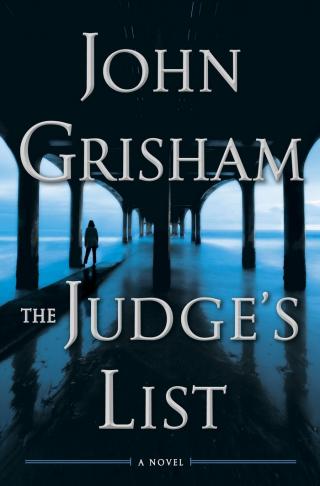
The Judge’s List
- Автор: Гришэм Джон
- Серия: Lacy Stoltz #2
- Год: 2021
- Язык: английский
- Год: Doubleday/Random House
- ISBN: 978-0-385-54602-7
- Жанр: Триллеры

Электронная книга - «The Judge’s List». Краткое содержание книги:
Then she meets a mysterious woman who is so frightened she uses a number of aliases. Jeri Crosby’s father was murdered twenty years earlier in a case that remains unsolved and that has grown stone cold. But Jeri has a suspect whom she has become obsessed with and has stalked for two decades. Along the way, she has discovered other victims.
Suspicions are easy enough, but proof seems impossible. The man is brilliant, patient, and always one step ahead of law enforcement. He is the most cunning of all serial killers. He knows forensics, police procedure, and most important: he knows the law.
He is a judge, in Florida — under Lacy’s jurisdiction.
He has a list, with the names of his victims and targets, all unsuspecting people unlucky enough to have crossed his path and wronged him in some way. How can Lacy pursue him, without becoming the next name on his list?
The Judge’s List is by any measure John Grisham’s most surprising, chilling novel yet.
“I understand discretion, Ms. Stoltz. Believe me, I do.”
“Can we go with Lacy and Allie?”
“Sure, and I’m Herman. I see you’ve brought a briefcase, so I assume there’s paperwork, maybe some photos.”
“Yes.”
“Perhaps we should go to the kitchen and use the table.”
They followed him inside, as did the dogs, and Mrs. Gray refilled their glasses. Herman sat on one side of the table and faced Lacy and Allie. She took a deep breath and began, “There are eight murders that we know about. The first was in 1991, the most recent less than a year ago. The first seven were by strangulation, same type of rope, same method, but for the last one no rope was used. Just a few blows to the head.”
“Twenty-three years.”
“Yes, sir.”
“Could we drop the ‘sirs’?”
“Yep.”
“Thank you. I’ll be eighty in two months but I am refusing to let the old man in.” Thin as a weed, he looked like he could walk ten miles in the hot sun.
“Obviously, we believe our suspect killed all eight people. Six men, two women.”
“There are probably more, you know?”
“Yes, but we have no knowledge of them.”
Herman took out his pen and found a notepad. “Let’s talk about Number One.”
Allie opened the briefcase and handed Lacy a file. She said, “Number One was a forty-one-year-old white male — all but one were white — who was found beside a walking trail in Signal Mountain, Tennessee.” She handed Herman a sheet of paper she had prepared with the words Number One typed in bold letters at the top. Date, place, age of victim, cause of death, and a color photo of Thad Leawood lying in the bushes.
Herman studied the summary and the photo and took notes. They watched him carefully and said nothing. When he had reviewed it, he asked, “Other than the body, was there anything from the crime scene?”
“The police found nothing. No prints, fibers, hair, no blood other than the victim’s. Same for all the crime scenes.”
“A strange knot, something like a clove hitch.”
“A double clove hitch, not very common.”
“Rare indeed. If he used it every time, then it’s obviously his calling card. How many blows to the head?”
“Two, with what appears to be the same weapon.”
“Autopsy?”
“The skull splintered, numerous cracks radiating from the contact point. The police in Wilmington, North Carolina, at another crime scene, thought it was something like a hammer or small round metal ball.”
“Works every time, though it does make a messy scene. The blood spatters to such a degree that the suspect probably had some on his clothing.”
“Which, of course, was never found.”
“Of course not. Motive?”
“The theory is that Number One sexually abused the killer when he was a young boy.”
“That’s a lot of motive. Any proof of this?”
“Not really.”
“Okay. How about Number Two.”
Lacy handed him the sheet for Bryan Burke and said, “The following year, 1992.”
Herman looked at it and said, “South Carolina.”
“Yes, each was in a different state.”
He smiled and made notes. “Motive?”
“Their paths crossed in college when the killer was a student. Number Two was one of his professors.” Lacy was careful not to use the words “law school.” That would come later. Allie had not told Herman much about her and had not revealed where she worked or who she investigated. Again, that would be discussed later in the afternoon.
Number Three was Ashley Barasso. Lacy said, “Four years later, in Columbus, Georgia. We know nothing of motive, only that they were in school together.”
“College?”
“Yes.”
“Was she sexually abused in any way?”
“No. She was fully clothed, nothing was disturbed, no sign of molestation.”
“That’s unusual. Sex is a factor in about eighty percent of serial crimes.”
Number Four was Eileen Nickleberry, in 1998.
With Number Five, Danny Cleveland, Lacy said, “Our man took a break for eleven years, at least as far as we know.”
“That’s quite a gap,” Herman said, studying the photo. “Same knot. He doesn’t want to get caught, too smart for that, but he wants someone to know that he’s out there. Not at all uncommon.” He scribbled more notes as his wife appeared and offered them cookies. She did not stay in the kitchen but Lacy got the impression she was close by, probably listening.
Number Six was Perry Kronke down in Marathon. Herman studied the photos and asked, “Where did you get these?”
“They were given to us by a source who’s been working on this for many years. Freedom of Information Act, FBI clearinghouse, the usual. We have photos from the first six crime scenes but not the last.”
“Too recent, I suppose. Poor guy was out fishing, just minding his own business. In broad daylight.”
“I’ve been to the scene and it was pretty remote.”
“Okay. Motive?”
“They crossed paths in the workplace, probably a disagreement over a job offer that didn’t materialize.”
“So he knew him too?”
“He knew all of them.”
Herman just thought he’d seen it all and was visibly impressed. “Okay, let’s see the last one.”
Lacy handed over Number Seven and Number Eight, and explained their theory that the first victim was the target and the second arrived on the scene at the wrong time. Herman studied the summaries and photos for a long time, then said with a grin, “Well, is that all?”
“That’s all we know about.”
“You can bet there’s more, and you can bet he’s not finished.”
They nodded and both took a bite of a cookie.
Herman said, “So, now you want a profile, right?”
Allie said, “Sure, that’s one reason we’re here.”
Herman put down his pen, stood and stretched his back, and scratched his chin as he thought. “White male, age fifty, started his mischief when he was mid-twenties. Single, probably never married. Except for the first two, he kills on Fridays and weekends, clear indication that he has an important job. You mentioned college, and it’s obvious he’s bright, even brilliant, and patient. No sex angle, so he’s probably impotent. You know the motive, driven by a sick need for revenge. Kills without remorse, which is usually the case. Sociopathic to say the least. Antisocial but, being educated, probably manages to put up a front and maintain what appears to be a normal life. Seven crime scenes in seven states over a twenty-three-year period. Very unusual. He knows the police won’t dig deep enough to link the crimes. And the FBI is not involved?”
“Not yet,” Allie said. “That’s another reason we’re here.”
“He knows forensics, police procedure, and the law,” Lacy said.
Herman slowly sat down and looked at his notes. “Quite unusual. Even unique. I’m impressed with this guy. What do you know about him?”
Lacy said, “Well, he certainly fits your profile. He’s a judge.”
Herman exhaled as if somewhat overwhelmed. He shook his head and thought for a long time. Finally he said, “A sitting judge?”
“Duly elected by the voters.”
“Wow. Quite unusual. Narcissistic, split personality, able to live in one world as a respected, productive member of society while spending his off-hours plotting the next kill. It’ll be hard to nail this guy. Unless.”
Allie said, “Unless he makes a mistake, right?”
“Right.”
Lacy said, “We think he’s made one, at his last stop. You asked about the FBI. They’re not involved in the investigation but they have found a clue. He left a partial thumb print on a cell phone. The lab in Quantico has spent months with it, run all the tests. The problem is there is no match anywhere. The FBI thinks he’s probably altered his prints.”