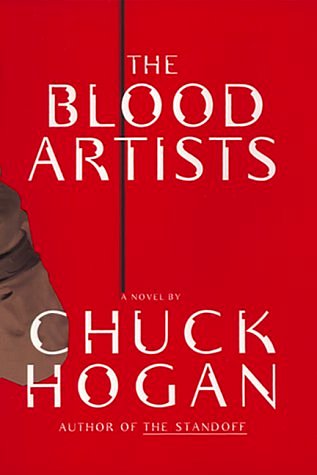
The Blood Artists
- Автор: Хоган Чак
- Год: 1998
- Язык: английский
- Год: William Morrow
- ISBN: 978-0-688-15622-0
- Жанр: Триллеры

Электронная книга - «The Blood Artists». Краткое содержание книги:
Maryk’s right hand went into his bag as his heart rate accelerated comfortably. He pulled out a syringe. “Breaking quarantine is a federal offense.”
The prisoner looked at the syringe in Maryk’s hand and smiled. He raised his meaty hands into a listless street fighter’s stance. “What you gonna do with that?” he said.
Maryk remained still. The syringe remained at his side.
The prisoner came at him. He moved lumberingly and raised his big arms to strike as Maryk ducked out of the way. The prisoner lurched past and slipped on a throw rug in the doorway and thundered headlong into the hallway wall. The staircase above him rattled.
The prisoner turned but Maryk was upon him. He braced the prisoner’s neck with his forearm and forced the man’s Adam’s apple up into his larynx as he spun the syringe in his hand. He gripped it needle-down and drove it into the prisoner’s chest. The needle slipped neatly between the man’s ribs and pierced the pericardium sac of his heart. The prisoner’s face burst wide.
Maryk thumbed the plunger and voided the barrel. The prisoner choked on a sucking breath as Maryk broke off the needle in his chest and stepped back. The prisoner’s legs buckled and he collapsed on all fours in the night light through the open front door.
Maryk retrieved his bag from the end table in the sitting room. The prisoner was lying on his side and issuing a series of agonal gasps as Maryk stepped past him into the short hallway.
A small shadow that was a second prisoner sprang from a closet ahead and crossed the wide living room. He scrambled over the sofa to another fireplace and picked up the largest piece of kindling wood he could find. He weighed it like a baseball bat as Maryk stepped into the room. The carpeting was plush and silent underfoot. The prisoner tried swinging the wood one-handedly before settling on a clublike grip.
He had light brown skin and weblike tattoos that laced his hands. He did not appear as visibly ill as the first prisoner.
Maryk was laboring under deep intoxicating breaths. His black bag shook slightly in his hand. He remained aware of his back at all times.
Maryk feinted suddenly toward the sofa. The prisoner retreated a quick step and then stopped and brandished the club anew. He uttered a low grunt and gave the weapon a threatening half swing. Maryk countered with another feigned step and the prisoner again jerked back and this time jostled the leg of a small parlor table. Chessmen thumped to the carpet. The prisoner reset himself and brought the wooden club down on the table leg with a solid crack. This seemed to invigorate him.
The blood rush in Maryk’s head and the force of his breathing built to a crescendo. At once he reached inside his bag and started forward.
This time the prisoner did not retreat. He did not have the chance. A yellow blur that was Freeley burst out from a side room and brought a syringe down slashing with both gloved hands.
The prisoner screamed. The wood sprang from his hands and he went down hard with the syringe buried in his neck. Freeley did not let go and worked the plunger with a combative wail. The prisoner writhed and gurgled beneath her. His shoe heels kicked adamantly at the wall as Freeley broke off the syringe in his neck and stood.
There was a noise upstairs. Maryk turned to the narrow staircase and mounted it in four strides, There was blood on the handrail at the top.
His shoes whisked over a worn Oriental runner along the length of the open second-floor hall. The closed doors were old with glass knobs and key locks. Flea market reproductions had been hung to cover the textured paper peeling off the walls.
He moved through the open door at the end of the hall into a master bedroom. An afghan was folded at the foot of the quilted bedspread and a glass dish of holy water was screwed next to the door.
There was blood smeared on the glass knob leading to a half bath. Maryk eased the door open with his foot before entering all at once and throwing aside a frilly shower curtain.
The glazed window inside was open and there was blood on the crank handle and sill. Maryk looked out onto the roof and saw an orange form dropping off the gutter. He looked across the long black yard to the wide swollen Mississippi River moving in the distance.
Maryk walked to the back door downstairs. He strode out alone over the stiff grass. He smelled the salt of the river and could feel it rushing ahead of him like the blood pushing through his veins. The limping prisoner looked back and saw Maryk coming and renewed his efforts. He was running toward the riverbank.
“Right,” the prisoner said finally. He had fallen exhausted to his knees in the muddy salt grass. “All right.” He turned to face Maryk. “I’ll go back.”
They were twenty yards or so from the great moving river. The prisoner raised his arms toward Maryk and his bloody sleeve billowed in the night breeze. Most of his hair was already gone and his face was spent and fading. This prisoner was the sickest of the three.
Maryk allowed him to struggle to his feet before driving the needle into his chest. The prisoner stiffened and looked at Maryk with flaring red eyes before he fell.
Maryk left him gasping up at the dark night sky and continued the short distance to the river bank. The familiar weight of the cascade thickened his mind and welled behind his eyes like sleep. He shed his cowl, cap, and face mask as he stood exhausted on the hard dirt bank and looked upriver. A broad halo of light glowed against the dark sky. It was a sleeping city of one million human beings.
Melanie saw their van return on a guard station monitor and was allowed to go to the underground garage. She came upon it being unloaded in a brightly lit side room. She noticed immediately the dark dirt splashed on its tires.
The van was empty. Dr. Freeley was speaking with some other BioCon agents while Maryk stood at the passenger’s door, away from her. He was looking at his face in the long side mirror. His headgear was gone, his white hair matted back and down.
Dr. Freeley was informing the men about some death certificates she had already written. Melanie heard her update the agents on a house being biocleaned a few miles away.
Maryk turned from the van door. He came forward a few steps before seeing Melanie there. He had a drowsy look in his eyes, and at once she noted the sluggishness of his manner, the guarded way he stood before her, like a practiced drunk. It struck her cold. “You murdered them,” she realized.
Freeley looked up, but Maryk did not answer. He frowned and lurched past her out of the room.
Pasteur’s Crypt
She waited with Maryk away from the nighttime travelers streaming through the New Orleans airport, seated alone among a row of hard plastic chairs along a cold wall of windows. Airplanes rolled on the taxiways behind them, and she had that feeling she always had in airports, of being among giants.
Within an hour of his return to Lewes B unit, Maryk decided he was through there; she guessed it had something to do with his cascade, and his concern about Dr. Pearse. A helicopter had ferried them to the airport, and now they were waiting for the flight back to Atlanta.
“Viruses love airports,” Maryk said. “Vital organs, located at every major human population center, catapulting incubators from city to city all over the world. The circulatory system of human civilization.”
He sat too heavily and too large for the chair, his big legs extended clumsily and crossed at the ankles, his eyes low and turned to the bustling terminal beyond. He was deep into one of his funks, and she wanted no part of him.
“Three phases of public response to an epidemic,” he said. “First: Denial. That occurred during the original outbreak in Plainville. The Search for Blame is what we’re into now, with the press. If the epidemiology continues to elude us and the virus strikes again, then the BDC will be made the scapegoat. Phase three is the Demand for Action. The blood response. In previous ages this meant burning down the houses of the sick, and the aristocracy fleeing into the hills. But there are no hills remote enough anymore. No oasis that doesn’t have a road running through it. And no foreigners foreign enough to blame. The ecosystem is sealed and starting to cook. House burning is all.”