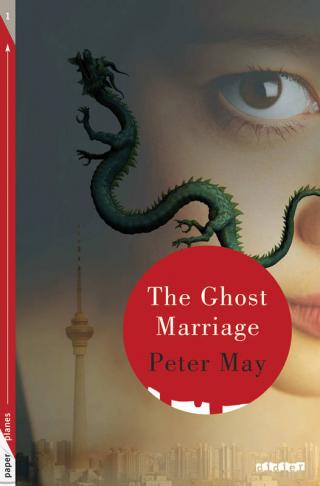
The Ghost Marriage
- Автор: Мэй Питер
- Серия: The China Thrillers #7
- Год: 2017
- Язык: английский
- Год: Quercus
- ISBN: 978-1-78648-704-9
- Жанр: Криминальные детективы

Электронная книга - «The Ghost Marriage». Краткое содержание книги:
Sheng Nuwa said, ‘We had no idea until we saw the Missing posters. She was only delivered to us on the day of the wedding. We thought she had come from the crematorium. That’s what the man who brought her said.’
‘I’ll need his name.’
‘We don’t know it.’ It was the husband who spoke this time, and when Li blew his disbelief through pursed lips, he added quickly, ‘They told us they weren’t able to get us a body, so we had resigned ourselves to proceeding with just the paper dummy. Then this guy arrives at the last minute.’
‘Who did you go to originally to ask for a body?’
Sheng Dai glanced darkly at his wife. Their reluctance to speak was clear.
But Li was losing patience. ‘Come on! Spit it out! You’re in trouble enough as it is. Don’t make it worse.’
The dead boy’s mother said, ‘We were given a name. A certain Gan Bo. He could find wives, we were told, for the living. It’s hard these days for a single man to find himself a woman.’
It was, Li knew, a demographic time bomb for the future of his country. A legacy of the one-child policy, and the traditional preference for boys over girls. With only 100 women for every 130 men, there was a growing demand for mail-order brides. And a criminal element had appeared to satisfy that demand, trading women for money.
Sheng Nuwa brushed a stray strand of hair from her eyes. ‘But we were told that sometimes Gan Bo could supply dead ones, too.’
Li could barely conceal his disgust. ‘So you put in an order for one.’
Her eyes dropped away from his. ‘We were only trying to do the best for our son.’
‘And what did Gan Bo say?’
Sheng Dai said, ‘He told us he would see what he could do. But he came back a couple of days later and said he couldn’t get one in time. And with the summer heat, we couldn’t wait.’
‘So then some guy just appeared from nowhere?’
‘Yes. On the morning of the minghun. He brought the girl in the back of a van. Said that Gan Bo had been able to find a body for us after all. We’d already acquired a second coffin.’
‘And you paid him.’
‘Yes.’
‘How much?’
‘He wanted dollars.’
‘How much?’
‘Twelve hundred.’
Li clenched his jaw involuntarily. So that was what a young girl’s life was worth these days. Twelve hundred dollars. The price of a plasma TV. ‘Tell me what the man who brought the body looked like.’
But the dead boy’s father just shrugged. ‘I didn’t pay him much attention. I was kind of in shock. He was just some guy. Forty, maybe. A little older. He didn’t stay long.’
Li found himself strangely disappointed that this description, however brief, in no way resembled the tall, skinny boy who had been Meilin’s lover. ‘And the bodies? I suppose you had them cremated.’ All evidence destroyed in the furnace.
‘That was the original plan,’ Sheng Nuwa said. ‘But then a cousin with a little land out near Donghulinmen offered to let us bury them there, and we jumped at the chance.’
Chapter Six
Li and Margaret drove in silence, south-west out of Beijing on the G109. Meilin’s parents sat in the back of the Jeep, Jiang Jin with his arm around his wife. But there was no consoling her. Li had broken the news to them that afternoon, and Jiang Ning had barely stopped crying since. Her eyes were red raw. There was only one final act now to be played out in the life and death of their daughter. And that was the identification of her body.
It was dark by the time they reached the cluster of houses among the trees at the end of a rough dirt track leading from the road. Li parked in a dusty square. These were poor rural houses with thin brick walls and low roofs, huddled around a badly equipped village store. Goats tied to a stand of willow trees raised their heads and bah-ed into the night. They heard the snuffling of pigs, and smelled them before they saw them.
Li guided the little group up a narrow track between crumbling walls towards a halo of light that broke the darkness ahead. Several Public Security vehicles and a white forensics van were assembled around the entrance to a long, low house beside a rectangular wall that enclosed a hundred square metres of wildly overgrown garden.
They passed through a moongate, and the officer standing guard nodded solemnly. Beyond, they could see where the vegetation had been beaten down and the earth freshly disturbed. The area was enclosed by white canvas stretched between wooden posts, and lit by arc lamps. Four men in white Tyvek suits stood around leaning on the spades they had used to uncover the shallow graves. All chatter ceased as Li led the girl’s parents to the graveside. Margaret stayed behind, leaving a respectful distance.
Li nodded to the nearest white suit, and the man stepped down into the hole where two coffins lay side by side. His shadow fell across the first of them as he prised open the top. Li heard Jiang Ning gasp as the decaying corpse of a young man was exposed to the full glare of the lamps. The maggots had already started to eat his face, which had taken on a ghoulish look, the flesh of his eyes, nose, and mouth receding, a ghastly grimace revealing long yellow teeth.
As the second lid was levered free, Jiang Ning howled: a piercing, desolate sound that came from deep in her throat and sent a glacial chill through them all, in spite of the heat.
Meilin’s body had not achieved the same degree of decomposition. She had been alive, it seemed, at least until the day before the minghun, several days longer than her ghost husband. But there was a strange lividity about her face. It seemed, if anything, slightly more distended than his. But there was no doubting who she was. Her mother turned away, burying her face in her husband’s chest to suppress her tears. He put comforting arms around her and closed his eyes.
Li became aware of Margaret at his side and half-turned. She was looking down into the dead girl’s coffin, and he saw that for once the professional detachment of the pathologist was missing. Moonlight flashed in tear-filled eyes.
‘I want to do the autopsy,’ she said, her voice barely a whisper.
Chapter Seven
The naked body of Jiang Meilin was wheeled into the autopsy room by two assistants, and transferred to a steel autopsy table. The air was chill and suffused with the slightly perfumed odour of decay, like meat that has been left in the refrigerator two weeks past its sell-by date.
Margaret stood at the table preparing for the initial examination. Beneath a long-sleeved cotton gown, she wore green surgeon’s pyjamas covered by a plastic apron. Plastic covers protected white tennis shoes, and her long blonde hair was secured beneath a plastic shower cap. Now she pulled on a pair of latex gloves, followed by plastic covers, then a steel-mesh glove over her non-cutting hand, before finally pulling on a further latex pair.
She was being assisted by Pathologist Wang, with whom she had conducted autopsies on many occasions. When she had first arrived in China, young and arrogant, and skilled in the latest Western techniques, he had resented the shadow she cast over him and his department. But such resentments were history now, and they had long ago arrived at something approaching mutual respect. Their working relationship was comfortable, and she enjoyed his irreverent sense of humour. But even Wang could find nothing amusing to say today. He cast his eyes over the slim teenager and shook his head.
‘Pity. Pretty girl.’
Margaret looked at the body on the table before her. Meilin was taller than the average Chinese, much of her height concentrated in the long femurs which had given her the power to run fast. But she did not possess the muscle mass that would have made her a sprinter. Instead her legs were slender and elegant. Margaret began with the feet and worked her way up the body looking for any unusual markings. She found some slight bruising on the forearms, noting them on a body chart she held in a clipboard, but did not consider them significant.
Wang examined her hands. ‘No sign of trauma,’ he said. ‘And no blood or skin beneath the fingernails.’ He and Margaret exchanged looks, and he nodded to one of the assistants, who drew blood from the femoral artery with a large syringe. ‘What do you think they’ll find in toxicology?’
Margaret shrugged. ‘These days, who knows? Rohypnol would have had a sedative effect after fifteen to twenty minutes. She obviously didn’t put up any kind of a fight.’
They continued the external examination. There was no sign of sexual activity, and no trauma around small, flat breasts with their tiny, dark areolae around the nipples.
Then they came to the neck, where a skin-coloured cosmetic foundation had dried and cracked. Using moistened cotton pads, Margaret carefully washed it away to reveal the bruising that the facial lividity had suggested would almost certainly be there: four circles on the left side of the neck, two of which were close to half an inch in diameter, one larger oval on the right side.
‘Her killer left his mark,’ Wang said.
Margaret carefully traced the line of the little crescent-shaped abrasions that were associated with the bruising. Tiny flakes of skin were heaped up at the concave side. ‘And took a little of her away with him beneath his fingernails.’
They moved up, then, to her face, where blood pressure had mounted in her head and caused petechial haemorrhaging of the tiny blood vessels around the eyes and nose. It was not necessary to stop someone breathing to strangle them. It only required around four-and-a-half pounds of pressure on the jugular to prevent blood draining from the head. Death would have come fast.
Margaret pulled back the eyelids and closed them again. ‘Strange.’
‘What is?’ Wang looked more closely.
‘There are circles of paler flesh around the eyes, blanched into the lividity.’ Margaret stared at the closed eyes of the dead girl, and could almost have sworn she saw patterns in those pale circles. ‘As if coins might have been placed over them to keep them shut.’ She turned to Wang. ‘Do we have a TMDT kit?’
‘We do.’ And he nodded to one of the assistants, who disappeared to return two minutes later with a four-ounce spray bottle of test solution, and a short-wave ultraviolet light source with a 4-watt bulb, sometimes known as a Wood’s lamp.
Margaret took the bottle, and carefully sprayed the solution around each eye, and they waited in silence for several minutes until it had dried. ‘Lights,’ she said. And the assistant turned out the overhead lights, plunging the autopsy room into total darkness.
Margaret snapped on the Wood’s lamp, and an eerie ultraviolet glow filled the room. She moved the lamp over the dead girl’s eyes. There over each one, marked in dark purple against the yellow background of the dried solution, were two perfectly round images with clearly engraved markings.
‘Coins,’ Wang said. ‘You were right. What metal is denoted by purple?’
Margaret stared thoughtfully at the circular patterns engraved into the lividity around the eyes. ‘Brass or copper,’ she said. ‘We’ll need to take photographs. And samples.’