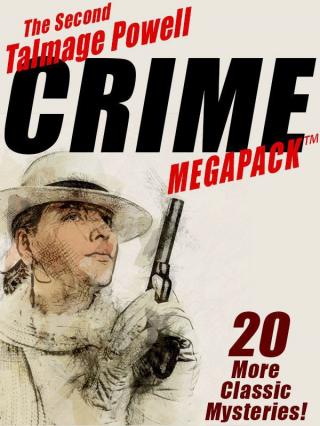
The Second Talmage Powell Crime MEGAPACK™: 20 More Classic Mystery Stories
- Автор: Пауэлл Тэлмидж
- Год: 2015
- Язык: английский
- Год: Wildside Press
- Жанр: Криминальные детективы

Электронная книга - «The Second Talmage Powell Crime MEGAPACK™: 20 More Classic Mystery Stories». Краткое содержание книги:
“In the old existence everything turned to mud,” he said. “But once I had buried myself, I began encountering all the luck I’d missed in a lifetime.”
He tossed the damp towel into a container. “Dudley had three thousand dollars in a savings account, his sole estate except for his pension checks and that camper. I ran the three to twenty thousand in a run at a craps table in Las Vegas. Drifted to Phoenix and won a hundred and fifty acres of land from a fellow in a stud game. It turned out to be worthless desert — but three months later a fellow from the government turned up. He had traced me, as Dudley Gillam, through my forwarding addresses. It scared the pants off me at first. But he was a purchasing agent, and Uncle Sam bought the desert land as a solar-energy pilot site.”
“How much?”
“A thousand dollars an acre. He was tickled to get it so cheap.”
“But even a hundred and fifty thousand doesn’t guarantee a lifetime at playgrounds like the Great Smokies Chilton and Miami.”
“You’re right about that. But I ran into a guy in Fort Worth, a wildcat oil man rigged up in Venezuela. Some minor civil troubles, guerrillas from the mountains, busted him up and he had run short of cash. He’d hopped up to the States to raise some. He needed a partner with a quick hundred thousand to see the drilling to completion.”
“And,” I said mind-boggled, “you brought in the wells.”
“Like water out of this faucet,” Hardtimes Calhoun said.
“How much are you worth now?”
“I’m not sure. I guess I could sell out my interest for five or six million.”
I drew in my breath.
“Now that you know—” His lank body began to pull itself together. He was mastering the hangdog guilt in his eyes. His lips were thinning, hardening. “What next? I owe you three thousand plus the interest on it and some pension checks and the interest on them. The only law I broke was to bury the wrong man — who had died of natural causes, as the Yuma coroner attested. Against my kind of money, you’d never make it in court if you tried to claim more than your just due.”
The idea of trying to fight his amassed wealth inspired some hard thinking.
Only he and I knew the truth. He was Dudley Gillam, even to Amanda. He was Dudley Gillam — and I was his sole heir.
I had a deep-down certainty that he hadn’t drawn a will cutting me out. His subconscious guilt would have forestalled that. And even if there should be a will, it could be destroyed, set aside. When there is enough money there is a way with a will.
I let a ruefully pleasant smile work to life on my lips. “It’s a different reunion than I’d planned. Uncle Dudley.”
“You mean — you’re going to accept it?”
I nodded. “Why not? What good would it do to fight you? I take my hat off to you. In many ways, you’re very much like the man you buried in Yuma.”
And the man, I thought, I’ll bury in Miami. A neat little accident Maybe an overdose of some of his medication. Or a cramp when he went swimming in the ocean. Or an unfortunate fall down a stairway. Accidents are always happening to geezers his age.
“You don’t have to duck me any longer. Uncle Dudley.”
As we strolled out together, I dropped my arm across his shoulders. My touch was light, but he’d soon learn it was the returning touch of hard times — the hardest of all times.
The Beacon
Originally published in Mike Shayne Mystery Magazine, April 1981.
The candle was the clue, the beacon, the wan glow of a single candle behind an old lace curtain in the decayed ghostliness of a once-splendid home.
Marley passed the place each evening as he drove in from his disgusting and demeaning job washing dishes in the kitchen of the country club. He didn’t notice the candle right away. The dragging misery of his situation choked off errant impressions, such as the color of a sunset, the notes of a singing bird, or idle speculation about a candle burning behind a window.
He was in the clutches of a particularly tough parole officer who had set the tenor of their relationship at their very first meeting: “Marley, you are one of my pet dislikes, a lifelong criminal despite everything society has tried to do to rehabilitate you. During your misspent life you have done it all. Passed counterfeit money. Fenced stolen goods. Gone door to door selling bogus termite exterminations to little old widows. Cold-decked suckers in illegal card games. Written rubber checks. Now at the age of... fifty-five, isn’t it?... you’ve drawn a parole after doing time for embezzlement. You’re a neat, trim, spry fellow, hardly gray and with all your original teeth. Take my advice. Don’t even think of once more using that blank, innocent appearance to worm your way into a sucker’s confidence. Or is it asking too much for a change in personality? In any event, if as human beings we are brothers, you’re going to find, until the final hour of your parole, that I’m one hell of a keeper.”
The loathsome tyrant had taken Marley out to the country club and introduced him to the head chef, an enormous Italian who’d never relaxed the chains of Marley’s parole-slavery from the very first moment.
The parole officer had made a single allowance, giving permission for Marley to buy and drive, within the county limits, a battered old car. But that was only because city bus-transit routes precluded the country club.
So each day was a hellish repetition: awaken in a squalid furnished room in the inner city; get through hours in which taverns and the kind of company Marley preferred were prohibited; drive out to the country club through Vanderling Estates, where the aura of so much old wealth and well being rubbed Marley absolutely raw; do the dishes the lordly dudes and their ladies befouled during lunch, dinner and sometimes a private party of an evening. Marley would burn, hearing the echoes of refined pleasure drifting back from the dining room. Occasionally, when the chef and second cook and salad girl and pastry chef had their backs turned, Marley would spit in the stock pot.
Each night he passed the candle in the window, never seeing it until the abysmal cruelty of his parole had only one more week to go. Even then, it was not the candle that caught his attention, but a white, ectoplasmic figure moving on the lawn in the moonlit darkness.
Marley held no truck with spooks, goblins or anything spiritual. But the glimpse of the ghostly figure caught and froze his gaze. He braked his wheezing car, an instinctive thought flashing through his mind. If someone was in trouble, perhaps he could play the Good Samaritan — and receive a suitable reward.
The apparition was a woman, rather tallish, thin and bony, clad in ankle-length gown, its white blending with her long fall of silvery hair. Her shoulders were slightly stooped, and Marley, unable to distinguish the features from this distance, received an impression of an old and wrinkled face.
Out of the shadows alongside the house came a heavyset man in the gray uniform of a chauffeur. He intercepted the woman in the middle of the lawn, spoke to her, and she compliantly nodded and walked toward the house. The servant watched until the front entrance had received her; then he returned along the driveway in the direction of lighted quarters over a large double garage.
Marley saw the window candle at last, and it sparked his always-sharp curiosity. His gaze drifted about the portion of the estate visible to him. Although centered in Vanderling Estates, the place didn’t quite belong, although it once must have been the hallmark of swank for neighbors to try and rival. The house was huge Normandy; the grounds were far flung; but the present-day details added up to a note of desertion and decay. The driveway was potholed; the hedges were raggedly untrimmed; the sweeping lawn was freckled with spots of brown; and the house itself was flecking paint and supporting guttering that was rotting away and hanging loose in spots.