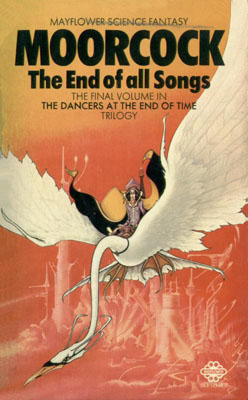
The End of All Songs
- Автор: Муркок Майкл
- Серия: Dancers at the End of Time #3
- Год: 1976
- Язык: английский
- Жанр: Научная фантастика

Электронная книга - «The End of All Songs». Краткое содержание книги:
But as the pandemonium progresses, some delicious and long-held mysteries are revealed and some distressing omens appear on the horizon. Due to circumstances beyond their control, immortality - at least as far as the immortals know it - will never be the same again.
This fresh ambiguity caused further retreat into his own thoughts. He had surprised himself with his criticisms, having half a notion that he did not really intend to attack Brannart Morphail at all. He was inexpert in this business of accusation and self-immolation: a novice in the expression of emotional pain, whereas she, it now seemed, was a veteran. He floundered, he who had known only extrovert joy, innocent love; he floundered in a swamp which she in her ambivalence created for them both. Perhaps it would have been better if she had never announced her love and retained her stern reliance upon Bromley and its mores, left him to play the gallant, the suitor, with all the extravagance of his world. Were his accusations really directed at her, or even at himself? And did she not actually rack her own psyche, all aggression turned upon herself and only incidentally upon him, so that he could not react as one who is threatened, must thresh about for an object, another person, upon whom to vent his building wrath, as a beaten dog snaps at a neutral hand, unable to contemplate the possibility that it is its master's victim?
All this was too much for Jherek Carnelian. He sought relief in the outer world; they flew across a lake whose surface was a rainbow swirl, bubbling and misty, then across a field of lapis lazuli dotted with carved stone columns, the remnants of some peculiar two hundred thousandth-century technology. He saw, ahead, the mile-wide pit where not long since they had awaited the end of the world. He made the locomotive circle and land in the middle of a group of ruins wreathed in bright orange fire, each flame an almost familiar shape. He helped her from the footplate and they stood in frozen attitudes for a second before he looked deliberately into her kohl-circled eyes to see if she guessed his thoughts, for he had no words — to express them; the vocabulary of the End of Time was rich only in hyperbole. He reflected then that it had been his original impulse to expand his own vocabulary, and consequently his experience, that had led him to this present pass. He smiled.
"Something amuses you?" she said.
"Ah, no, Amelia. It is only that I cannot say what I wish to say —"
"Do not he constrained by good manners. You are disappointed in me. You love me no longer."
"You wish me to say so?"
"It is true, is it not? You have found me out for what I am."
"Oh, Amelia, I love you still. But to see you in such misery — it makes me dumb. The Amelia I now see is not what you are!"
"I am learning to enjoy the pleasures of the End of Time. You must allow me an apprenticeship."
"You do not enjoy them. You use them to destroy yourself."
"To destroy my old-fashioned notions. Not myself."
Perhaps those notions are essential. Perhaps they are the Amelia Underwood I love, or at least part of her…" He subsided; words again failed him.
"I think you are mistaken." Did she deliberately put this distance between them? Was it possible that she regretted her declaration of love, felt bound by it?
"You love me, still…?"
She laughed. "All love all at the End of Time."
With an air of resolve, she broke the ensuing silence. "Well, I will look for Harold."
He pointed out a yellow-brown metal pathway. "That will lead you to the place where you left him."
"Thank you." She set off. The dress and the boots gave her a hobbling motion; her normal grace was almost entirely gone. His heart went to her, but his throat remained incapable of speech, his body incapable of movement. She turned a corner, where a tall machine, its casing damaged to expose complicated circuits, whispered vague promises to her as she passed but became inaudible, a hopeless whore, quickly rebuffed by her lack of interest.
For a moment Jherek's attention was diverted by the sight of three little egg-shaped robots on caterpillar tracks trundling across a nearby area of rubble deep in a conversation held in a polysyllabic, utterly incomprehensible language; he looked back to the road. She was gone.
He was alone in the city, but the solitude was no longer palatable. He wanted to pursue her, to demand her own analysis of her mood, but perhaps she was as incapable of expressing herself as was he. Did Bromley supply a means of interpreting emotion as readily as it supplied standards of social conduct?
He began to suspect that neither Amelia's society nor his, for all their differences, concerned themselves with anything but the surface of things. Now that he was in the city it might be that he could find some still functioning memory bank capable of recalling the wisdom of one of those eras, like the Fifth Confucian or the Zen Commonwealth, which had placed rather exaggerated emphasis on self-knowledge and its expression. Even the strange, neurotic refinements of that other period with which he had a slight familiarity, the Saint-Claude Dictatorship (under which every citizen had been enjoined to supply three distinctly different explanations as to their psychological motives for taking even the most minor decisions), might afford him a clue to Amelia's behaviour and his own reactions. It occurred to him that she might be acting so strangely because, in some simple way, he was failing to console her. He began to walk through the ruins, in the opposite direction to the one she had taken, trying to recall something of Dawn Age society. Could it be that he was supposed to kill Mr. Underwood? It would be easy enough to do. And would she permit her husband's resurrection? Should he, Jherek, change his appearance, to resemble Harold Underwood as much as possible? Had she rejected his suggestion that he change his name to hers because it was not enough? He paused to lean against a carved jade post whose tip was lost in chemical mist high above his head. He seemed to remember reading of some ritual formalizing the giving of oneself into another's power. Did she pine because he did not perform it? Or did the reverse apply? Did kneeling have something to do with it, and if so who knelt to whom?
"Om," said the jade post.
"Eh?" said Jherek, startled.
"Om," intoned the post. "Om."
"Did you detect my thoughts, post?"
"I am merely an aid to meditation, brother. I do not interpret."
"It is interpretation I need. If you could direct me…"
"Everything is as everything else," the post told him. Everything is nothing and nothing is everything. The mind of man is the universe and the universe is the mind of man. We are all characters in God's dreams. We are all God."
"Easily said, post."
"Because a thing is easy does not mean that it is difficult. Because a thing is difficult does not mean that it is easy."
"Is that not a tautology?"
"The universe is one vast tautology, brother, yet no one thing is the same as another."
"You are not very helpful. I sought information."
"There is no such thing as information. There is only knowledge."
"Doubtless," said Jherek doubtfully. He bade good day to the post and retreated. The post, like so many of the city's artefacts, seemed to lack a sense of humour, though probably, if taxed, it would — as others here did — claim a "cosmic sense of humour" (this involved making obvious ironies about things commonly observed by the simplest intelligence).
In the respect of ordinary, light conversation, machines, including the most sophisticated, were notoriously bad company; more literal-minded even than someone like Li Pao. This thought led him, as he walked on, to ponder the difference between men and machines. There had once been very great differences, but these days there were few, in superficial terms. What were the things which distinguished a self-perpetuating machine, capable of almost any sort of invention, from a self-created human being, equally capable? There were differences — perhaps emotional. Could it not be true that the less emotion the entity possessed the poorer its sense of humour — or the more emotion it repressed the weaker its capacity for original irony?