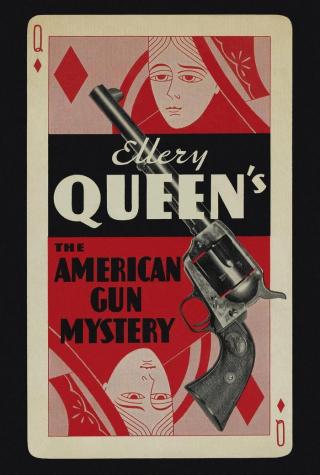
The American Gun Mystery (Death At the Rodeo)
- Автор: Куин (Квин) Эллери
- Серия: Ellery Queen #6
- Год: 1933
- Язык: английский
- Год: Frederick A. Stokes Company
- Жанр: Классические детективы

Электронная книга - «The American Gun Mystery (Death At the Rodeo)». Краткое содержание книги:
Now each eye of Curly Grant’s box held the ring of a lock, and the locks in both instances were still shut and untouched. The box had been forced open by a much cruder method than breaking the locks. The thief had grasped the locks and twisted them until the strain upon the metal eyes had told and the eyes themselves had given way. The eyes lay on the table, twisted rings still entwined with the closed locks. In each case the eyes had been turned toward the back of the box, as was clear from the convolutions of the twisted metal.
The Inspector put the box down and said grimly to Sergeant Velie: “These dressing rooms were searched for the rod before, Thomas, weren’t they?”
“Right, Inspector.”
“Well, have the boys go over them again — not for a rod but for the swag. Didn’t find ten grand on anybody searched tonight, did you?”
Velie grunted. “Not much.”
“Well, by God, nobody can tell me that dough’ll disappear like the .25, Thomas!’ Raid those dressing rooms!”
Sergeant Velie silently departed. Ellery leaned against the wardrobe, deep in thought, his confusion and stupefaction superseded by a new and apparently invigorating line of thought.
“Yo’re wastin’ yore time,” said Curly defiantly. “You won’t find no ten thousand of my dollars in these rooms, not by a long shot!”
The Inspector did not reply. And so they waited. Kit sat in the only chair, elbows on her knees, chin cupped in her hands, and stared expressionlessly at the floor.
And then, of course, Sergeant Velie barged triumphantly into the room, a mammoth in the doorway, and flipped something across the room to the table. It landed with a little thud.
They looked at it, startled. It was a sheaf of yellow-backed bills held together by a rubber-band.
“Ha!” exclaimed the Inspector with sour satisfaction. “There’s one mystery solved, anyway! Where’d you find it, Thomas?”
“In one of the dressing rooms along here.”
“Come along,” said the Inspector; and dumbly they followed him, astonishment in the eyes of all except Ellery.
Sergeant Velie paused by an open door.
“Here she is,” he said. “This room.” He pointed to a small table, its drawer open and cluttered with unimportant odds and ends of masculine character. “Found it in that unlocked drawer. Right on top. Damn crook didn’t even take the trouble to hide the loot,” growled Velie.
“Hmm,” said the Inspector. “Whose room is this, Grant?”
Curly chuckled hoarsely, to the Queens’ amazement, and even Wild Bill uttered a short ugly laugh. As for Kit, she shook her head with weary resignation.
“Ain’t found a crook at all,” drawled Curly. “You’ve lost one.”
“Lost one? What the deuce d’ye mean by that?”
“This room belonged to One-Arm Woody!”
“Woody!” exclaimed the Inspector. “So that’s the ticket. One-armed wonder stole the dough and was knocked off before he could get away with it. Now isn’t that queer? I don’t see... Murder and robbery just couldn’t have had anything to do with each other! God, what a mess!” He groaned and shook his head. “Here, Grant, you’re sure these are the same bills that lawyer gave your son this afternoon?”
The old showman took the sheaf and counted the bills. There were ten. “Look the same. I couldn’t say for sure. Comerford didn’t bring the money with him from Cheyenne. I had it in trust, an’ Mars gave me the cash — saved me the trouble o’ goin’ to the bank. I gave ’im a check on m’own bank.”
“Thomas, get Tony Mars.”
The Sergeant returned with the haggard promoter very shortly. Mars examined the bills. “Tell you in a minute,” he muttered. “I always keep a raft of cash in my safe upstairs, an’ I’ve got the serial numbers somewhere on me...” He fished in his wallet. “Here it is! Check ’em, Bill.” He read the numbers slowly aloud. And Grant nodded with each number.
“Fine!” said the Inspector. “I mean — terrible. It’s more of a mess than ever. Here’s your money, Mr. Curly Grant; and for the love of heaven hang on to it, will you?”
In the small hours, with dawn a hair’s-breadth away, the Queens — that normally affectionate father and son — were back in their Eighty-seventh Street apartment. Djuna was fast asleep and they did not disturb him. The old man pottered into the kitchen and brewed some coffee. They drank it in silence. Then Ellery paced the livingroom rug, and the Inspector with ashen face sat before the fire; and for long hours they remained that way — long after the sun was up and there was a stir of morning traffic in the street below.
A blank wall at the end of a dark alley... Every living soul in the Colosseum had been searched; every square inch had been gone over. And with no result. The automatic had not been found, as if after exploding the cartridge which had buried itself in Woody’s body the wielder of the weapon, like Merlin, had caused it to vanish by merely wishing it away.
And so the Inspector sat, and Ellery pounded up and down, and there seemed nothing to say.
But gradually a look of relief spread over Ellery’s drawn features as normal intelligence recovered from the shock; and once he even intoned a vague quotation as he chuckled to himself.
Then Djuna appeared and bundled them both off to bed.
21: On the Screen
Ellery awoke to the accompaniment of a vigorous shaking.
“Git up!” shouted Djuna in his ear. “There’s a feller here.”
Ellery blinked the drowse out of his eyes and groped for his dressing gown.
The visitor proved to be a brash young man bearing a large manila envelope. “From Major Kirby, Mr. Queen,” he said. “Just printed ’em, he said to tell you.”
He tossed the envelope on the table and left, whistling.
Ellery tore open the brown packet. Inside were a dozen damp, curly photographic prints. They depicted the last earthly moments of the late unlamented One-Arm Woody.
“Ah,” said Ellery with satisfaction. “That Major chap’s a prince, Djuna, simply priceless. He anticipates your every wish. Hmm.” He examined the series of infinitesimally differing photographs with scrupulous attention... It was amazing how faithfully these pictures coincided with those earlier pictures of Buck Horne’s demise. Except for the figure of Woody himself, with its distinguishing characteristic of the left-arm stump, these might be the same photographs the Queens had examined in the Major’s projection room a month before.
Again the camera had caught horse and rider at the instant of the bullet’s impact. Again the horse’s brawny length was parallel to the track, and again the series showed Woody leaning to the left as his horse crept by micrometric degrees around the northeastern turn of the oval.
“Nothing wünderlich there,” muttered Ellery to himself. “An exact duplication of conditions. Naturally the phenomena would repeat themselves. Horsemen obey natural laws — I hope.” He spent some time studying the key photograph — that in which, clearly, Woody had died. In the head-on view of the photograph, the one-armed rider’s body was leaning a sharp thirty degrees off the perpendicular toward the southern side of the arena. Quite as Buck Horne’s had leaned. Due to the mottled pattern of Woody’s ponyskin vest and the obtrusion of his left-arm stump, it was difficult to make out the bullet hole. But from the expression on the man’s face it was quite apparent in which picture he had died.