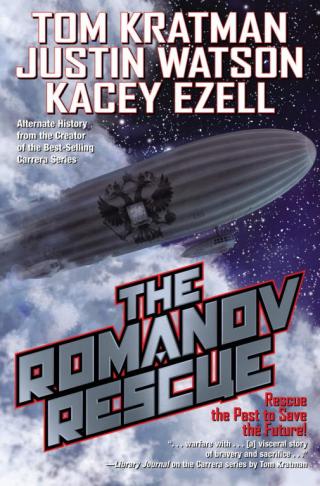
The Romanov Rescue
- Автор: Кратман Том, Watson Justin
- Год: 2021
- Язык: английский
- Год: Baen
- ISBN: 978-1-9821-2570-7
- Жанр: Альтернативная история

Электронная книга - «The Romanov Rescue». Краткое содержание книги:
As WWI comes to a close a German general, an escaped prisoner of war, and the crew of an airship converge to effect THE ROMANOV RESCUE. Can there be a world without communism?
Mankind’s history is bound up in the fabric of fate, a strong cloth, tough and closely woven.
It is the beginning of 1918, the last year of the greatest war in human history, to date. All the belligerents stagger on their feet. Starvation is an ever present reality, while disease waits in the wings. In Russia, no longer a belligerent but, instead, rapidly descending into civil war and chaos, a lone family—Father, Mother, four beautiful young girls, and a brave but sickly boy—await their own fate, shivering and hungry in the dark, hoping and praying for salvation.
Their relatives in England have turned their backs. The guards set over them do little but torment them. They look Heavenward, but God doesn’t answer. They know they’re a threat to the new regime, a threat that will, in time, be eliminated.
But even the strongest fabric has flaws. An escaped prisoner of war, caught, injured, and punished, but still highly capable, might be one. An airship, returned and at loose ends after a failed mission to Africa might be another. A German general, taking a wrong turn on his nightly walk and suddenly coming face to face with the reality of the monster rising in the east, would be a third.
Follow, then, as the general gives the orders, the prisoner of war raises the men from among his fellows, and the airship launches itself forward, to contest fate, to tear the fabric of time, and to effect The Romanov Rescue.
About the Carrera series:
“I found a dozen liters,” the German replied, “and have requests in for two dozen more. Tobacco? It’s not going to be very good tobacco.”
“Shitty tobacco would be fine. Also, maybe some diatomaceous earth, ‘Kieselguhr,’ I think you call it. As for the turpentine, the dozen liters should do for now,” Kaledin said, “provided the rest comes in.”
“Provided,” the German echoed, distantly and doubtfully.
“Problems, Weber?” Romeyko asked.
“Several,” the German replied. The left side up his moustache went up in company with his curling lip.
Romeyko followed that up with a “give forth” motion.
“One problem is that we’re on the ass end of nowhere and can’t raise a huge stink lest the enemy start thinking we’re more important than we seem to be. I mean, after all, he may not have many spies but he must have at least some. The other is that some things that should have been on the train never showed up, at least not in the quantities marked on the invoices.
“Example, we were supposed to receive one hundred and twenty kilograms of nails. Eighty showed up, with the remainder being taken up with rocks buried under the nails. There is no telling where the other forty went. Something similar happened with food, two days in a row. Taenzler fixed that by sending one of his men, armed, to the depot we’re drawing from and escorting the food here. But he’s still having to do that.
“Mine,” the German continued, “is a very proper, correct, and honest people… if… well, frankly, a little pig-headed. When they start stealing things like this… we… we are in trouble.
“No,” he hastened to add, his tone one of despair, “we will not lose the war for forty kilograms of nails, nor a couple of thousand daily rations. But those things are indicative of a deeper problem, a moral one, the rise of selfishness when total selflessness is needed.”
The German’s chin sank upon his chest. “I don’t think we’re going to win the war.”
Neither Romeyko nor Kaledin nor any of the clerks present had anything immediately to say to that. Yes, they and the Germans had been at war until quite recently. But Weber had become an ally and perhaps even something of a friend.
“If it’s any consolation,” Romeyko said, finally, “in Russia it’s worse.”
“Not a lot of consolation, no, sir, but thanks for trying.”
Range V (Grenades), Camp Budapest
An exceedingly rare pig, temporarily spared from Taenzler’s butcher’s knife, was tied to a log inside the trench. It, being a pig, didn’t have much of an idea about what was to happen to it.
Nothing ventured, nothing gained, thought Lieutenant Baluyev as he unscrewed the safety cap at the base of the stick on the grenade he was currently holding.
Baluyev had, in total, a dozen modified grenades. The other eleven were lined up outside of the trench and far enough away that setting off one down inside would not set off the others.
The grenades were numbered, with one of his soldiers standing by to record the effects of each version. These ran from a half ounce to two ounces of TNT as the explosive filler, or a twelfth to a third of the normal grenade’s filler. The flash powder ran from completely filling the remainder to roughly half filling it for most of the samples. The exceptions were the grenades with under an ounce of explosive. In these cases the remainder of the casing was only a quarter to a half filled with flash powder.
Baluyev and the men had already had quite enough of that much flash powder going off in an expanding cloud around them. This grenade, for example, “Number One,” was the one with only half an ounce of TNT and perhaps a quarter filled with flash powder.
And it will be years, years, before my moustache is presentable again! Years!
The lieutenant let the screw cap fall to the floor of the trench. A small porcelain ball attached to a string dropped out.
“Grenade One,” Baluyev announced to the recorder.
“One lot, two dolya TNT,” the man answered, “two lot, four dolya flash powder.” A Russian lot was equal to about twelve and four-fifths grams, a dolya to about a sixth of a gram.
Baluyev pulled the knob and immediately tossed the grenade around the corner of the trench. Four seconds later he was rewarded with a considerable bang, and a flash which lit up the opposite wall in a most satisfying manner.
Hmmm… could it be that easy?
Baluyev went to investigate and discovered that, sadly, even a half ounce of TNT, going off in the confined space of the grenade’s head, was sufficient to shatter that head, sending fragments to scatter around the room. The pig, most satisfyingly, was staggering and seemed blinded enough that it ran itself, still pulling its log, head first into the wall.
Unfortunately, the pig was also bleeding into two places, small cuts from light metal fragments. This was no real danger to the pig, but what would have been almost harmless for the pig would likely have proven fatal to the tsarevich.
“No,” Baluyev muttered, “it couldn’t be that easy. Oh well, back to the drawing board.”
Turning to his two assistants, he shouted—he had to shout; they were still half deaf from the previous extravaganza, “Pick up the remainder and let’s give some thought to what we might be able to do to keep them from sending out any fragments. Oh, and give the pig some food.”
Camp Budapest
Okay, thought Baluyev, later in his tent, what do we know and what do we not know?
We know that even a very small charge of TNT will shatter the casing and send out some fragments. We know, too, that it is sufficient to also set off the flash powder. We know that it is also sufficient, in an enclosed space, to stun an animal about the size and complexity of a man.
Do we know what’s in the flash powder? Not exactly, but the drum says potassium perchlorate, magnesium, and lycopodium spores. I don’t know how we’d isolate these, or even if they’d still work if we could. Yeah, we’re stuck with what we have there.
How about if we strengthen the casing, make it stronger, thicker and heavier? Hmmm… out of what? Cast iron? Steel? Outside of our own abilities and the Germans are already pressed. Not enough time, either. So no.
Make the casing softer? Cardboard maybe? No, never hold up to rough use, and the private soldier is the very embodiment of rough use.
Right; can’t make it stronger, can’t make it softer, can’t reduce the charge. What’s left? What’s left? What the fuck is left?
Baluyev closed his eyes—he was still feeling the effects of the previous experiment—and lay back on his pallet. When the wave of nausea had passed, he opened his eyes to stare at the tent’s off-white roof. The small stove’s pipe ran up through a…
“That’s IT! That’s fucking IT! We can perforate the casing, then line it with cardboard. The casing will protect the cardboard from rough handling. The cardboard will disintegrate without fragments. Even the casing shouldn’t fragment on that low a charge, if the blast can escape through the holes.
“Hmmm… we’ll need to wax the cardboard to protect the whole thing from moisture, but that shouldn’t be hard.”