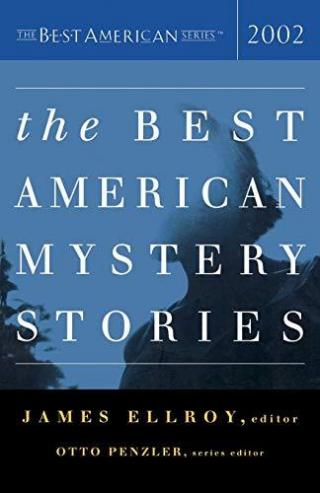
The Best American Mystery Stories 2002
- Автор: Грейди Джеймс, Камински Стюарт Мелвин
- Год: 2002
- Язык: английский
- Год: Houghton Mifflin Harcourt
- ISBN: 978-0-618-12494-7
- Жанр: Другие детективы

Электронная книга - «The Best American Mystery Stories 2002». Краткое содержание книги:
Guildenstern looked at Rosenkrantz. “He being profound?”
“Just nifty,” said Rosenkrantz.
“Just careful,” said Ballard. “If you try to take down the game, our guy’s family gets hit.”
“And if he holds the game, he gets hit. We got that part of it.” Rosenkrantz was suddenly angry. “The mayor and the D.A. are always telling us there ain’t any Mafia in San Francisco. Asian gangs fighting for power, maybe. Chicano gangs fighting over turf, perhaps. Black gangs fighting over drug money and rap music, could be. But—”
“But no Mafia action,” said Guildenstern. “These days, local guys who are connected have only bookkeepers on their payroll. They need something done, they make a call and somebody gets on a plane out of Chicago or Detroit or even Cleveland.”
Rosenkrantz took it up. “The threatener picks up his hardware at the airport on the way in, does what he does, leaves his hardware at the airport on the way out. We got a lot of names and reputations, but we can’t get nothing on nobody.”
“You’re saying the guy with the violin case isn’t local?”
“Tell us about him,” suggested Rosenkrantz.
They did. The cops exchanged glances.
“Knuckles Colucci out of Detroit,” said Guildenstern.
“Mean as a snake,” said Rosenkrantz.
“Call the undertaker for your pal,” said Guildenstern.
“Who hired him?”
The two big cops heaved themselves to their feet. “South Bay? Let us worry about that,” they said almost in unison.
“Who runs the Chinese Benevolent Association?”
“Let us worry about that, too.”
“You’ll let us know when Colucci leaves home again?”
Rosenkrantz said, “What’s the most important question to ask a woman if you’re interested in safe sex?”
“What time does your husband get home?” said Guildenstern.
Larry and Bart descended the back stairs to the big back office that office manager Giselle Marc shared with the mainframe computer and the teenage girls who sent out legal notices and dun letters after school. Giselle was a tall, lithe blonde in her early thirties whose brains were even better than her long and wicked legs. This early she was alone in the office.
“Well?” asked Ballard.
“Every word,” said Giselle with an almost urchin grin. She held up the tape recorder she’d had plugged into the intercom that Heslip, at her suggestion, had left open in the conference room. “Was that a yes or a no on Colucci from those guys?”
“A yes,” said Ballard. “No, there’d have been no joke.”
“If you think you’re leaving me out of this, you’re crazy.”
“Never crossed our minds,” fibbed Heslip.
They had been listening to the tape for about ten minutes when behind them O’B said, “Ahem.”
Patrick Michael O’Bannon, in his early fifties, with guileless blue eyes in a leathery drinker’s face splattered with freckles, was as devious as a two-headed snake. He was also the best repo man around save Kearny himself. He pulled up a chair and sat down.
“Now, you got a couple of holes in your plan...”
None of them thought about letting Dan Kearny, their boss, in on things. He’d just say no, then he’d take over their operation and run it himself. He did it every time.
The Chinese Benevolent Association was up a flight of creaky wooden stairs from an aged Buddhist temple on Old Chinatown Lane, a little stub of an alley just below Stockton Street. There was nothing to tempt the casual tourist or, indeed, any Caucasian to try the street door. It just bore a set of Chinese characters that spelled out God knew what.
Yet on this particular Thursday midday, two bulky white men came tramping up the stairs and into the reception room. It was hung with bright silk tapestries and there were delicate carved ivory figurines on inlaid tables. There was a hint of incense on the air. On the walls were numerous photos of association leaders shaking hands with local and national politicians.
A pert, pretty Chinese girl was making her fingers fly over the keyboard of a very modern computer. She looked up when the) entered, finding a smile for them.
“May I help you?”
When they just walked past her toward the door in the back wall, she dove for the buzzer under her desk. But by then they were already into the next room, where a white-haired Chinese gentleman sat behind a desk arranged so no window overlooked it. A heavyset thug was coming out of his chair on their side of the desk even as he reached for his armpit.
Guildenstern put a big hand on the man’s face and pushed. He pushed with stunning, unexpected strength. The thug went backward over his chair. Rosenkrantz was holding out his badge for the older gentleman to see.
“Rosenkrantz and Guildenstern, SFPD Homicide,” he said.
The old man spoke sharply in Mandarin. The thug righted his chair, sat back down, and ceased to exist for them.
“Mr. Li?” asked Rosenkrantz.
“I am Fong Li,” admitted the white-haired man gravely. His English was accented but elegant. He had a long, narrow, lined face with a thin aristocratic nose. His eyes were dark but benevolent, like his association. In any country of the world, in any race, at any time, he would have been a patriarch.
Rosenkrantz sat on a corner of the desk. “Ray Chong Fat.”
“Ah so,” said Fong Li, much as Ray Chong said, “No savvy.”
“Guy came around and threatened him with death if he held your Asian card game this weekend.”
“I am desolated that I have no information of this event for the honored gentlemen,” said Fong Li.
Guildenstern turned from a table under the window with a delicate Chinese urn in one paw. “This one of them Ming vases?”
Fong Li went very still. He said very softly, “I can make inquiries and discover whether this game of which you illustrious gentlemen speak might be canceled.”
“We don’t want it canceled,” said Rosenkrantz.
Surprise actually flitted across the Chinese man’s august features. “Then I am sure that Mr. Chong Fat need not run—”
“We want Ray to run it this weekend,” said Guildenstern.
Sudden comprehension illuminated Fong Li’s face. “Ah so,” he said again, with a very different inflection.
“But after this weekend, he don’t have to ever run another one,” said Rosenkrantz. “And he don’t owe you any money. The books are balanced, the slate is wiped clean. Anything ever happens to him, or his daughters, anything at all...”
Fong Li bowed gracefully. “This insignificant person would not wish to insult such brilliant men as yourselves, but—”
“I said we were Homicide. We don’t care about gambling.”
A delighted Fong Li beamed. Rosenkrantz stood. Guildenstern carefully set the Ming urn back on the table.
“Nice vase,” he said, making the word rhyme with base.
Two-Ton Tony Marino took his nickname from the heavyweight boxer Two-Ton Tony Galento, who had once gotten himself creamed by Joe Louis. Tony didn’t weigh quite two tons, but even so he was built like a watermelon. When the phone rang in his Detroit office on the following Monday afternoon, he picked up without hesitation: The place was swept twice daily for bugs.
“Yeah, Marino.”
“Tony. Leone in San Francisco. The scemo Chinaman held the game last Saturday night. So Knuckles’ll have to come back out.” Leone gave a sudden gross chuckle. “Blood on the chop suey by Wednesday, right?”
They said laconic goodbyes and hung up. Tony was a little offended. Leone had no real class. You didn’t say things like that. Things got done, bing bang boom, they were over. Nothing personal. You never talked about them before or after.