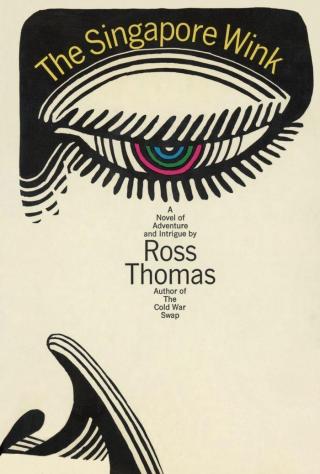
The Singapore Wink
- Автор: Томас Росс
- Год: 1969
- Язык: английский
- Год: William Morrow
- Жанр: Триллеры

Электронная книга - «The Singapore Wink». Краткое содержание книги:
“Who is this crumb?” Cea said.
“His father used to own half of Singapore,” I lied. “Now Trippet does.”
My partner smiled modestly. “Only a third, Edward.”
“I don’t care what he owns,” Cea said to me. “You’re the one who’d better be worried because I’m going to be right on your ass from now on. Me and Terilizzi.”
I shrugged. “You can reach me at the Raffles.”
“They told me that was a real crummy old place.”
“Old anyway.”
“Did you book me a room?” Trippet said.
“You’ve got the one that Carla had.”
“Fine,” Trippet said.
“You going to stay in it?” Cea said and he seemed a little shocked.
“Well, I never really knew the lady, you understand.”
“Yeah. I guess that’s right. Me and Terilizzi are at the Hilton.”
“Where else?” I said.
“What’s that, some kind of a crack?”
“Forget it,” I said. “If you want to talk to the cops, the ones to see are Detective-Sergeants Huang and Tan.”
“Write ’em down, will you?”
I wrote the names down on the back of Cea’s airline ticket.
“Thanks,” he said. “I’ll go see ’em. Just remember, Cauthorne, I don’t care how much pull your partner here has, me and Terilizzi are going to be right on your ass. The boss didn’t take it too good about Carla. In fact, he took to the bed when the telegram came. He don’t feel so good and finding who got to Carla might make him feel better.”
“Should cheer him up tremendously,” Trippet said.
Cea gave him a sour look. “Just remember what I told you, Cauthorne.”
“Right on my ass,” I said.
“You,” Terilizzi said again.
“You better believe it,” Cea said, turned, and went to pick up his luggage.
“Pompous bastard, isn’t he?” Trippet said.
“You know something?”
“What?”
“That must be the first time he’s ever been described in just those terms.”
We collected Trippet’s bag, a bleached pigskin affair that seemed to have solid silver fittings, found a porter who laughed when Trippet said something to him in Malay, and located a bearded Sikh cab driver who agreed to take us to the Raffles in his prewar Jowett-Jupiter that was a marvel to us both.
“Just what did Lira say to you exactly?” I said, once the cab was rolling.
“First, he told me that you had been rather badly beaten and from the bruise on your jaw I’d say he was telling the truth — as he usually does, of course.”
“What else?”
“That the Lozupone girl had been killed and that you were getting in over your head and had refused any offer of assistance. He strongly recommended that I come out and lend a hand.”
“Doing what?”
“Well, I must confess he was rather vague about that.”
“Dangerfield’s here,” I said.
“The FBI man?”
“Yes.”
“What’s he doing?”
“Lending a hand.”
“Oh,” Trippet said and gazed out the window at the Singapore scene as we threaded our way through the Indian section that lined Serangoon Road. “It hasn’t changed,” he said as we rolled slowly through the treeless, grubby neighborhood, entire sections of which could have been transplanted intact from Bombay or Calcutta or Jubbulpore. Ghee and tal cooked in pans over cow dung fires and their odors mingled with those of oil and urine and incense and rose water. Men in white dhotis chewed betel and stared at nothing and everything. Women in bright, even brilliant, saris rattled their gold bangles and a Hindu wise man, his arms smeared with ashes, wandered through the crowd. A Parsee leaned against a post, picked his teeth with a sharp knife, and sneered at the Hindu. An old man hobbled by with the aid of a malacca cane, his mouth wrapped in gauze, his eyes fixed on the ground.
“What’s the one with the gauze over his mouth?” I said.
“Must be a Jain,” Trippet said.
“Afraid of germs?”
“Not at all. He’s probably orthodox. The gauze keeps insects from committing suicide by flying into his mouth. Notice how carefully he walks; he doesn’t want to step on any of them either.”
Just past Balestier Road which takes you to the Singapore Island Country Club, if you can afford the dues, the traffic became spotty and the driver urged his aged car on to new efforts. We must have been making forty when the black, four-door Chevelle pulled up alongside and stayed there. Our driver slowed, but the Chevelle dropped back with us. When the Chevelle’s rear window started to roll down, I caught Trippet by the shoulder and gave him a hard, abrupt shove towards the floor. I dropped flat on the seat and one of the two shots plunked into the far door about eight inches from my head while the second one, fired at an angle as the Chevelle pulled ahead, knocked out the taxi’s rear window. The glass wasn’t shatterpoof and a few shards fell on the seat.
Our driver shouted something and then slammed on his brakes. I rolled off the seat onto Trippet. He squirmed under me and I managed to get back to a sitting position and noticed that a crowd was gathering.
“The neighbors are here,” I said.
Trippet raised up to look around. “So they are. Any damage?”
“The rear window and my nerves.”
“Do you have any money?”
“Sure.”
“Give me fifty dollars.”
The driver was now outside of the car, explaining to the interested bystanders how it had happened and his gestures were a pleasure to watch. Trippet got out the left door and walked up to the driver and said something into his ear while pressing the bills into a hand that momentarily was not in flight. The driver peeked at the denominations, smiled, and hurried around to open the door for Trippet The crowd watched us drive away. A four- or five-year-old boy waved for no good reason and I waved back.
“It was an accident, sir,” the driver said.
“I’m sure of it,” Trippet said.
“But the rear window.”
“A sad loss, but fortunately replaceable.”
“Perhaps after all one should inform the police.”
“It would only inconvenience them,” Trippet said.
“If only I could be certain it was indeed an accident,” the driver said.
Trippet stretched his hand out to me, palm up, and I laid two Singapore twenty-dollar bills across it. Trippet folded them and tapped the driver on the shoulder. “Perhaps this will give you the certainty you seek,” he said.
The driver’s right hand came up over his right shoulder and his fingers closed over the bills. He didn’t turn his head. He glanced down at the numerals on the bills and then tucked them into his shirt pocket “Truly,” he said, “it was a most regrettable accident.”
Chapter XXII
Trippet knocked on my door after he had unpacked, showered, and changed clothes. The temperature outside was pushing ninety and the humidity was even higher. Both of us had been sopping by the time we reached the hotel.
“Gin and tonic?” I said. “My boy brought some fresh limes.”
“Anything,” Trippet said.
I mixed the drink and handed it to him.
“We’ll drink to your first Singapore shoot-’em-up,” I said.
“I still expect to go into shock any moment,” Trippet said. “I must say that it didn’t seem to bother you much; but perhaps you’re used to it by now.”