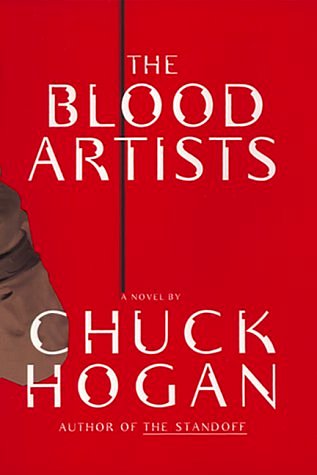
The Blood Artists
- Автор: Хоган Чак
- Год: 1998
- Язык: английский
- Год: William Morrow
- ISBN: 978-0-688-15622-0
- Жанр: Триллеры

Электронная книга - «The Blood Artists». Краткое содержание книги:
“Tell me you haven’t locked her away somewhere, Peter.”
“She is staying in an Emory dormitory room. She eats at the school cafeteria. She has no idea how many people I have watching her everywhere she goes. But she is refusing to help.”
Stephen nodded. “And that is why you finally agreed to bring her here.”
“I need her to see what is at stake. She needs to understand that this is life or death.”
The red light flashing over the submarine door indicated movement into the shower room. The nurse was bringing Melanie through.
“Could you turn down the lights?” Stephen said.
Maryk dimmed the overhead bulbs and the shadows deepened on Stephen’s face. Stephen sat up as straight as his gaunt body was able. He appeared nervous.
“What is she like?” he said.
“She hates me,” Maryk said. “You two should have a lot to talk about.”
But Maryk was relieved not to be facing her alone again after their last encounter. He heard movement behind the door. It was pushed open and the pressure in the room changed. Air rushed in. The nurse stepped through the oval doorway and Melanie followed behind.
Maryk had ordered her sealed inside a suit. He was not taking any chances with her health. She kept her head down inside the hood and remained just to the left of the door. The unsashed fabric bagged around her waist and bunched at her knees until the nurse connected her air feed to the ceiling runner. Then Melanie’s suit inhaled.
Her eyes rose gradually. She looked away immediately after first seeing Stephen on the bed. She worked hard to smother her reaction before looking at him again. The shock of seeing this public figure convalescing was exactly what Maryk had wanted.
“Hello, Melanie,” Stephen said.
Her stare at him was interrupted only by a flickered glance at Maryk.
Stephen said, “I wanted to thank you in person. I know this all must be bewildering to you. You were brave to come.”
Stephen’s voice was ripe with enthusiasm. He was good that way.
“Your life is worth more to the human race than mine or even Dr. Maryk’s,” he went on. “There are ways you could help. You could help us by donating your blood. You could help others by meeting with them, by going out into the field.”
Maryk stopped him. “Stephen.”
“She’s looked it in the face, Peter. She’s survived.”
Maryk tried to silence him. “It’s too hazardous. The bug mutates too fast.”
“You said her hemo screens are sound, even with the mutations. She’s curing it. Think of the effect her presence would have on the ill.”
“Stephen — I do not need her going around holding people’s hands.”
A sharp gasp distracted them. It came from the nurse as she reached out toward the girl.
Melanie had split the diagonal seal across her suit. She broke open the folds and flipped the hood back off her head. Her garish hair sprang loose and her eyes were fierce as she glared at Maryk. She took a deep breath and filled her unprotected lungs.
Melanie sat on an examining table in another room in the same building, pressing a folded square of gauze to her left elbow and still buzzing from what she had done.
Recollections from her illustrious days in premed: The ecosphere of the human lung absorbs 20,000 liters of air each day. Less than 1/100,000 inch of protection separates the lung air environment from the vast human bloodstream. Viruses need to open a hole of only 1/1,000,000 inch in order to hitch a ride on the sanguineous superhighway.
“Stupid,” Maryk sputtered again. It was all worth it just to have witnessed that moment of impotence on his face, that had preceded the dark, furious frown he now wore. “You are immune to casual airborne exposure to Plainville. But if even a minute amount of infective blood or saliva came into contact with your eyes, your mouth — you would be at risk.”
She remembered similar tablebeds in her father’s office, and how he used to pull tissue paper down from a roller beneath the head cushion, a new strip for each sniffling kid. That had been his generation’s idea of sterile medicine. Her schoolyard version had been a Popsicle stick inoculation to ward off a sudden outbreak of boy cooties.
Pasco paced behind them, and she felt his tension too. Maryk mixed something into her blood and waited while it set in a small container, marked PCR, connected to his tablet. She peeled the cotton pad back from the puncture wound on her arm and looked at the resulting bloodstain still spreading through the gauze webbing like a flower opening in bloom. Miracle Blood! Watch it go! She looked down at her wasted, bruised arms with a renewed sense of anger and potent shame.
“Will you lock me up in the basement now like your friend?” she said.
His eyes burned gray. Everything he did disgusted her now.
“Why would you task yourself like this?” he said.
“I’m special,” she told him. “I’m different.”
Seeing Dr. Pearse like that, fragile and shrunken with those ghostly red eyes, had been shocking; she hadn’t seen anyone that sick in over four years. But as bad as she felt for him, her loathing for Maryk was a hundred times more intense.
He looked up from his little tablet. “Well?” she said, Insistent. Defiant.
He disconnected the contraption. He said: “Clean.”
It was simple enough to disguise her own relief. But when Maryk showed none, she became enraged. She was his number one pin cushion, after all.
She sensed an urgency in his actions as he cleaned up. “It was your blood,” she said. “Your freak blood, transfused into me in the hospital. That’s how I was ‘cured.’ ”
His silence told her she was right. She threw the bloody gauze down onto the table in front of him, and he stopped and looked at it crumpled there before pulling fast the buckle straps on his bag.
“You’re a freak,” she told him. “And you’ve made me into a freak.”
Maryk stopped at the door with his bag. He looked back at the cold table, not at her. “Take her to her room,” he said to Pasco.
“My room?” she laughed, though it came out a bray. Maryk opened the door and started down the hallway, and suddenly Melanie wasn’t laughing anymore. “Why didn’t you let me die in Plainville!” she screamed. But he continued away, and the white door closed on his back and clicked shut.
The Oracle
Cyberviruses Section was located two doors down from the STD unit in BDC Building Eighteen, Most CVs were hacker-engineered although there had been incidences of corrupted files breaking off from legitimate programs and mutating “naturally” file to file. The turn-of-the-century Internet boom had corroborated the epidemiological axiom that any surge in population represents a fertile breeding ground for viral incursion. The new ecology of computer technology had engendered indigenous viral activity.
Suzy Lumen, was the co-section head. She was an obese woman of more than 250 pounds and was legally blind. She sat before a semicircular computer console in her office like a priestess divining at an oracle. She wore a loop earphone connected to a chin mike and the fingertips of her right hand explored a flat blue pad that raised screen characters into Braille. Her thickly soled sneakers worked foot pedals beneath the console that controlled her microphone. Suzy Lumen was the human liaison to the DNA-powered Genetech II computer that ran the BDC.
Maryk pulled over a chair and sat at her side. The cascade from his long visit with Stephen made thoughts sound like voices arguing in his head.
“Here’s what I need,” he told Suzy Lumen. “Assume that the director’s tablet had been compromised by some outside interest.” He was trying to be careful with his wording. “What would that mean?”