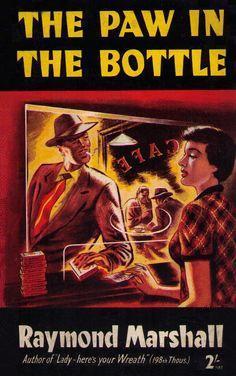
The Paw in the Bottle
- Автор: Чейз Джеймс Хэдли
- Год: 1949
- Язык: английский
- Год: Jarrolds
- Жанр: Криминальные детективы

Электронная книга - «The Paw in the Bottle». Краткое содержание книги:
‘She could have taken the underground. Taxis aren’t easy to get these days.’
‘I think that’s what happened, sir. If she caught a train at once she would have arrived about the time she did.’
‘Let’s get back to Wesley. How does his statement compare to the actual facts?’
‘All right, sir, with two exceptions. One was the commissionaire told him Mrs. Wesley was in the bar and he says he didn’t know where she was. But then, of course, he might not have heard the man. But when he came out of the theatre after the curtain had gone up, the commissionaire offered to get him a taxi, and he refused. That seems a bit odd to me, sir. I have his statement here. He says, “It occurred to me that she might have returned here and I became alarmed. I had some difficulty in stopping a taxi. At last someone took pity on me and stopped one for me.” ’
‘Yes, very odd. If the commissionaire offered to get him a taxi and he was alarmed, why didn’t he let the man get him one? Why go blundering about the street? He surely would know he couldn’t hope to get a cab for himself. I think I’ll have another word with him about that. He’s not living at Park Way any longer. He’s moved into a flat in Vigo Street. He’s living with that Holland girl.’
Garson showed his surprise.
‘That’s something that foxes me, Garson.’ Dawson pushed back his chair, thrust his knee against his desk. ‘What’s the idea of a fellow like Wesley living with that Holland girl?’
Garson grinned.
‘She’s a pretty nice-looking girl, sir. A fellow doesn’t worry too much about what’s inside a girl’s head these days so long as she’s got a good body and a pretty face. At least, not the fellows who want that kind of fun.’
‘What’s a pretty face to a blind man?’
Garson blinked.
‘Yes, of course. I wasn’t thinking. No, you’re right, sir. I wonder what the idea is?’
‘I’ve had a man keeping an eye on them. Wesley’s throwing money away on her. They’re going everywhere: night clubs, theatres, bottle parties, dances, restaurants, even riding in the Row. He’s not going to the factory any more. For the past four days they’ve been everywhere together. I want to know what the idea is.’
‘Blackmail?’
‘I don’t think so. If it were blackmail why should she go around with him? A blackmailer likes to keep at a safe distance. And she doesn’t strike me as the type.’
‘Perhaps they’re in love, sir.’
‘Perhaps they are. I don’t know. All right, Garson, you concentrate on the Frenches. I want ’em quickly. They’re holed up somewhere. Keep after them. I’ll have a word with Wesley. And keep after those taxi drivers. There’s still a chance one or both’ll come forward.’
When Garson had gone, Dawson glanced at his watch. It was a few minutes after three o’clock. He’d call on Wesley about five, he told himself. If Wesley wasn’t in, he might get a chance to talk to Julie Holland.
III
Benton lived alone in a small but comfortable West End flat on the top floor of an old-fashioned building that contained three bachelor flats and was serviced by a housekeeper and a valet. Breakfast was the only meal provided, and this was served in the small alcove leading off Benton’s sitting-room.
At eight o’clock each morning (nine o’clock on Sundays), the meal was set on the table. Benton rose at seven-thirty, bathed and shaved, and then, in pyjamas and dressing gown, had breakfast. He left the flat at nine o’clock for the factory.
His breakfast consisted of cornflakes with watered milk, toast, a scraping of butter and strong coffee: it never varied. When he had finished the meal, he lit a cigarette and unfolded the newspaper that lay in a tight roll on the tray. No matter how important the news, he didn’t look at the paper until he moved from the table and sat in an arm-chair.
On the morning following Blanche’s death he had bathed, shaved and breakfasted with his usual pale calm. His mind was preoccupied with the two main interests in his life: Blanche and money.
He had met Blanche for the first time at her wedding, although he had seen her several times on the stage and had admired her from a distance. Wesley had given him no warning of his marriage. Wesley and he had been partners for a number of years. Together they had developed the Wesley-Benton Aircraft Factory from a small and experimental idea into four hundred acres of machine shops, runways and hangars. The drive admittedly had come from Wesley, but Benton’s contribution had been none the less important. In his quiet, pale way, he had a brilliant flair for organization. He could turn chaos into orderly efficiency with a stroke or two of his pen. He could handle difficult contractors, placate irritable ministers, soothe nervous and suspicious hankers. He undertook all the petty, irritating jobs (vitally important in spite of their pettiness) where Wesley’s temperament would have failed. The partnership had been successful, although each man disliked the other intensely, and where Wesley was concerned it had been profitable. Benton was never able to keep money for long. He was a spendthrift and his share of the profits was invariably lost in gambling and unsound undertakings which he could easily be persuaded to finance.
Some six years ago Wesley had wandered into Benton’s office and had announced casually that he was getting married. Benton offered his congratulations and was curious to see the bride; curious and inclined to sneer. Who in the world would want to marry a cold fish like Wesley, he wondered. Probably some horsey-looking woman whose only claim to fame was an occasional photograph in the Tatler or Sketch. Benton loathed that type of woman. But when Wesley introduced him to Blanche he had the shock of his life.
Benton was a profligate. His headmaster had once said before the whole school that he had a mind like a body full of sores. That was when Benton had been involved in a particularly unpleasant scandal and had been publicly expelled. Women were as necessary to him as drugs to an addict. He had admired Blanche when he had seen her on the stage; at close quarters she bowled him over. He hadn’t been in her company for long before he was obsessed by her. She had a sensual, animal magnetism that caught him by the throat. This was no passing infatuation; no idle lusting after a pretty woman. It went much deeper than that. It was like a virulent germ in his blood; a craving that tortured him; a suffocating feeling every time he heard her name; a pounding of blood in his ears at the sound of her voice.
When Wesley volunteered for the Royal Air Force, Benton, unfit for any of the Services, did not hesitate to take advantage of his absence. By then Blanche was drinking heavily and Benton willingly became her drinking partner. Drink had no effect on him, but it rotted Blanche mentally and physically.
Somewhat to Benton’s surprise his obsession for Blanche showed no signs of waning. He had felt like this before with other women, but once he had become intimate with them the desire for their company wilted. But not so with Blanche. The more he saw her, the more intimate they were, the more he desired her: it was like throwing petrol on a smouldering bonfire. He would have married her if he had had the money. Blanche was willing and kept urging him to put his money affairs in order, refusing to use her own money so long as she could use Wesley’s.
From a grimy, erotic beginning, their association developed into an odd but deep-rooted kind of love. Benton led a lonely life. He was not popular and had no friends. There was something about him that other men distrusted, and Blanche was his only companion.
When he unfolded the newspaper and saw Blanche’s photo-graph staring at him from the printed page and read the banner headline that told of her murder, he went deathly pale. He sat motionless, the paper gripped in his long, rather beautiful fingers, his eyes closed.