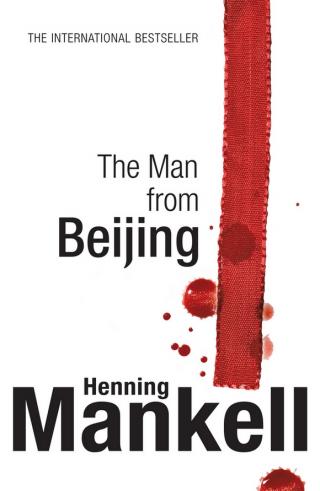
The Man from Beijing
- Автор: Манкелль Хеннинг
- Год: 2010
- Язык: английский
- Год: Harvill Secker
- ISBN: 978-1-84655-257-1
- Переводчик: Laurie Thompson
- Жанр: Криминальные детективы

Электронная книга - «The Man from Beijing». Краткое содержание книги:
I’m dying too soon. But even if I lived to be a thousand, I would still die too soon as I would not have succeeded in restoring our family’s honour. I did what I could, but it was not enough.
Ya Ru closed the diary and put it away in a drawer, which he locked. He took off the gloves. He opened another desk drawer and produced a thick envelope. Then he pressed the intercom button. Mrs Shen answered immediately.
‘Has my guest arrived?’
‘Yes, he’s here.’
‘Ask him to come in.’
The door in the wall slid open. The man who entered the room was tall and thin. He moved smoothly and nimbly over the thick carpet. He bowed to Ya Ru.
‘It’s time for you to leave, Liu Xin,’ said Ya Ru. ‘The beginning of the Western New Year is the most appropriate time for you to carry out your task. All you need is in this envelope. I want you back here in February, for our New Year.’
Ya Ru handed over the envelope. The man took it and bowed.
‘Liu Xin,’ said Ya Ru. ‘The task I have given you is more important than anything I’ve ever asked you to do. It has to do with my own life, my own family.’
‘I shall do what you ask.’
‘I know you will. But if you fail, I beg you not to return here. If you did, I would have to kill you.’
‘I shall not fail.’
Ya Ru nodded. The conversation was over. Liu Xin left, and the door closed silently. For the last time that evening Ya Ru spoke to Mrs Shen.
‘A man has just left my office,’ said Ya Ru.
‘He was very taciturn but friendly.’
‘But he has not been here to see me this evening.’
‘Of course not.’
‘Only my sister, Hong Qiu has been here.’
‘I haven’t seen anyone else. Nor have I noted down any name other than Hong Qiu in the diary.’
‘You may go home now. I’ll stay for a few more hours.’
The conversation was over. Ya Ru knew that Mrs Shen would stay until he had left. She had no family, no life apart from the work she carried out for him. She was his demon guarding his door.
Ya Ru returned to the window and gazed out over the sleeping city. It was now well past midnight. He felt exhilarated. It had been a good birthday, even if his conversation with Hong Qiu had not turned out as he’d expected. She no longer understood what was happening in the world. She refused to acknowledge that times were changing. He felt sad at the realisation that they would drift further and further apart. But it was necessary. For the sake of his country. She might understand one day, despite everything.
However, most important, this evening, was the end of all the preparations, all the complicated searches and planning. It had taken Ya Ru ten years to establish exactly what had happened in the past and draw up his plan. He had almost given up on many occasions. But whenever he read Wang San’s diary, he had been able to find the necessary strength once again. He had the power to do what San could never have achieved.
There were a few empty pages at the end of the diary. That is where Ya Ru would write the final chapter when everything was over. He had chosen his birthday as the time to send Liu Xin out into the world to do what had to be done. He now felt relieved.
Ya Ru stood motionless by the window for a long time. Then he switched off the lights and left through a back door leading to his private lift.
When he got in his car, which was waiting in the underground car park, he asked the chauffeur to stop at Tiananmen. Through the tinted glass he could see the square, deserted but for the permanent presence of soldiers in their green uniforms.
This is where Mao had proclaimed the birth of the new People’s Republic. Ya Ru had not even been born then.
The great events that would soon take place would not be proclaimed in this square in the Middle Kingdom.
The new world order would develop in deepest silence. Until it was no longer possible to prevent what was going to happen.
Part 3
The Red Ribbon (2006)
Wherever battles are waged there are casualties, and death is a common occurrence. But what is closest to our hearts is the best interests of the people and the suffering of the vast majority, and when we die for the people, it is an honourable death. Nevertheless we should do our best to avoid unnecessary casualties.