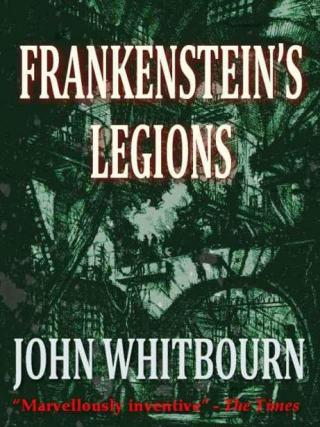
Frankenstein’s Legions
- Автор: Whitbourn John
- Год: 2011
- Язык: английский
- Жанр: Попаданец

Электронная книга - «Frankenstein’s Legions». Краткое содержание книги:
but the Governments who have hijacked his discoveries see the advantage of
resurrection on an industrial scale. What better way to fight their
never-ending wars than with armies of obedient undead soldiers, recycled from
earlier battles? And how better to silence their own citizens who protest at
ceaseless conflict and plundered graveyards?
Set in the 1830s,
Frankenstein’s Legions details an alternative history in which Frankensteinian
science is a reality, revived after patchy prohibition by a second and even
more fanatical French Revolution. The republican regime, inspired by zeal and
desperation, has swept over Europe, employing inexhaustible swarms of
zombie-like (or Lazaroid) troops. The remaining independent nations, including
England, are obliged to shed their scruples and likewise raise Lazaroid
armies.
Across this crazed and Gothic history stride Julius Frankenstein,
soldier nephew of the notorious scientist; Charles Babbage inventor of the
proto-computer Difference Engine; and the Honourable Augusta Ada, Countess of
Lovelace, genius daughter of Lord Byron. Pulling their strings – they believe
– are the puppetmasters Talleyrand, French statesman par excellence and now a
renegade in English employ; and Sir Percy Blakeney, sometime Scarlet Pimpernel
and current head of the British Secret Service.
Meanwhile, the French
have been unwise enough to revive their recently deceased Emperor. The
intention was simply to pick the brain of history’s foremost military mind.
However, the risen Emperor Napoleon is developing fresh ambitions of his own…
No, civilised minds should transcend first thoughts and come to cooler conclusions, thereby building their house on rock (as Scripture so wisely advised). What did he really think about the unnatural horror show parading before his very window? Or, broader still, about the world-as-it-was come to see him in all its glory?
Answer came easy, in the form of another of his infamous epithets, said long before but in a similar death-connected context: ‘It is worse than a crime; it is a mistake!’ Which said it all as far he was concerned.
That settled, the man then chided himself that any old world-class intellect could describe the world. That was the easy bit. The point (and problem) was how to change it.
More difficult still, how could just one individual—even an exceedingly clever individual (such as he)—amend things for the better?
And, of course, have monstrous fun at the same time?
It was a quite a trip for name checks. Another important personage happened to see the new-forged regiment too. They crossed paths with Admiral Nelson, (Lord Merton, Duke of Bronte, Knight-commander of Naples, etc. etc.) as boats ferried him in his capsule to HMS Victory and them to their troopship.
Nelson curled his lip at their wafting stench of serum mixed with decaying meat—though, strictly speaking, in no position to cast stones himself.
In Germania the regiment proved its worth.
A stubborn salient of churned mud and rubble still described on maps as ‘The Prince-Archbishopric of Dresden’ was holding up the French armies. Any breakthrough by them there might lead to the recapture of Berlin for the umpteenth time. Occasion, it was decided, for a rare Allied counter-attack.
Disposed against that were legions of Lazarans (though the Conventionary army more tactfully termed them ‘New-Citizens’), backed by massed French cannon in unassailable positions.
Unassailable, that is, to soldiers with a life to lose. A life which they valued. And families. And souls.
The colonel’s ‘413th regiment of Revived Foot’ had few such qualms. Or if they did, bayonets and barbed-whips overcame them. They rushed the French emplacements and blocked grapeshot with their second-hand bodies whilst live troops manoeuvred and won the battle elsewhere.
So it was worth all the grave-robbing and serum and upsetting Littleton and Nelson after all.
Afterwards, men from the ‘Charon brigades’ went and collected any identifiable bits in order that the glorious 413th might become the glorious 414th.
Accordingly, Berlin didn’t fall for a further fortnight.
Chapter 2: A DAY IN THE LIFE OF JULIUS FRANKENSTEIN
‘…how pleased you would be to remark the improvement of our Ernest! He is sixteen, and full of activity and spirit. He is desirous to be a true Swiss, and to enter into foreign service… My uncle is not pleased with the idea of a military career in a distant country; but Ernest has never had your powers of application. He looks upon study as an odious fetter;—his time is spent in the open air, climbing the hills or rowing on the lake. I fear that he will become an idler, unless we yield the point, and permit him to enter on the profession he has selected.’