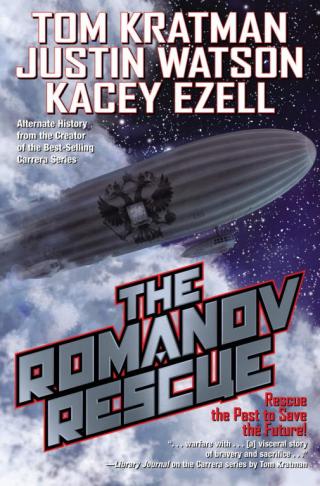
The Romanov Rescue
- Автор: Кратман Том, Watson Justin
- Год: 2021
- Язык: английский
- Год: Baen
- ISBN: 978-1-9821-2570-7
- Жанр: Альтернативная история

Электронная книга - «The Romanov Rescue». Краткое содержание книги:
As WWI comes to a close a German general, an escaped prisoner of war, and the crew of an airship converge to effect THE ROMANOV RESCUE. Can there be a world without communism?
Mankind’s history is bound up in the fabric of fate, a strong cloth, tough and closely woven.
It is the beginning of 1918, the last year of the greatest war in human history, to date. All the belligerents stagger on their feet. Starvation is an ever present reality, while disease waits in the wings. In Russia, no longer a belligerent but, instead, rapidly descending into civil war and chaos, a lone family—Father, Mother, four beautiful young girls, and a brave but sickly boy—await their own fate, shivering and hungry in the dark, hoping and praying for salvation.
Their relatives in England have turned their backs. The guards set over them do little but torment them. They look Heavenward, but God doesn’t answer. They know they’re a threat to the new regime, a threat that will, in time, be eliminated.
But even the strongest fabric has flaws. An escaped prisoner of war, caught, injured, and punished, but still highly capable, might be one. An airship, returned and at loose ends after a failed mission to Africa might be another. A German general, taking a wrong turn on his nightly walk and suddenly coming face to face with the reality of the monster rising in the east, would be a third.
Follow, then, as the general gives the orders, the prisoner of war raises the men from among his fellows, and the airship launches itself forward, to contest fate, to tear the fabric of time, and to effect The Romanov Rescue.
About the Carrera series:
Brinkmann, having transferred his cane to his left hand, took aim. His shot then did for the right leg holder, as Hoffmann finished off the left.
Hoffmann then, and much to the horror of both the major and the woman, walked forward and proceeded to put another bullet into the brain of each of the assailants. After that he bent to offer the woman a hand up. The act of lifting also allowed her dress to fall back into place.
Only then did he realize that the “woman” was actually quite a young girl, perhaps fourteen years old or, if she’d been well fed recently, maybe even thirteen.
“Dziakuj,” said the girl, leaning against the mountain in the form of a man. “Dziakuj,” she repeated, throwing her arms around him. Hoffmann let her stand like that for a few minutes, The poor thing is shaking so badly. Don’t think I blame her.
“I recognize at least one of these,” Brinkmann said, using his cane to ease himself down to one knee. He twisted by the chin the bloody, shattered, brain-leaking head of one of the corpses. “I’ve seen him standing guard on one of the Bolshevik diplomat’s huts.”
Hoffmann holstered his pistol, then put hands on both the girl’s shoulders and eased her gently away. He had his first real view of her face. Pretty thing, he thought. Or she’ll grow up pretty, anyway. If she grows up.
“Do you speak Russian?” he asked the girl. “German?”
“Leetle Russian,” she answered. “Leetle. Speak Belarus better.”
“Who were these?”
“Dunno. Me walk home from Papa’s store. Grab me. Next, you see what they do. Try do.”
“Did they speak Russian, at least.”
“Not to me. Not understand they speak, anyway.”
“Okay, girl. What is your name?”
“Maryja,” she answered. “Maryja Pieliski, sir.”
“Are you all right, Maryja?” Hoffmann asked. “Will you be fine going home now?”
“Yes. Think so, sir. You save me before they…”
She doesn’t need to describe this, or think about it, Hoffmann thought. “Okay. Go home then and tell nobody what happened here. Bad for all of us if you do.”
“I go. I say nothing.” Before she turned though, she threw her arms, at least as far as they’d go, once more around Hoffmann’s more than ample waist and repeated, “Thank you. Thank you! Thank you!”
As she scampered off, footsteps clattering on cobblestones, Brinkmann searched through the pockets of the corpse he’d been inspecting. “Here’s the… well… paybook, I suppose, for this one.”
Hoffmann took the proffered booklet and thumbed it open. “It’s written in Russian,” he said, “but it says he’s a Latvian.”
“Makes sense; they’re the most reliable troops the Reds have.”
“Animals,” Hoffmann pronounced. “Just animals. And we’ve turned them into our neighbors for the foreseeable future.”
“It reminds me of when we took Riga, last September,” Hoffmann continued. He led off once again, rescued girl and Bolshevik corpses for the nonce forgotten. “There, the Russian Army had so badly disintegrated into a rabble that none of the people felt safe until we drove them out.”
“Well… Russians, after all,” Brinkmann said.
Hoffmann stopped for a moment, somewhat incredulous. “What, you think Russians are invariably rabble? It is not so, Brinkmann; I assure you it is not so. Whether with Suvarov in Italy, or at Eylau under Bennigsen, at Poltava facing the Swedes or Borodino versus Napoleon, the Russian soldier has always been well disciplined. I saw him fighting the Japanese, around Port Arthur. The Russian soldier is docile, quiet, and unassuming; he is also innately brave. It’s not him, not the Russian soldier; it’s the Bolsheviks, who have ruined him, at least for the nonce.”
“The Cossacks?” Brinkmann countered. In many circles, the Germans not least, the Cossacks had a reputation for pillage and rapine, along with the other usual battlefield atrocities.
“Different role, different culture,” Hoffmann explained.
Brinkmann accepted this without demur, though he retained his private doubts. “They’ll be trying to infect us, too, with their propaganda.”
“They already are,” Hoffmann said. “I refused them their demand to be allowed to send it to our soldiers. They’ve officially accepted my refusal for now… but in the long run? We have to do something about them.”
“What can we do?” asked Brinkmann. “I note that our own newspapers, and the Austrians’, too, are in high dudgeon over your refusal to let the Reds spread their propaganda.”
“Indeed,” said Hoffmann. “One would almost wonder whose side the papers are on, except we’ve known for years they’re on the enemy’s side. On the plus side, the British, French, and American papers are largely on ours. Seems a universal problem.
“As to what we can do… maybe nothing,” Hoffmann admitted. “But I am recalled to see Ludendorff in Berlin in about two weeks’ time. I’m going to try to make them see reason.”
He said the next sentence without conviction, “Someone has to see reason…”
Later that evening, in his quarters, under a dim lamp, Max Hoffmann put his own reason to work, sketching out a possibility with a few branches and arrows, with the overall grand object of getting rid of the Bolsheviks.
But how? But how? We can’t do the work for any number of reasons, and even if we did, we’d get no thanks from it and do no good, even if we succeeded. But maybe…
At one point Hoffmann shouted out to his aide, “Find me the report from Jambol, Bulgaria… no, I don’t remember the date, only that it was marked ‘Naval’ and was a little over a month ago.”
Berlin, Germany
Hoffmann entered Ludendorff’s office fully intending to brief him on a particular idea he had. Faced with the quartermaster general’s cold anger over a certain diplomatic faux pas, however, that ambition quickly died.
“How could you let such a note pass, Hoffmann?” Ludendorff demanded angrily. “You should have stopped it before the Russians were misled and then stomped off in a huff. You speak Russian, for God’s sake; you should have made sure there were no such misunderstandings. Moreover, why didn’t you inform me of its contents?”
With someone of Ludendorff’s sheer force of character, coupled to the sudden and unexpected absence of the warmth and cordiality that had existed between them even since before the war, Hoffmann was almost flabbergasted. He kept his cool enough to explain that he had assumed, and had every right and reason to assume, that Ludendorff had been fully briefed by the Foreign Office.
“Moreover, the problem was not one of translation but of sheer understanding. The Russians had simply blithely assumed that no forcible annexations meant no self-determination, even though self-determination was one of their principles, when they entered into the negotiations. How is one to prevent that? Didn’t you all, after all, discuss this at the meeting on the eighteenth?”
“We did not,” Ludendorff admitted. “As to whether you were justified in assuming so… well… I supposed so. My apologies then. I am under a good deal of strain of late.”
“I understand,” Hoffmann said.
“So lay out for me, then, both the status of the negotiations and of the front. You may consider this a dress rehearsal, because His Majesty wishes you to come to the Bellevue Palace for lunch, where he is certain to want the very same things.”