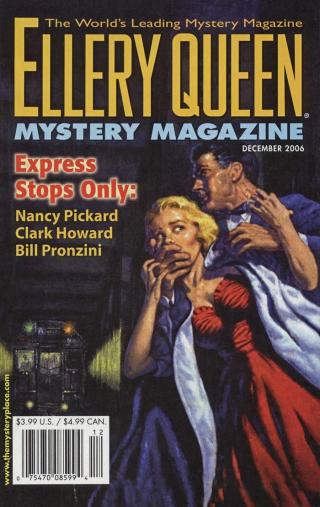
Ellery Queen’s Mystery Magazine. Vol. 128, No. 6. Whole No. 784, December 2006
- Автор: Пикард Нэнси, Пронзини Билл
- Год: 2006
- Язык: английский
- Год: Dell Magazines
- ISBN: 0013-6328
- Жанр: Другие детективы

Электронная книга - «Ellery Queen’s Mystery Magazine. Vol. 128, No. 6. Whole No. 784, December 2006». Краткое содержание книги:
The painter regarded his figures almost lovingly. None of these people would ever humiliate him again. Never! For a long time, he’d pondered who should serve as his model for the arrogant fellow in the front on the left. And then who should appear out of the blue but his neighbor, complaining of extreme financial distress and inquiring with an odd grin what Winfred had been up to in his garden in the middle of the night — and had thereby solved Winfred’s problem. Now the only thing missing was the man in the top hat.
In the future, Kaltendorf decided, he’d continue to stick to familiar paintings. Not that he lacked any ideas of his own, mind you. His works wouldn’t really be copies, you see; they’d just make it easy for people to recognize his genius when they compared his paintings to the originals. He’d be the one to truly perfect the original painting’s artistic idea! Winfred also realized that he’d been too cautious and petty in the choice of his, ah, circle of models. In the future he’d have to be much bolder. After all, his mission extended beyond mere bourgeois revenge fantasies; it was intended to be worthy of the quality of his art. Art, he realized, is the fusion of genius and life, of death and grace! Grace! He liked the word. He who is graced can also show mercy. Hadn’t it been the quintessence of mercy to release these people from the meaninglessness of their material lives, to grant them immortality through his art?
The telephone rang. It was an Arnaldo somebody-or-other from Spain, asking for Pollack. Arnaldo! Kaltendorf didn’t know any Arnaldo, but he knew the voice. Even after all these years he’d recognize it among a thousand voices — the arrogant tones of a former fellow student who had never paid him any notice. Doubtless this “Arnaldo” would soon turn up in person — and he’d be the perfect “man with a top hat”!
But that was enough for today. Almost. Kaltendorf had given some thought to what, in the end, had caused his predecessors to fail. They were painters who’d never really been pushed beyond their own limits. Van Gogh, vastly overestimated, had cut off his ear. An ear! How ridiculous! Had Van Gogh painted with his ears? He, Kaltendorf, would sacrifice something truly absolute on the altar of art. He positioned the axe carefully and with deliberation. The right or the left? After a moment’s hesitation he decided on the right. Naturally, he nearly fainted from the pain. And yet his left hand would learn, virginally and unencumbered by the past, to wield the brush. And through the throbbing and the blood that had spattered in his eyes, he had a vision of his next works: Rembrandt’s The Night Watch, for example, or Seurat’s Bathers at Asnières. And just as his existence seemed to be composed of nothing but searing, burning pain, his ultimate masterpiece came to him in a flash — Altdorfer’s The Battle of Alexander at Issus!
Copyright © 2006 by Paul Lascaux, Stefan Slupetzky, Anke Gebert, Richard Lifka, Thomas Przybilka, & Christoph Spielberg.
Translation © 2006 by Mary Tannert.
Devil’s Brew
by Bill Pronzini
Bill Pronzini’s stellar reputation in the mystery field is based mainly on his fiction writing, but his name is also seen frequently as the editor of mystery anthologies. His most recent editorial project is a book of Erle Stanley Gardner stories entitled The Casebook of Sidney Zoom (Crippen & Landru/July ’06). He also had a new novel out this past summer. See The Crimes of Jordan Wise (Walker/June ’06).
There were few more undesirable places for a detective and temperance man to be plying his trade, Quincannon reflected sourly, not for the first time in the past week, than the bowels of a blasted brewery.
The fine, rich perfume of malt, hops, yeast, and brewing and fermenting beer permeated every nook and cranny of the two-story, block-square brick building that housed Golden Gate Steam Beer. Whenever he prowled its multitude of rooms and passages, he was enveloped in a pungent miasma that tightened and dried his throat, created a thirst that plain water couldn’t quite slake. In his drinking days he had been mightily fond of the type of lager, invented during the Gold Rush and unique to San Francisco, known as “steam beer.” John Wieland’s Philadelphia Brewery, the National Brewery, and others operating in the city in this year of 1896 specialized in porter and pilsner; if one of their owners had sought his services, he would not be suffering such pangs as this place instilled in him. But it had been Golden Gate’s James Carreaux who had come calling, and the fee-plus-bonus he’d offered for an investigation into the bizarre death of his head brewmaster was a sum no Scot in his right mind could afford to turn down.
In the five years since Quincannon had taken the pledge, he had seldom been even mildly tempted to return to his bibulous ways. Even on those occasions when he visited his old watering hole, Hoolihan’s Saloon, to spend an evening with cronies or clients, he hadn’t once considered imbibing anything stronger than his usual mug of clam juice. But after one full week of undercover work in the Golden Gate’s rarefied atmosphere, his craving for a tankard of San Francisco’s best lager had grown to the barely manageable level. Another week here and he might well be seduced.
Well, it was a moot point. He wouldn’t be here in the guise of a city sanitation inspector for a second week, or even for one more day. There was no longer any doubt that Otto Ackermann’s death had been a deliberate homicide, not the freak accident the authorities had ruled it to be. He knew who had manufactured what Carreaux referred to as a “devil’s brew” by coshing Ackermann and pitching him into a vat of fermenting beer to drown, and he was tolerably certain he knew the reason behind the deed. All that was needed now was additional proof.
Instead of entering the brewery with the arriving employees, as he had on previous mornings, he loitered outside the main entrance. The cold, fog-laden March wind was much preferable to the brewery perfume. He smoked his pipe, feigning interest in the big dray wagons laden with both full and empty kegs that passed by on Fremont Street.
Caleb Lansing, the assistant brewmaster, was among the last to arrive, heavily bundled in cap, bandanna, and peacoat. He barely glanced at Quincannon as he passed and entered the building. Quincannon essayed a small satisfied smile around the stem of his briar. Lansing had no idea that he was about to be yaffled for his crime; if he had, he would have taken it on the lammas by now.