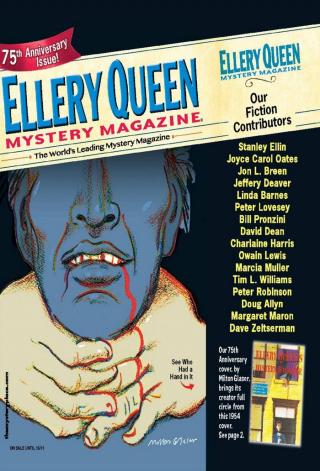
Ellery Queen’s Mystery Magazine. Vol. 148, Nos. 3 & 4. Whole Nos. 900 & 901, September/October 2016
- Автор: Дивер Джеффри, Эллин Стенли
- Год: 2016
- Язык: английский
- Год: Penny Publications
- ISBN: 0013-6328
- Жанр: Другие детективы

Электронная книга - «Ellery Queen’s Mystery Magazine. Vol. 148, Nos. 3 & 4. Whole Nos. 900 & 901, September/October 2016». Краткое содержание книги:
The warmth in the cabin and the work he’d done on the schoolteacher had drained his energy. He made his way to the sofa before his legs gave out from beneath him. Grunting from the effort, he rolled Salt-and-pepper’s corpse from the couch, heard his head thwack off the coffee table, and then dropped down on the cleanest cushion he could find.
The girl stared at her boyfriend’s body and then stroked her son’s head. “Why did you kill him?” she asked. “What’s wrong with you? I don’t understand why you had to do this.”
Her words came in a tumble and then she fell quiet again, her mouth quivering a little. Ezell frowned at the question.
“He shouldn’t beat on you,” he finally said. “A thing like that ain’t right. I got a daughter. A man did the same thing to her once.” He gestured down at Salt-and-pepper’s corpse. “This one here got off easy.”
“You killed him because of me?” she asked, her voice cracking at the end. “You didn’t do that, did you? Not because of me.”
“I did it for a lot of reasons, but mainly because I wanted to, I guess.”
“I don’t understand,” she said. “I don’t know. I just don’t.”
There was a half pack of USA Gold on the coffee table. Ezell shook out a cigarette, leaned forward, and patted the dead man’s pockets until he found a lighter. He breathed smoke deep into his lungs and held it until his eyes watered, enjoying the bite of the tobacco. He was almost ready to begin.
“You got any beer in the fridge? It don’t matter what kind as long as it’s cold.”
She stared at him, open-mouthed, but finally said, “There’s a six-pack, I think.”
“Bring me a couple, hon.” He gestured toward the baby with the tip of his cigarette. “But you leave that one lying on the chair.”
“Don’t hurt him, okay?”
“He’ll be fine as long as you don’t do nothing but bring me those beers.”
She worked herself free from the baby’s mouth, but he was too full and sleepy to put up a protest. When she laid him on the chair, he kicked his legs and cooed a little, burped of his own accord, and fell silent. All in all he seemed like a pretty good baby, the kind, Ezell thought, that Sarah would have had.
When the girl came back, she stood by the arm of the couch, a sixteen-ounce can of Milwaukee’s Best in each hand. Her eyes were as shell-shocked as if she’d been dragged from a battlefield.
“Just give them to me and sit back down,” Ezell said. “It’s all right. Just do what I tell you.” He cracked open one of the beers and took a long, deep drink and let out his breath in a satisfied rush. “I can’t tell you how long it’s been since I’ve tasted a beer.”
The girl picked up her baby, clutched him to her chest, and sat back down. “What do you want from us?” she asked. “I don’t know why you’re here.”
“Just give me a second to get it all together in my head.”
“What does that mean?” she asked. “I don’t understand any of this. I don’t know what you’re talking about.”
“I’m going to tell you who I am, what I’ve done. You got to know everything about all of it or at least all of it I can remember.”
“I’m not sure I want to listen.”
“Doesn’t matter what you want. I’m the one with the gun in his hand,” he said. “And you have to hold onto it. I ain’t got much mind left. That’s what the doctors say, and I reckon they’re right.” He shook his head. “You know, it took me three times to remember how to tie my boots, and me a grown man. I been tying my shoes since I was five years old, but now I can hardly remember how to work the laces. That’s why you got to hold onto all this. You’re the only one who will know once them shadows overtake me.”
He spoke of himself as a boy, of things he’d done, thoughts he’d had. He told her of the blond woman and the child who had died in this very cabin. He spoke of hitchhikers and truck-stop waitresses, of bodies dumped in rivers and landfills. He told her everything he could remember. Then he fell silent. His exhaustion, the heat, and the beer made him drowsy. His muscles relaxed, his chin sank to his chest.
Later, he woke alone to the distant sound of sirens and wiped at the tingling in his face with the back of his hand. He found himself in a strange room in an uncertain place. It felt familiar, but he couldn’t say why. He knew he didn’t live here. He stood on aching legs and made his way to the door.
When he stepped outside, a blast of cold air burned his lungs, and he trembled. The sirens were growing louder, but he couldn’t think of what that might mean or why he should care. He looked to the river, felt a sliver of recognition. Something terrible had happened here. He didn’t know what it was or when it had occurred, but he was sure there had been some sort of tragedy. He felt the pull of the water and thought of walking to its edge in the hope it would clear his clouded head, but it was cold, and he was tired. None of it seemed worth the effort, so he sat on a small back stoop and hugged himself against the chill.
A couple of minutes later, he saw red and blue lights through the bare tree branches, but looking at them hurt his head, so he turned his attention back to the river. He thought of all that dark water moving from here to somewhere else. Somehow he found it a comfort. He studied the chop and the whitecaps as if their very motion held an answer to a question he hadn’t known to ask. The sirens and the flashing lights were nearly on him now. Something had happened here. He knew that for sure, but he couldn’t remember what it was or why he’d ever thought it was a tragedy.
The Village That Lost Its Head
by Peter Robinson
Winner of the best-short-story Edgar for his 11/00 EQMM story “Missing in Action,” Peter Robinson may be best known to EQMM readers today as the author of the DI Alan Banks novels, which have been made into a TV series for the U.K.’s ITV and shown on PBS. The fifth season of the TV series, starring Stephen Tompkinson, is currently in production. This new Banks story is set, like the rest of the series, in the author’s native Yorkshire.
DCI Alan Banks knelt by the body in the stocks and stared into its empty eye sockets. Despite the ungodly hour, a small crowd had already gathered around the borders of Fortford village green. As people pushed up against the crime-scene tape and craned their necks to see what was going on, the local Police Community Support Officers were doing their best to keep order as two CSIs struggled to erect a canvas screen around the body. DI Annie Cabbot and DS Winsome Jackman were already in the crowd asking questions. Beyond the murmur of voices, Banks could hear the dawn chorus from the trees and hills. Already the low sun was warm enough to bring out a sheen of sweat on his forehead.
Banks heard his knees crack as he stood up to look behind, where he saw that the man was sitting on a wooden stool about three feet high. The stocks were of the pillory kind, with holes for legs, hands, and head. Anyone locked in between the hinged wooden boards would hardly be able to move. They were large enough that he wasn’t bent quite double, but had he been alive he would have been hellishly uncomfortable after a few hours of such imprisonment.
Banks looked at his watch as he gently touched the victim’s jaw and neck to make sure his theory about rigor was correct. They had hardened. In general, he knew, the facial muscles began to stiffen about two or three hours after death. It had been a warm night, which would have speeded up the process, and judging by the stage they had reached now, Banks estimated time of death at maybe four to six hours ago. As it was now just after six o’clock in the morning, the man had probably died around midnight, give or take an hour. Which made sense. Banks didn’t know at that point whether he had been killed in the stocks or put there after his death, but it was more than likely that, whatever the sequence of events, they had taken place after dark.