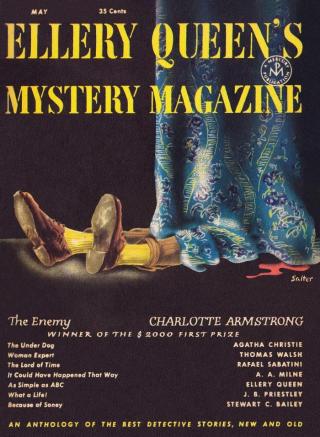
Ellery Queen’s Mystery Magazine. Vol. 17, No. 90, May 1951
- Автор: Кристи Агата, Куин (Квин) Эллери
- Год: 1951
- Язык: английский
- Год: Mercury Publications
- Жанр: Другие детективы

Электронная книга - «Ellery Queen’s Mystery Magazine. Vol. 17, No. 90, May 1951». Краткое содержание книги:
He heaved a sigh of exasperation.
“You press admirably the trousers, George,” he said, “but the imagination you possess it not. Get up and let me take your place.”
Poirot in his turn sat down at the writing table.
“I write,” he declared, “I write busily. You Steal up behind me, you hit me on the head with the club. Crash! The pen slips from my fingers, I drop forward, but not very far forward, for the chair is low, and the desk is high, and, moreover, my arms support me. Have the goodness, George, to go back to the door, stand there, and tell me what you see.”
“Ahem!”
“Yes, George?” encouragingly.
“I see you, sir, sitting at the desk.”
“Sitting at the desk?”
“It is a little difficult to see plainly, sir,” explained George, “being such a long way away, sir, and the lamp being so heavily shaded. If I might turn on this light, sir?”
His hand reached out to the switch.
“Not at all,” said Poirot sharply. “We shall do very well as we are. Here am I bending over the desk, there are you standing by the door. Advance now, George, advance, and put your hand on my shoulder.”
George obeyed.
“Lean on me a little, George, to steady yourself on your feet, as it were. Ah! Voilà.”
Hercule Poirot’s limp body slid artistically sideways.
“I collapse — so!” he observed. “Yes, it is very well imagined. There is now something most important that must be done.”
“Indeed, sir?” said the valet.
“Yes, it is necessary that I should breakfast well.”
The little man laughed heartily at his own joke.
“The stomach, George; it must not be ignored.”
George maintained a disapproving silence. Poirot went downstairs chuckling happily to himself. He was pleased at the way things were shaping. After breakfast he made the acquaintance of Gladys, the third housemaid. He was very interested in what she could tell him of the crime. She was sympathetic toward Charles, although she had no doubt of his guilt.
“Poor young gentleman, sir, it seems hard, it does, him not being quite himself at the time.”
“He and Miss Margrave should have got on well together,” suggested Poirot, “as the only two young people in the house.”
Gladys shook her head.
“Very stand-offish Miss Lily was with him. She wouldn’t have no carryings-on, and she made it plain.”
“He was fond of her, was he?”
“Oh, only in passing, so to speak; no harm in it, sir. Mr. Victor Astwell, now he is properly gone on Miss Lily.”
She giggled.
“Ah vraiment!”
Gladys giggled again.
“Sweet on her straight away he was. Miss Lily is just like a lily, isn’t she, sir? So tall and such a lovely shade of gold hair.”
“She should wear a green evening frock,” mused Poirot. “There is a certain shade of green—”
“She has one, sir,” said Gladys. “Of course, she can’t wear it now, being in mourning, but she had it on the very night Sir Reuben died.”
“It should be a light green, not a dark green,” said Poirot.
“It is a light green, sir. If you wait a minute I’ll show it to you. Miss Lily has just gone out with the dogs.”
Poirot nodded. He knew that as well as Gladys did. In fact, it was only after seeing Lily safely off the premises that he had gone in search of the housemaid. Gladys hurried away, and returned a few minutes later with a green evening dress on a hanger.
“Exquis!” murmured Poirot, holding up hands of admiration. “Permit me to take it to the light a minute.”
He took the dress from Gladys, turned his back on her and hurried to the window. He bent over it, then held it out at arm’s length.
“It is perfect,” he declared. “Perfectly ravishing. A thousand thanks for showing it to me.”
“Not at all, sir,” said Gladys. “We all know that Frenchmen are interested in ladies’ dresses.”
“You arc too kind,” murmured Poirot.
He watched her hurry away again with the dress. Then he looked down at his two hands and smiled. In the right hand was a tiny pair of nail scissors, in the left was a neatly clipped fragment of green chiffon.
“And now,” he murmured, “to be heroic.”
He returned to his own apartment and summoned George.
“On the dressing-table, my good George, you will perceive a gold scarf pin.”
“Yes, sir.”
“On the washstand is a solution of carbolic. Immerse, I pray you, the point of the pin in the carbolic.”
George did as he was bid. He had long ago ceased to wonder at the vagaries of his master.
“I have done that, sir.”
“Тrès bien! Now approach. I tender to you my first finger; insert the point of the pin in it.”
“Excuse me, sir, you want me to prick you, sir?”
“But, yes, you have guessed correctly. You must draw blood, you understand, but not too much.” George took hold of his master’s finger. Poirot shut his eyes and leaned back. The valet stabbed at the linger with the scarf pin, and Poirot uttered a shrill yell.
“Je vous remercie, George,” he said. “What you have done is ample.”
Taking a small piece of green chiffon from his pocket, he dabbed his linger with it gingerly.
“The operation has succeeded to a miracle,” he remarked, gazing at the result. “You have no curiosity, George? Now, that is admirable!”
The valet had just taken a discreet look out of the window.
“Excuse me, sir,” he murmured, “a gentleman has driven up in a large car.”
“Ah! Ah!” said Poirot. He rose briskly to his feet. “The elusive Mr. Victor Astwell. I go down to make his acquaintance.”
Poirot was destined to hear Mr. Victor Astwell some time before he saw him. A loud voice rang out from the hall.
“Mind what you are doing, you damned idiot! That case has got glass in it. Curse you, Parsons, get out of the way! Put it down, you fool!”
Poirot skipped nimbly down the stairs. Victor Astwell was a big man. Poirot bowed to him politely.
“Who the devil are you?” roared the big man.
Poirot bowed again.
“My name is Hercule Poirot.”
“Lord!” said Victor Astwell. “So Nancy sent for you, after all, did she?”
He put a hand on Poirot’s shoulder and steered him into the library.
“So you are the fellow they make such a fuss about,” he remarked, looking him up and down. “Sorry for my language just now. That chauffeur of mine is a damned ass, and Parsons always does get on my nerves, blithering old idiot.
“I don’t suffer fools gladly, you. know,” he said, half apologetically, “but by all accounts you are not a fool, eh, M. Poirot?”
He laughed breezily.
“Those who have thought so have been sadly mistaken,” said Poirot placidly.
“Is that so? Well, so Nancy has carted you down here — got a bee in her bonnet about the secretary. There is nothing in that; Trefusis is as mild as milk — drinks milk, too, I believe. The fellow is a teetotaler. Rather waste of your time, isn’t it?”
“If one has an opportunity to observe human nature, time is never wasted,” said Poirot; quietly.
“Human nature, eh?”
Victor Astwell stared at him, then he flung himself down in a chair.
“Anything I can do for you?”
“Yes, you can tell me what your quarrel with your brother was about that evening.”
Victor Astwell shook his head.