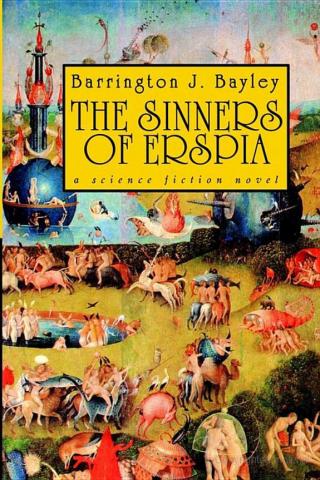
The Sinners of Erspia
- Автор: Бейли Баррингтон Дж.
- Год: 2011
- Язык: португальский
- Жанр: Научная фантастика

Электронная книга - «The Sinners of Erspia». Краткое содержание книги:
The middle one of his five eyes regarded Laedo, who walked closer and stared up at the unhuman face in challenge.
“Why do you carry out experiments on human beings?” he demanded in as loud a voice as he could manage. “Don't you know it's wrong?"
Klystar's head turned slightly, bringing the second eye from the left into line with Laedo. Another turn, and the second eye from the right regarded him. Then the extreme left eye, followed by the extreme right eye.
Laedo was intrigued. Did Klystar's perceptions alter according to the order in which he used his eyes?
“Wrong?” Klystar echoed, his tone heavy with scepticism. “What is the meaning of ‘wrong'?"
“Ethically wrong. Surely you know what ethical means. It is not right to use intelligent beings for your own ends, without their knowledge or consent."
Klystar gave vent to a sigh. Laedo wondered where his voice was coming from. He could see no mouth.
“First of all, your species is not intelligent in the proper meaning of the word,” Klystar said. “An intelligent being has control over his consciousness. He forms his own thoughts and does not allow others to form them for him. His mental state is not at the disposal of others. This is not so in your case, is it?"
“We are a social species,” Laedo argued. “We don't live in isolation. We interact with one another."
“Yes, I am familiar with your social organisation. It is a feature of the lower orders of life. You are the mammalian parallel of the social insects—ants, bees and termites, to name those that occur on your original Earth. The only difference is that where you are concerned the social phenomenon incorporates a mild degree of intellectual functioning. But no human being would have any intellectual functioning at all were he raised outside human society."
“And you would?” Laedo asked in amazement.
“One of my kind, if born and left to develop without any company or education, would grow up fully conscious and with full reasoning ability. That is the case with all the intelligent species which I-Klystar have encountered, with the sole exception of yours. That is why I-Klystar took the trouble to study you.
You are a curiosity. You are a species which can think, to some extent, and yet which lacks inner determination."
Klystar's eyes shifted again. “The condition can be attributed to your species having evolved too quickly.
Your native biosphere is less than four billion years old. Ten billion years is the normative time frame in which to evolve an intelligent species. A series of accidents on the Earth home world would appear to be responsible for this premature development. Your scientists must have wondered why your galaxy rarely contains anything higher than animal life."
“Yes, they have,” Laedo admitted thoughtfully. Klystar was right. The galaxy abounded with life, but nowhere did it get any further than the equivalent of a mouse or a horse or a lizard, or a fish or even a bacterium. And yet many of the biospheres examined were much older than Earth's.
Astronomers had come up with an explanation which tended to agree with Klystar's assertion. The planets and moons of the solar system were heavily cratered as a result of long-term bombardment by asteroids and meteorites. It came as a surprise to discover that the same had not happened to other planetary systems, which had known more peaceful and orderly histories. Something unusual must have happened to the solar system early on. It was now accepted that there really had once been a planet between Mars and Jupiter, and that it had disintegrated, filling the system with dangerous debris. While evolution elsewhere proceeded at a sedate pace, on Earth it had been forced to cope with recurrent catastrophes—mass extinctions from asteroid strikes which sometimes had nearly extinguished the biosphere altogether. The repeated twists and turns of fate had accelerated evolutionary change.
What could have shattered a planet? Collision between neighbouring worlds, while possible, would not have scattered the fragments far and wide, as had happened. They would have slumped back together by self-gravitation. Something more energetic was needed, and for that one had to look outside the solar system. The current hypothesis was that an interstellar intruder, zipping through the solar system with enormous velocity from high above the ecliptic plane, was the culprit.
Collision was more plausible if a cluster of interstellar transients was involved. Another might have struck Uranus a glancing blow, tilting its axis to its present unusual alignment nearly parallel to its orbital plane.
So far so good. But for the accident to have resulted in a premature and half finished mankind, flawed, inadequate, below the cosmic standard, was a new and unwelcome idea.
“Come with me,” Klystar said. “I-Klystar will show you what I mean."
He resumed striding down the rubble-strewn slope. Laedo followed. Once they neared the valley floor, the crater's panorama vanished. The horizon intervened, leaving only the lip of the crater wall visible to the eye.
Klystar's approach had been noticed. A crowd of people poured from the barracks and fields to welcome him. They reminded Laedo of primitives on some island paradise, naked except for a simple piece of white cloth worn around the waist, by both men and women. They fell to their knees before Klystar, placing their hands together in an attitude of prayer.
A hoarse, windy voice arose from one of the older men.
"We have buried our dead, O Klystar! How have we failed?"
In a stentorian voice, completely different from the one he had used when speaking to Laedo, Klystar answered.
"YOU HAVE NOT HAD ENOUGH FAITH! BEGIN AGAIN! HAVE MORE FAITH! YOU MUST
BEGIN A NEW TOWER TOMORROW!"
A chant grew from the crowd. "We will have faith! We will begin again!"
The crowd melted away as the people returned from whence they had come.
“Look at those idiots,” Klystar said quietly. With one of his four thin lank arms he pointed to the nearest pile of ruins on the horizon. It appeared to be the base of a tower, surrounded by tumbled stone. “For generations I-Klystar have been telling them to build a tower twenty miles high so that they can climb up it to heaven. It is manifestly impossible to build a tower that high with the materials available. On reaching a certain height it collapses and kills large numbers of the builders. Yet do they ever lose faith in me? Do they tell themselves that I-Klystar might be lying and perhaps am not even a god, as they think? No, they do not. They begin again. And simply because my personality is stronger than theirs."
Such cynicism appalled Laedo. But he was also puzzled. Why should the mighty Klystar, whose deeds were so awesome, come to resemble a corny Jehova?
At the same time there was something odd in the way the alien being referred to himself as ‘I-Klystar'. Or was it ‘I/Klystar'?
An inspired thought came to him. He blurted it out immediately.
“You're not Klystar at all, are you? What are you? A robot proxy? Or a biological one, perhaps?"
'Klystar’ paused, before he answered, his tone neutral and matter-of-fact. “You have acuity, for a member of an inferior race,” he congratulated. “No, I-Klystar am not a proxy. I am a relic. To be exact, I am Klystar's body. Klystar himself, that is to say his mind, or essence, is away journeying. Methods for moving material objects, such as those used by your starships, are not fast enough for his requirements.
He uses a technique which abstracts the individual from his corporeal form and expresses him as a pattern of consciousness and thought. This can be instantaneously transferred to an immense distance."
“How?"
“By a means known as Immediacy of Thought. It would be tiresome to explain."
“What happens at the other end?"
“A replacement body is needed as an instrument of action. Klystar forms one from available materials where this is possible. Or he may arrange for one to be constructed beforehand."