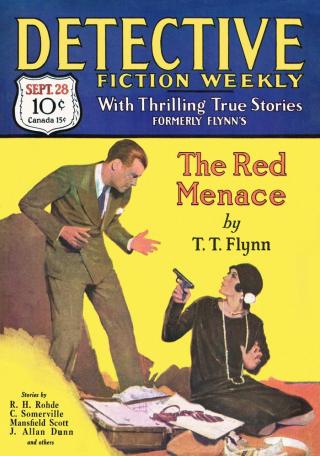
Detective Fiction Weekly. Vol. 44, No. 5, September 28, 1929
- Автор: Dunn J. Allan, Flynn T. T.
- Год: 1929
- Язык: английский
- Год: Red Star News Company
- Жанр: Другие детективы

Электронная книга - «Detective Fiction Weekly. Vol. 44, No. 5, September 28, 1929». Краткое содержание книги:
“I gather that she is disappointed with captains of industry.”
Trent was glad to see Nurse Gregory. He had obtained the information for which he had come and was now anxious to see Hubbard who was even now in the house, but in bed with the after effects of influenza.
Hubbard was glad to see him. Now that John Addison was gone, the old man needed some strong man from whom to derive comfort. And he felt that his blameless senescence was being vilified by the police. Especially by Mallon who licked his lips every time he saw him and sought to entangle him in long cross-examinations.
“I’ve been through a lot, sir,” he said, tears in his faded eyes, “since you left me at Fairhaven. I used to think Mr. Roger’s teasing was bad enough, but he’s an angel compared with Mallon and I am bound to say he’s behaving very well now. I guess it’s Miss Cynthia’s influence.”
“I suppose,” Trent said, wasting no time in arriving at his point, “that you disliked Marcus North principally because he used to bully Mr. Addison?”
“And,” Hubbard cried with a touch of his old acidity, “because he used to play practical jokes on me. I never saw a boy who had so many ways of bothering you. I’ve always had this room since I took service with Mr. John’s father and you’d think nobody could get in here when the door was locked, but that Marcus, he got in one time and sawed the wooden legs of my bed nearly off so that when I climbed in they collapsed. And I got blamed for it. I had a Yale lock put on the door so I could keep my room to myself and Marcus couldn’t get in. I was the only one who had a key. Marcus swung himself on to the roof from a tree. There were trees all around the house then. Tall trees. I don’t know what sort. I’m not interested in trees and I wasn’t the one to raise a holler when Mrs. Addison had them cut down. I felt safer. That boy could get in anywhere, no matter whether the windows were barred or the doors locked.”
“And Mr. Addison followed suit?”
“In the early days he fairly worshiped his cousin. Yes, he tried everything Marcus did and nearly broke his neck doing it, but he wouldn’t give in and Marcus was always trying stunts that he hoped Mr. John would fail in. A lot he cared if any one broke their necks.”
“Well.” Trent said, “death got him at last. Did any of the family go to the funeral?”
“Mr. John did, I think, but it wasn’t a subject to talk about. The North’s and the Addisons hold their heads high and they didn’t want any publicity of that sort. A pretty penny it cost Mr. John to buy silence, I’ve heard. It’ll be six years on my birthday that he died, and I was born the same day Washington was. Mr. Roger used to say it was the same year, but that was his exaggeration.”
“What I came to see you about,” Trent said, and spoke only half a truth, “was about the necessity to employ a good lawyer.”
Hubbard’s obstinate jaw was thrust out. He was conscious of his innocence and did not think truth needed any assistance. Trent pooh-poohed this naive theory. “You, more than any one else, need a good lawyer. Nothing convinces the ordinary jury less than bare truth. It is so unreasonable as a rule, whereas the clever lie carries conviction with it. I’ve already arranged for a good man to look after your interests. I don’t anticipate any trouble, but the police have to have some one to exhibit and you made a mistake in attacking Mr. Ellis.”
“I know,” the old man admitted, “but I was out of my mind with worry at the time. I’ve apologized to him, Mr. Trent, and I will say he showed himself the gentleman. Shook my hand and said the whole family were grateful to me for my loyalty. It was after that, feeling good, you understand that this Mallon said I insulted him. Perhaps I did.” Hubbard smiled as he thought of his splendid sarcasm toward authority as exemplified by Detective Mallon. “I guess what I said was a bit above him.”
Trent did not stay long at the Mill House. After the first cold snap and snow the weather became mild and the meteorological bureau — that faithful and unjustly abused public servant — promised a continuance of it.
“Golf calls me,” said Trent to Barton Dayne, “and as my wife won’t be back until Christmas I am going to see what those new links at Hillsbro are like. They’ve been chosen for the National next year so they’re certain to be first class. I may be down here at any moment.”
“Your bed and board awaits you,” Dayne said, “and you’ll be the most welcome guest in the world.” He hesitated a moment. “Does this mean you’re giving up the Addison case?”
“I have allowed Inspector Edwards to think I am retiring, vanquished. It has done a lot to restore his self-confidence. But, my dear Barton, privately, do you think I’m the sort to give up things?”
Dayne looked into the keen face and shook his head. “No.”
“Golfing with me is often a way of getting information. I’ve asked Roger to keep me posted as to what happens. Just now the police are doing good work and work that I couldn’t hope to equal them at. Their theory is that Addison was killed and is buried in the woods or old quarries somewhere near the house. Naturally that search takes a lot of time and men. It may very well be that they find the body. That will be their triumph.”
“And what will yours be?”
“I should like to find the man who killed him.”
“Edwards says if they find the body they’ll get the murderer.”
Anthony Trent was not inclined to be communicative. “Edwards has his moments,” he said, “but that was not one of them. It’s a cliche to say that dead men tell no tales, but it’s worth remembering if Edwards has another burst of hope.”
“It beats me,” Dayne said, reverting to golf, “why you don’t go in for the big tournaments. You’d land in the first six, I’d bet.” He was not to guess those reasons which drove Anthony Trent to remain little known and wholly unphotographed. In the early, wild days he had met men who might still be able to identify him if his photographs stared from the papers and magazines. And since, in these days, we pay so much more homage to supremacy in sport than to any intellectual achievement, his decision was wise. But what Dayne had said was true. It would take one of the celebrated golfers to beat him.
“I haven’t energy to keep perpetually in trim,” he answered, “and I’m getting more and more interested in aviation. I’ve got three hundred flying hours to my credit already.”
Thomas Perkins was not forgotten. Trent drove into the paved yard where he left his car before taking his farewell of the Addisons. “I want you to report to me on what you personally observe the police to be doing,” he said. “Here’s my address.”
“They’re still searching the quarries,” the chauffeur told him “and they’ve dragged every pond in the county. There won’t be much to tell.”
“They may find the body,” Trent answered. “They probably will if it’s anywhere near. Edwards is thorough, though uninspired.”
“I’ve got the letter from the Zodiac people,” Perkins said. “I don’t know how to thank you. They offer me a splendid position from the first of the year. I’m afraid you exaggerated my abilities.”
“It’s up to you to preserve my reputation,” Trent retorted. “I’m not worrying about that. I haven’t made many mistakes in the men I’ve picked. I’ve just come from Elm Falls. Dayne is turning out to be a business genius who would, but for a little luck, have tried to be a college professor. I’m cashing in on him already and I shall on Captain Evvyndike, too. I’m at heart a rapacious and mercenary type.”
Thomas Perkins, soon to cease the driving and cleaning of other men’s cars, looked after him with gratitude in his heart. It was still inexplicable why this Anthony Trent should have given him this opportunity, but it had nothing to do with mercenary motives. So long as one played fair with this man with the keen eyes and the hawk profile one had nothing to fear. That his tongue could be sharp Perkins had found when he heard him talk to Mallon. Perkins turned again to the polishing of a panel of the big limousine. It was hard work to make its luster match that other panel upon which his former helper had spent so many hours.