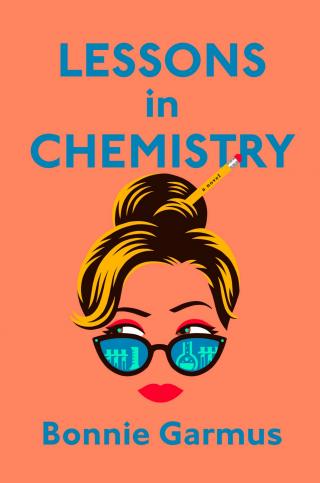
Lessons in Chemistry
- Автор: Garmus Bonnie
- Год: 2022
- Язык: английский
- Год: Doubleday Canada
- Жанр: Современная русская и зарубежная проза

Электронная книга - «Lessons in Chemistry». Краткое содержание книги:
No. Kim was too short.
And then he thought, What about Madeline? Elizabeth had read him Remembrance of Things Past—he couldn’t really recommend it — but he had understood that one part. The part about the madeleine. The biscuit. Madeline Zott? Why not?
“What do you think of the name ‘Madeline,’ ” Elizabeth asked him after finding Proust inexplicably propped open on her nightstand.
He looked back at her, his face blank.
—
The only problem was, getting Mad’s name changed to Madeline required a trip to city hall, and once there, a form that demanded a marriage certificate and several other details Elizabeth wasn’t very excited to share. “You know what?” Elizabeth said, meeting Six-Thirty on the stairs just outside the building. “We’ll just keep this between ourselves. She’s legally Mad, but we’ll call her Madeline and no one will be the wiser.”
Legally Mad, Six-Thirty thought. What could possibly go wrong?
—
The other thing about Mad: she got really mad when the Hastings people dropped by. “Colicky,” Dr. Spock would have diagnosed. But Elizabeth thought it might be that the baby was a good judge of character. Which worried her. Because what, then, would she think of her own mother’s character? A woman who didn’t speak to her family, who’d refused to marry a man she deeply loved, who’d gotten fired from her job, who spent her days teaching her dog words? Would she seem selfish or crazy or both?
She wasn’t sure, but she had a feeling that the woman across the street would know. Elizabeth wasn’t one for church, but there was something holy about Harriet Sloane. She was like a practical priest, someone to whom one could confess things — fears, hopes, mistakes — and expect in return, not a simpleton’s recipe for prayers and beads, or a psychologist’s standard “And how does that make you feel?” runaround, but actual wisdom. How to get on with the business at hand. How to survive.
She picked up the phone, unaware that Harriet’s binoculars were already confirming the dialing pattern from her front window.
“Hello?” Harriet answered casually as she forced her binoculars back between the sofa cushions. “You’ve reached the Sloane residence.”
“Harriet. This is Elizabeth Zott.”
“Be right over.”
Chapter 19
December 1956
The biggest benefit in being the child of a scientist? Low safety bar.
As soon as Mad could walk, Elizabeth encouraged her to touch, taste, toss, bounce, burn, rip, spill, shake, mix, splatter, sniff, and lick nearly everything she encountered.
“Mad!” Harriet shouted every morning as she let herself in. “Put that down!”
“Down!” Mad agreed, flinging a half-filled coffee cup across the room.
“No!” shouted Harriet.
“No!” agreed Mad.
As Harriet fetched the mop, Madeline teetered into the living room, picking up this, discarding that, her grubby little hands automatically reaching for the too-sharp, too-hot, too-toxic, the things most parents keep out of reach on purpose — in short, the best things. Nevertheless, she lived.
It was because of Six-Thirty. He was always there, sniffing out danger, blocking light sockets, positioning himself beneath the bookshelf so when she scaled it — which she did nearly every day — he would be the cushion that broke her fall. He’d failed once to protect someone he loved. He would not fail again.
“Elizabeth,” Harriet scolded her. “You can’t just let Mad do whatever she wants.”
“You’re absolutely right, Harriet,” Elizabeth said without taking her eyes off three test tubes. “You’ll notice I’ve moved the knives.”
“Elizabeth,” Harriet implored. “You have to watch her. I found her crawling into the washing machine yesterday.”
“Don’t worry,” Elizabeth said, still staring at the test tubes. “I never start a load without checking first.”
—
Yet despite her constant state of alarm, Harriet could not dispute that Mad seemed to be growing in ways her children never had. Even more unusuaclass="underline" the mother-daughter relationship had a symmetry Harriet could not ignore. The child learned from the mother, but the mother also learned from the child. It was like a mutual adoration society — you could see it in the way Mad looked at Elizabeth when she was being read to, the way she crowed when her mother whispered in her ear, the way Elizabeth beamed when the child combined baking soda with vinegar, the way they constantly shared whatever they were thinking and doing — chemistry, babble, drool — sometimes using a sort of secret language that felt to Harriet just a bit exclusionary. One could not — should not — be one’s child’s friend, she’d warned Elizabeth. She’d read that in one of her magazines.
She watched as Elizabeth popped Mad up onto her lap, then held her close to the bubbling test tubes. The child’s eyes filled with wonder. What had Elizabeth called her teaching method? Experiential learning?
“Children are sponges,” Elizabeth explained the previous week as Harriet chided her for reading aloud to Madeline from On the Origin of Species. “I’m not about to allow Mad to dry out early.”
“Dry,” Mad shouted. “Dry, dry, dry!”
“But surely she can’t understand a word of what Darwin wrote,” Harriet argued. “At the very least, couldn’t you read her the abridged version?” Harriet only ever read abridged versions. Reader’s Digest was her favorite publication for that very reason — they cut big boring books down to a chewable size like St. Joseph aspirin. She once overheard a woman in the park saying she wished Reader’s Digest would condense the Bible, and Harriet found herself thinking, Yes — and marriages.
“I don’t believe in abridgments,” Elizabeth said. “Anyway, I think Mad and Six-Thirty enjoy it.”
That was the other thing — Elizabeth read to Six-Thirty, too. Harriet was fond of Six-Thirty; in fact, sometimes she felt like she and the dog shared similar worries about Elizabeth’s que será, será approach to parenting.
“I wish you could talk to her,” Harriet told him more than once. “She’d listen to you.”
Six-Thirty looked back at her, exhaling. Elizabeth did listen to him — obviously communication was not limited to conversation. Still, he sensed that most people did not listen to their dogs. This was called ignoring. Or wait, no. Ignorance. He’d just learned that one. By the way and not to brag, but his word count was up to 497.
—
The only person besides Elizabeth who didn’t seem to underestimate what a dog understood, or what it meant to be a working mother, was Dr. Mason. As threatened, he dropped by her home about a year after the delivery, ostensibly to see how things were going, but more obviously to remind her about his boat.
—
“Hello, Miss Zott,” he said as she opened the door at seven fifteen a.m., astonished to see him there, in his rowing kit, his crew cut damp from a hard row in the morning fog. “How are things? Not to make this about me, but I had the most godawful row this morning.” He stepped in and walked past her, casually fighting his way upstream through the litter of babyhood until making it to the lab, where he found Mad contemplating her escape from her high chair.