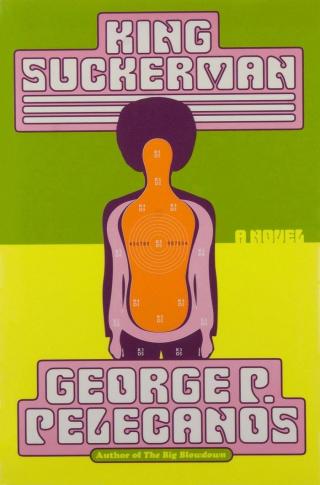
King Suckerman
- Автор: Пелеканос Джордж
- Серия: D.C. Quartet #2
- Год: 1997
- Язык: английский
- Год: Little, Brown and Company
- ISBN: 978-0-316-69590-9
- Жанр: Триллеры

Электронная книга - «King Suckerman». Краткое содержание книги:
Karras walked past the bank of TVs, most of which appeared to be Sonys, that year’s hot number. Yul Brynner’s image — Brynner, with hair! — appeared on all the sets in a two-shot with a bored-looking Robert Mitchum. It was difficult to tell if Mitchum was asleep or awake. This was the one about Pancho Villa, though Karras couldn’t remember its name, and Charlie Bronson was in it, too. It was Yul Brynner Week on Money Movie Seven, and MAL had been running Brynner pictures every day.
Karras went down a long aisle that split the store. Signage and accent striping gave him the impression that everything around him, including the merchandise, was either gold or red. He felt like he was peaking in a gold-and-red-tinted trip. To the right of the center aisle were major and small appliances, and to the left were televisions and stack-and-sell ACs. The ACs blew brightly colored tongues of streamers at him as he passed. He had gotten the message out on the sidewalk — it was midsummer, and these guys had air conditioners to sell. Overkill seemed to be the intention at Nutty Nathan’s
The aisle ended at a hastily arranged group of metal desks separated by cushioned dividers. An Arab-looking gentleman — his nose was large, his complexion rather dark — sat in a chair with his feet up on one of the desks. He appeared to be sleeping with a smile on his face. He opened his bloodred eyes halfway, but only for a moment, and nodded at Karras slowly, very slowly, before closing them and issuing a deep and contented sigh.
Karras walked into a darkened area of the store housing cheap compacts and components, where a banner reading “Sound Explosion” hung. He heard “Any Major Dude Will Tell You” coming from a room separated from the rest of the stereo equipment by sliding glass doors. One of the doors was open, and Karras stepped inside.
A short wide-shouldered guy with his hair pulled back and banded in a ponytail stood in front of a receiver nodding his head to the music. The music sounded clear and bass-heavy; you could hear the pluck of the strings against the fret. In the darkness, the blue and orange display lights made the equipment look sexy and sleek. A row of floor speakers arranged in ascending height fanned out and seemed to embrace the ponytailed dude wearing a gold jacket.
The guy turned around, noticed Karras. “Hey.”
“Hey.”
“What’s happenin’, man?” Like the didn’t-give-a-fuck cat out in the lot, this one obviously recognized Karras as a fellow stoner.
“Nothin’ much.”
Karras went forward, shook the guy’s hand. His name tag said, “Hi, my name is Jeff Fisher.” His jacket was soiled and smelled of cigarettes and weed. A coat-of-arms patch had been sewn on the breast pocket, an embroidery displaying a microwave oven, stereo system, and television set. His gold tie featured the same design; the tie looked as if it doubled on occasion as Fisher’s napkin.
“My name’s Dimitri Karras. I’m a friend of the Stefanos family. Is Nick working today?”
“He’s downstairs in the stockroom on his break,” said Fisher, whose mouth turned up in an ingratiating two-bong grin. This Fisher dude was higher than Neil Armstrong. A half-smoked cigarette was lodged firmly behind his right ear. “I’ll get him if you’d like.”
“That would be good.”
“Wanna hear something first?”
Karras shrugged. “Okay.”
Fisher lifted the dust cover of the working turntable, took the needle off of Pretzel Logic, slipped a cassette tape into a nearby deck. He went to a master switching box, pushed in a black button, then returned to a tall Marantz receiver and started punching buttons and twisting treble and bass dials mounted below the radio band. He moved quickly, excitedly, like every audiophilic pothead Karras had ever known.
“Gotta hear this through the 901s,” said Fisher, jerking his head toward a relatively small Bose speaker that sat up on a pedestal base.
The music began. Karras recognized it as the intro to Curtis Mayfield’s “If There’s Hell Below,” the one where Curtis is shouting, “Niggers... Whiteys... Jews...” against some acid guitar, bongos, and echo effects right before the jam really kicks in. But on this tape, the Curtis vocals had been mixed out, replaced by the voice of another black singer, this one in the Eddie Levert mold, the rhythm track just pumping along. It was the same song, basically, but with a different singer, and way different lyrics:
You Jewish bastards, you know your dicks are disasters.
You Nigger dudes, you know you fuck real rude.
You Chinese bitches, you know you like big switches...
The song went along in that inventive vein, insulting every ethnic group with lewd, unrestrained glee while keeping straight on with the killer groove.
“What the fuck is this?” said Karras.
Fisher smiled. “Guy named Sam, used to work here, cut this track.”
“It’s bad.”
“Damn right it’s bad. Sam was bad, too. He was funnier than a motherfucker, man, and he could write some music and really sing.”
“Was?”
Fisher turned down the volume. “Died about six months ago. His father shot him during a card game. Both of them were drunk.” Fisher blinked his eyes, flicked some skin off his nose. “C’mon, I’ll show you where Nick’s at.”
Karras followed Fisher out of the Sound Explosion. The guy from the parking lot was back in the store now and pitching a cheap Spectracon receiver, talking very fast to an older black man wearing a purple rayon shirt.
“Got to get the rebop on the bebop,” said the salesman.
“Say what?” said the customer.
“Just sayin’ this receiver can put it out.”
The customer stroked the end of his Vandyke. “How many watts this box got?”
“Box got lotsa watts,” said the salesman. “I ain’t kiddin’ you, Jim.”
Karras and Fisher moved out of the stereo department. Karras looked back at the jive-ass salesman with the muttonchop sideburns.
“Who was that?”
“McGinnes.” Short and abrupt, like the name itself said it all.
They walked by the desk where the smiling Arab-looking gentleman sat sleeping. “And him?”
“Phil Omajian,” said Fisher. “Our manager.”
“He looks happy.”
“Down freak. Stays out of our way, though. The best kind of manager you can have.”
They entered a small room housing clock radios, irons, and a heavy metal desk holding paperwork and overflowing ashtrays.
“Hey,” said Fisher, “I almost forgot. You need any sound equipment?”
“No, I’m all right.”
“See me if you do. If I’m not here, we got this new young guy can help you out. Real nice guy. Name’s Andre Malone.”
“Okay.”
Fisher pointed to a lit stairwell. “Nick’s down there.”
“Thanks.”
Karras went down a shaky set of wooden stairs. The musty odor of damp cardboard hit him as he stepped onto a concrete floor littered with warranty cards and cigarette butts.
“Hello!”
“Back here,” came a voice from deep in the stockroom.
Karras walked past rows of cartoned televisions and appliances, all up on pallets, toward the source of the voice. The basement ran the depth of the building and was lit dimly by widely spaced naked bulbs suspended on cords. Near the end of the center row, a teenage kid sat atop a Panasonic color TV carton, grease-stained restaurant wrap and a go-cup scattered around him, his legs dangling off the carton’s side.
“Hey, man,” said the kid.
“Hey.”
The kid jumped down off the carton, landed cleanly on his feet. He shook his shoulder-length hair with a toss of his head.
“What’s happenin’?”
“Nothin’ much. My name’s Dimitri Karras. Friend of your papou’s.”