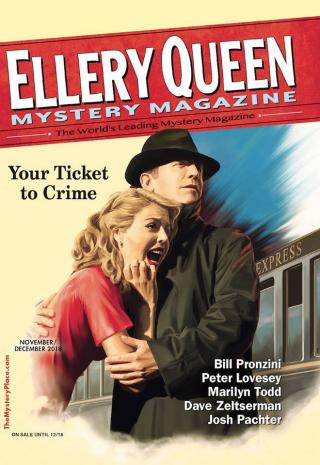
Ellery Queen’s Mystery Magazine. Vol. 152, Nos. 5 & 6. Whole Nos. 926 & 927, November/December 2018
- Автор: Ловси Питер, Зельцерман Дэйв
- Год: 2018
- Язык: английский
- Год: Dell Magazines
- ISBN: 0013-6328
- Жанр: Другие детективы

Электронная книга - «Ellery Queen’s Mystery Magazine. Vol. 152, Nos. 5 & 6. Whole Nos. 926 & 927, November/December 2018». Краткое содержание книги:
Suddenly her father stops short. “Stupid, stupid,” he says, hitting his head.
He sits down abruptly on the curb. Nino sits down beside him. “I should have taken the money.”
The pavement still retains faint heat from the day’s sun. Overhead, bats fly past, emitting faint cries. Her father hides his head in his hands.
Nino stands up and starts walking back to the house. It feels like a long way — somehow longer returning than going. She rings the doorbell, surprised how suddenly calm she’s feeling, and when Jan opens the door, she tells her that she’s come for the money.
Jan goes to get her checkbook while Nino waits silently in the kitchen. Returning, Jan fumbles the checkbook open, presses it flat against the counter, uncaps a pen; Nino observes that her hands are trembling, and she experiences an odd satisfaction in the woman’s discomposure. “How much?” Jan says.
“Five hundred dollars,” Nino says. It’s a number that she plucks from the air, one that sounds large to her ears. She watches as Jan writes the amount, leaving the “pay to” field blank, then signs it and tears it out of the book. When she hands the check to Nino, the woman avoids making eye contact.
“Was that the doorbell?” Richard calls to his wife from the other room.
Nino goes out the door, holding the check in a damp hand. Her father won’t want to take it from her at first, she knows, but he will eventually; what else can he do? It might be enough to cover the costs of the immigration lawyer.
She turns onto the sidewalk. A breeze stirs the tops of the trees. Transformers hum on telephone poles. A few stars shine dimly overhead. When was the last time she’d actually stared up at the night sky? She’s remembering how her father had bought her a telescope for her tenth birthday, how impatient he’d been for darkness to try it out. He’d spent almost an hour getting it set up for her, slapping mosquitoes, making tiny adjustments of the lenses, while she’d read a book on the couch. Come quick, he’d said, running back into the apartment. So she’d followed him outside, into the narrow gravel lot at the rear of the building beside the trash bins. Look, he’d said: Jupiter. She bent down and put her eye to the lens, but saw only darkness. In the time between them, the earth had kept turning, and the planet had fallen away from view. But she’d kept looking through the lens, imagining it hanging like an earring in the velvet of outer space. Do you see it? he’d asked. I do, she’d told him. I see it.
© 2018 by Reed Johnson
50
by Josh Pachter
Fifty years ago this month, Josh Pachter appeared in EQMM’s Department of First Stories, while still a teenager! In the intervening years he’s authored more than sixty stories, many of them collaborations with other authors — making him one of the most successful literary collaborators in our genre. He’s also one of mystery’s foremost translators. To express our congratulations, we’ve posted his 1968 first story on elleryqueemnysterymagazine.com!
The leaves outside his office window had burned, almost without his notice, from green to gold to gone. There were a few stragglers, he saw now, few enough to count.
Professor Griffen found that he was counting them, realized what he was doing, and forced himself to drag his eyes away from the window and back to his computer. From the speakers on either side of the monitor, James Taylor sang about fire and rain, and the coincidence reminded him that he was supposed to be updating his lecture notes on Robert Frost for a generation of students — a giggle of girls, a bluster of boys — whose mental temperature had devolved into such lukewarmth he despaired of ever convincing them that fire and ice were momentous enough to even momentarily divert their attention from their Instagram and Twitter feeds.
There were fewer words on his screen than leaves on the trees, and he felt himself no more capable of adding to the former tally than to the latter.
“Thought I’d see you, thought I’d see you, fire and rain, now...”
James Taylor’s voice faded away, was replaced by “Fifty Years After the Fair,” and not for the first time he marveled at iTunes’s telepathic ability to follow — or lead? — his thoughts.
How, he wondered, could he possibly capture the interest of the teenagers in his freshman lit class? He’d been a teenager himself, once upon a time — but it was fifty years after that fair. Half a century ago, his widowed father and three siblings had clustered around the 19-inch television in the family room to listen to Walter Cronkite tell them about Vietnam on the evening news. Today, with their screens in their pockets and five hundred channels to choose from instead of three, all his students seemed to know or care about was which Kardashian was having sex with which football player or rapper...
“Fifty years after the fair,” Aimee Mann sang, “I drink from a different cup. But it does no good to compare, ’cause nothing ever measures up.”
He turned away again, away from both monitor and window, and let his gaze drift across the spines of his dearest friends, his books, the fat poetry anthologies and slender chap-books and single-author collections he had accumulated over the course of his career.
Perhaps it was the song that steered his fingers to the lineup of old magazines on the bookcase’s bottom shelf. There were several dozen of them, long-ignored souvenirs of his youth. He slid the left-most volume free and held it in his hands, surprised to see how well the green and red and yellow cover had withstood the passing of five decades.
“9 NEW stories,” the bold red letters beneath the yellow words that identified the publication proudly announced. He counted only six writers listed on the cover — Hugh Pentecost, Lawrence Treat, Agatha Christie, Berkely Mather, Celia Fremlin, George Harmon Coxe — then gingerly opened the old magazine and smiled to see his own name included in the table of contents.
A folded sheet of paper tucked between the pages marked the location of his contribution. He’d long since forgotten that editor Frederic Dannay — who, with his cousin Manfred B. Lee, had written those marvelous novels and short stories, beginning way back in the late 1920s — had devoted an entire page of the magazine, page 106, to an introduction.
“Department of First Stories,” he read. “This is the 325th ‘first story’ to be published by Ellery Queens Mystery Magazine... another ‘first’ by a teenager (God bless ’em!)...”
And then, on the facing page, the title and byline:
He sat there, completely absorbed, for fifteen minutes, rereading the story for the first time in — how long? — certainly thirty years, probably forty. It wasn’t bad, really, was actually rather good for the sixteen-year-old he’d been when he wrote it, especially if he compared it to the drivel produced by the majority of his current students, who were two or three years older than he’d been when he’d written it back in 1968.
The professor’s father, Ross Griffen, a homicide detective with the Tyson County Police Department, had been a lifelong fan of detective fiction, and he’d somehow convinced his wife to allow him to name their four children after the heroes — and one heroine — of his literary passion. Sherlock Holmes Griffen, Jane Marple Griffen, Ellery Queen Griffen, and Nero Wolfe Griffen. For the purposes of this, his first short story, young Ellery had expanded the family to eleven children, adding Peter Wimsey, Albert Campion, Parker Pyne, Perry Mason, Augustus Van Dusen, Gideon Fell, and John Jericho to the brood.