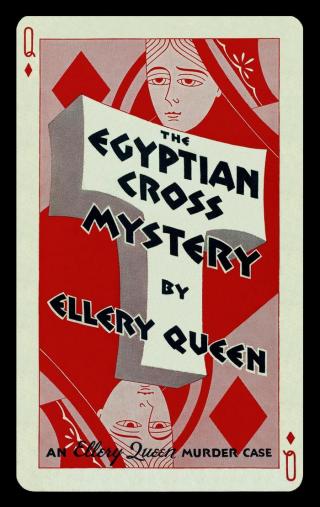
The Egyptian Cross Mystery
- Автор: Куин (Квин) Эллери
- Серия: Ellery Queen #5
- Год: 1932
- Язык: английский
- Год: Frederick A. Stokes Company
- Жанр: Классические детективы

Электронная книга - «The Egyptian Cross Mystery». Краткое содержание книги:
Stallings shrugged with decorum. “The pieces. Of course, their position is different. Mr. Brad naturally played on after I left.”
“Oh,” said Ellery with relief. “That’s excellent, Stallings. You have within you the delicate makings of a Sherlock, the camera eye... That’s all.”
Stallings cast a reproachful look at Stephen Megara, who was staring moodily at the wall and puffing at a West Indian cheroot, and left the room.
“Now,” said Ellery briskly, “let’s scatter.”
“But what the hell do we look for?” grumbled Vaughn.
“Heavens, Inspector, if I knew a search wouldn’t be necessary!”
The scene that ensued would have been ludicrous to any observer except Stephen Megara; that man, it seemed, was minus the faculty of laughter. The spectacle of four grown men crawling about a room on hands and knees, doing their best to climb up the walls and tap plaster and wood, going through the stuffing of the divan’s pillows, wrenching experimentally at the legs and arms of chairs, divan, secretary, checker-table... an Alice-in-Wonderland situation. After fifteen minutes of fruitless search Ellery, rumpled, hot, and much annoyed rose and sat down by Megara’s side, to sink instantly into a reverie. The daydream was, from the expression on his face, more in the nature of a nightmare. The Professor, nothing daunted, toiled on; he was enjoying himself hugely as he crawled, his ungainly length doubled up, over the rug. Once he straightened and looked up at the old-fashioned chandelier.
“Now that would be an unusual hiding place,” he muttered, and forthwith proceeded to stand on a chair and tinker with the crystal ornaments of the chandelier. There was a defective or exposed wire somewhere, for he suddenly yelped and crashed to the floor. Vaughn grunted and held another piece of paper up to the light; the Inspector working on the theory, apparently, that a message had been written in invisible ink. Isham was shaking out the draperies; he had already unwound the window shades and searched for hollow interiors in the lamps. It was all pleasant and unreal and useless.
All of them, at one time or another, had cast speculative glances at the books bristling in their built-in cases, but no one had made a move toward examining them. The enormity of the task of going through those myriad volumes one by one seemed to discourage even a beginning.
Ellery leaned back suddenly and drawled: “What a pack of prime fools we are! Chasing our tails like pups... Krosac wanted us to come back and search this room for something. Then he wanted us to find it. He wouldn’t put it in a place which would take the combined ingenuity of a Houdini and a bloodhound to discover. On the other hand, he would secrete it in a place not so obvious as to be found in a superficial search, yet not in so obscure a place as never to be found, even in a thorough search. As for you, Professor, please remember when you attempt to explore chandeliers again that Krosac probably isn’t so well acquainted with this room that he knew where there would be hollows in furniture legs, or in lamps... No, it’s in a clever, but accessible, hiding place.”
“Swell talk,” said Vaughn sarcastically, “but where?” He was tired and dripping. “Know of any hiding places here, Mr. Megara?”
Professor Yardley’s chin-brush jutted out like the false beard of an Egyptian Pharaoh as Megara shook his head.
Ellery said: “Reminds me of a remarkably similar search my father, Assistant D.A. Cronin, and I made not long ago when we were investigating the murder of that crooked lawyer, Monte Field who was poisoned — you recall? — in the Roman Theater during a performance of Gunplay.[1] We found it in—”
The Professor’s eyes glistened, and he hurried across the room to the alcove in which the grand piano was ensconced. Isham had gone through the alcove some minutes before. But Yardley did not bother with the body of the instrument, or the piano chair, or the music cabinet. He merely sat down in the chair and, with all the gravity Ellery remembered from the Professor’s lectures at the university, began at the first bass note on the keyboard and wended his digital way up toward the treble, one note at a time, depressing each key slowly.
“A canny analysis, Queen,” he said as he sounded one note after another. “Gave me a positive inspiration... Suppose I were Krosac. I want to hide something — small, let us say, flat. I have only a limited time and a limited knowledge of the premises. What shall I do? Where shall—” He stopped for a moment; the note he had struck was off-key. He pressed it several times, but when it was apparent that the note was merely out of tune, he continued his ascending exploration. “Krosac wants a place which won’t be discovered until he’s ready — won’t be discovered even by accident. He looks about — and there’s the piano. Now mark this: Brad is dead; this is Brad’s room. Certainly, he reasons, no one is going to play a piano in the private study of a dead man — not for a long time, anyway. And so...”
“A positive triumph of the intellect, Professor!” cried Ellery. “I couldn’t have done better myself!”
And just as if the concert had been scheduled to begin at the immediate conclusion of this modest program note, the Professor made his discovery. The even ripple of the scale had been interrupted; he had come to a key which stubbornly refused to be depressed.
“Eureka,” said Yardley, with an expression of utter disbelief on his ugly face. He looked like a man who has been taught a trick of legerdemain and is astonished to find at his first attempt that the trick was successful.
They crowded around now, Megara as eager as the rest. The note refused to descend more than a quarter of an inch, despite all of the Professor’s efforts. And suddenly it stuck completely, refusing even to rise again.
Ellery said sharply: “Just a sec,” and took out of his pocket the little kit he always carried in defiance of his father’s derision. He selected a longish needle from this kit and began to probe the crevices between the stubborn key and the note on either side. A moment’s work, and between two of the ivory slabs the tiny edge of a wad of paper appeared.
They all straightened up, sighing. Ellery gently worked the wad out. In silence they surrounded him and backed into the library. The paper had been flattened and crushed; Ellery unfolded it with care and spread it out on the table.
Megara’s face was inscrutable. As for the others, not one of them, including Ellery himself, could have prophesied the extraordinary message conveyed by the heavily scrawled writing on the sheet.
TO THE POLICE:
If I am murdered — and I have good reason to believe that an attempt will be made on my life — investigate immediately the murder of the Arroyo (W. Va.) schoolmaster, Andrew Van, who was found crucified and beheaded last Christmas Day.
At the same time notify Stephen Megara, wherever he may be, to return posthaste to Bradwood.
Tell him not to believe that Andrew Van is dead. Only Stephen Megara will know where to find him.
Please, if you value the lives of innocent people, keep this absolutely confidential. Do not make any move until Megara advises what to do. Van as well as Megara will need every protection.
This is so important that I must repeat my admonition to let Megara lead the way. You are dealing with a monomaniac who will stop at nothing.
The note was signed — it was unmistakably genuine, as an immediate comparison with other samples of the man’s handwriting in the secretary proved — Thomas Brad.
15. Lazarus
Stephen Megara’s face was a study in boiling expression. The metamorphosis in this vital, self-possessed man was startling. The pressure of the unknown had finally torn the mask of will from his face. His eyes glittered with an icy unrest. He looked rapidly about the room — at the windows, as if he anticipated the phenomenon of a phantasmal Velja Krosac leaping at him; at the door, where the detective leaned indifferently. He took a squat automatic from his hip pocket and examined its mechanism with lightning fingers. Then he shook himself and strode to the door, closing it in the detective’s face. He went to the windows, and with hard eyes looked out. He stood there quietly for a moment, uttered a short laugh, and slipped the automatic into his coat pocket.
1
Mr. Queen refers here to the investigation which he later embodied between the covers of The Roman Hat Mystery (Signet Books). — EDITOR’S NOTE.