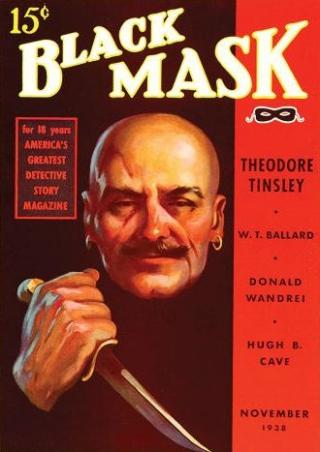
Black Mask (Vol. 21, No. 8 — November, 1938)
- Автор: Баллард Уиллис Тодхантер, Cave Hugh B.
- Год: 1938
- Язык: английский
- Год: Pro-Distributors Publishing
- Жанр: Другие детективы

Электронная книга - «Black Mask (Vol. 21, No. 8 — November, 1938)». Краткое содержание книги:
“So Mrs. Fretas,” I said, “put an eye to the keyhole, to see if Vanetti was in, and she saw him hanging there.”
“You and Evans went over there?” the Chief said.
He knew we’d gone over there. He was just pulling it out of me for the benefit of Nick Lomac. It didn’t take a swami to size this thing up. Nick Lomac was sore because of my murder talk, and he wanted a complete, detailed explanation, and he was influential enough to get it.
“When we got there,” I said, “we had to bust in the door. Mrs. Fretas didn’t have an extra key because, so she says, she gave her spare to Vanetti, a couple of days ago. He lost his and asked for another. So we broke in and found him hanging there.”
Nick Lomac opened his mouth for the first time. “What was he hung with, Thompson?”
“Fishline.”
“Fishline?”
“Yeh. The kind you catch cod on. Heavy stuff, tarred. It seems Vanetti did a lot of fishing in his spare time and had a couple of tackle boxes under his bed.”
Nick Lomac had an imagination. He put his fingers up to his throat and rubbed them around the edge of his starched collar, and winced. I didn’t blame him. That line had almost sawed Vanetti’s head off.
“So you and Evans walked in,” the Chief said, “and found him hanging there. The door was locked. The windows were locked. On the floor you found the chair on which Vanetti stood while adjusting the noose. That’s right, isn’t it?”
I nodded.
“You cut him down?”
“We cut him down.”
“Then what?”
“Nothing,” I said. “Just police routine.”
“But when the reporters arrived, you told them it was murder.”
“That’s not so,” I insisted. “I just warned them to leave things alone because it might be murder.”
“But, damn it, Thompson they quoted you as saying it was murder!”
“That was their mistake.”
The Chief glared at me, then let me have it. He possessed a nice vocabulary, most of which he picked up while handling mules in the War. Ordinarily I’d have grinned at him, but with Nick Lomac there I didn’t. Because the lacing I was getting was solely for Lomac’s benefit, and I knew it.
When it was over I muttered, under my breath and got up and walked out, pretending to be sore.
Jojo Evans still had his dogs on my desk. He grinned at me. “Way out here,” he said, “I heard the biggest part of it. There’s one word he uses that really gets me. That ‘scurrilousness.’ Some day I’m gonna look that up. What’s it mean?”
Pippo’s lunch cart has the best coffee you ever tasted, and he deals it to you by way of his black-eyed daughter Anna, who stands five-three and has a smile that wide.
I slupped the coffee and thought things over. This wasn’t an ordinary case of detecting. There are standard jobs and there are crazy quilts. In the former you smell along a given trail, knowing more or less what ought to be at the end of it. You just keep on smelling until you uncover the source of the stench. But in this particular job there were too many possible angles. Smells emanated from it the way tentacles curl out from an octopus.
First-off, the world was never going to miss Vanetti. The air would be cleaner with him underground. And I could name at least ten persons to whom his demise would bring a great big belly laugh. So, without any deep thinking at all, you could practically fill a phone book with the names of suspects.
And then again, maybe Vanetti’d really hung himself.
I drank a second mug of coffee, just to see Anna Pippo smile at me. Jojo Evans slid onto the stool beside me.
“There’s going to be hell to pay,” he said.
I glared. “Why?”
“Nick Lomac didn’t ask to have you fired. I eavesdropped.”
“Why should he ask to have me fired?”
“He’s sore.”
I said, “That guy is always sore. He just hops from one sore spell to another. Last week he burned up because a right guy got elected to fill that vacancy on the school committee. The week before that he had pups because Mitchell Brothers got the contract for that high school.”
“Only this time,” Evans said, “he didn’t blow up. He didn’t shoot off his mouth.” He gave me a fishy stare. “I’m only the police photog man but I know this time, Thompson, that it goes a lot deeper. The Lomac guy actually told the Chief to lay off you. Said you only did what you thought was your duty.”
“Real nice of him,” I snapped.
Evans reached across me for the sugar. “You keep out of dark alleys, cop. You watch your step.”
I didn’t think much about it. There was too much else on my mind. “You get those pictures finished yet?” I asked.
He shook his head. I dropped my check into his coffee and walked out and drove up to Ancell Street, to the rooming house where Mr. Leon Vanetti had committed suicide — perhaps.
It was a crummy dive, as you’d expect in a neighborhood like that. The name of Ancell Street got to be so bad at one time that respectable residents at the cleaner end of it petitioned the city fathers to change its label. Mrs. Fretas’ rooming house offered its high class tenants a nice respectable view of a dump on the side and an abandoned brewery on the other.
The downstairs door was open and I walked in The door of the landlady’s apartment was open, too. Mr. Fretas was parked in a rocking chair in his shirt-sleeves, reading a paper, and the missus was jammed into another chair, the whole two hundred and fifty pounds of her, peeling spuds.
I told her I was going upstairs to have another look around.
“Sure,” she said. Her old man didn’t even look up.
Vanetti’s room was second floor front, and when I got into it I just stood there looking around, wondering why I’d come. It wasn’t anything I could put a finger on, but that room fascinated me, just the way certain scenes in a movie do things to you. As a room it was worth just about what Vanetti’d paid for it — four bucks a week. The bed was up against one wall, a seedy green carpet covered the floor, and the furniture was heavy old-fashioned stuff salvaged from a junk store somewhere.
I felt dumb, gaping there. Something in that room was getting me down. I walked around it slowly, poking bed, the bureau. I hefted the chair which Jojo and I’d found overturned on the floor. I decided what the hell, maybe I was crazy. But still I couldn’t shake that feeling.
I hiked downstairs again, and Mrs. Fretas was still peeling potatoes. I sat down, envying her old man because he looked so all-fired comfortable. A spud dropped with a noisy plop into Mrs. Fretas’ bucket of water and I asked:
“Did Vanetti have many phone calls?”
She blinked her eyes at me. She had a face like an inflated basketball and her eyes were like imperfections in the leather. “Phone calls?” she echoed. “Why, no, I don’t think so, officer.”
“Who was the girl called him last night? Know?”
She shook her head, very solemn. “No, I don’t think so.”
“Did she ever call before?”
“No. No girl ever call him before, which I know of.”
“And she didn’t give her name, hey?”
“She just say, ‘Please, I wish to speak with Mr. Vanetti. You call him to the phone, please.’ ”
I was wasting time. Still, that phone call could have been important. I wondered if by any streak of long-shot luck I’d be able to trace it.
There was another angle, though, which might prove to be more valuable at the moment. I lit a cigarette, watched the skin curl off a potato for a moment, then said: “You have keys to most of your rooms, don’t you, Mrs. Fretas?”
She said, “Yes,” and labored around to point to a row of hooks on the wall. Each hook held a couple of keys and the keys were tagged.