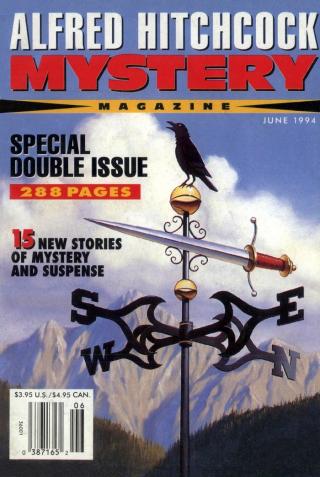
Alfred Hitchcock’s Mystery Magazine. Vol. 39, No. 6, June, 1994
- Автор: Bashover Albert, Crawford Dan
- Год: 1994
- Язык: английский
- Год: Dell Magazines
- ISBN: ISSN: 0002-5224
- Жанр: Другие детективы

Электронная книга - «Alfred Hitchcock’s Mystery Magazine. Vol. 39, No. 6, June, 1994». Краткое содержание книги:
My master’s gaze fell on each face around the room. Most of them looked back at him insolently. Sneeringly.
“Second, no raiding party would have been able to penetrate these waters and get away again undetected without having a safe haven inside the defensive network set up by the brave Protector of the Coast, Captain Yi.”
The mention of the name caused many guffaws around the long table. “He is but a blind military man. A base lout. A man of no subtlety.”
Inspector Kang moved his hand to the hilt of his sword.
“Third, whoever the clumsy fools were who were following me in Mokpo were not professional spies.” He turned to the Young Pak. “Instead of sending your poets to follow me, you should have opened your purse and paid a professional. Certainly your father would not have insulted me by dispatching amateurs.”
Young Pak laughed and clapped his hands in glee. “Oh, yes, good inspector. You are so right.” These poets considered all my master’s efforts and speaking here to be nothing but entertainment. Raw material for their empty verses.
“Fourth, you were foolish enough, after your last raid on the village of Hei-byon, to go into Mokpo to celebrate with the ladies of the Inn of the Diving Crane.”
A young poet lifted his cup high over his head. “Let’s hear a cheer for the good lady Yun-hi.” All the poets applauded and cheered at the same time. It was more than I could bear. I stood up, my fists clenched. Inspector Kang shot me a glance that froze me in my tracks.
He swiveled slowly and looked down at the Young Pak. His voice was low but filled the chamber.
“Have you nothing to say for your crimes? Have you no remorse over the infants and children and men and old people who were killed? Have you no mercy on the young women who were raped and torn cruelly from their families? Is this the legacy of your so-called art? To turn yourselves into beasts? To become no better than ravenous animals?”
Young Pak sprang to his feet.
“What do you know of it? You who have spent your life in service of a king? What do you know of art? And beauty? We who need to express ourselves in beautiful verse also need to constantly stoke the fires of our experience. What good would be a boring bureaucratic life to an artist like me? I need adventure. I need life. I need passion. That’s what we have found here. Real life, real passion, real tears from the people we rape and kill. What if a few peasants suffer? We are producing poetry here that will transform all poetry for all time. Even the great masters of the Middle Kingdom will stand in awe of us. We are a workshop of artists who will take the experience we need and dare the gods or your peasantry or even the laws of the king to do anything about it!”
The poets all stood up, cheering.
Inspector Kang waited until they quieted down and kept waiting until the room was very still again. “Listen to me closely, Young Master Pak, and listen to me closely, all you poets of the Island of the White Crane. You have committed grievous crimes against the subjects of Sejong Daewang, and their deaths will not go unavenged. In the name of the king, I place you all under arrest.”
A great laughter went up. When it died, the Young Pak spoke.
“And how will you accomplish this arrest, Inspector Kang? When you left Mokpo, no one knew where you were going. Yes, you evaded my spies on the open seas, but they have since reported to me.” The wind rapped shutters loudly against the outside walls. “And with this storm upon us, who will doubt that men in a small craft could be lost on such a terrible night?”
“So you will kill the fisherman?”
“That has already been taken care of. You called us amateurs. In the ways of spying, I suppose you’re right. But don’t try to outsmart a poet. He is always far ahead of you.”
A servant, drenched with rain, ran into the hall.
“Invaders, sir. Armed men. Coming up the bluff!”
The poets froze, and then all eyes were on Inspector Kang. Young Pak spoke. “But you brought no force with you from Seoul. We had you followed. You came only with this mangy scribe.”
“I didn’t need to bring a force with me. You created one for me.”
“What do you mean?”
“Are you a poet who knows nothing about hatred? Well, congratulations, Young Pak, you are about to become well acquainted with that most heated of all emotions. At the hands of the fishermen from the neighboring villages of Hei-byon!”
I grabbed one of the oil lamps and tossed it at the poet who had insulted the beautiful Yun-hi. He screamed, and his silk robes burst into flames. Inspector Kang Huang-ho kicked over the long table, and cups and hot wine flew everywhere. There was shouting at the gates. I ran outside to the courtyard, slipped through the darkness, and pulled back the heavy log that barred the entranceway. Skeletons armed only with sickles and hoes flew in.
“They are in the dining hall,” I shouted. “Stop them before they can get to their swords!”
The army of bone and sinew flew past me. I followed as the young poets erupted into the courtyard. Some of them brandished swords, and the heavy grunts and screams of fighting for life and death enveloped me. I grabbed earthen pots crammed with kimchi and hot pepper paste and threw them at whoever was wearing flowing silk robes.
Inspector Kang had been a greater judge of emotion than the erstwhile poet Pak. Hatred carried the day, and soon what was left of the young poets and their servants were kneeling in the center of the courtyard, facedown in blood, amidst the bodies of their fallen comrades. The fishermen stood around them, appropriated swords at the ready, taunting them and daring them to move.
Inspector Kang emerged from the dining hall, the tip of his sword at the back of the Young Pak’s neck. He forced him to fall on his belly and crawl through the muck and the blood to the front of the formation of his defeated comrades.
Yong-sok peeked through the gate and, seeing that all was quiet, ran to his father. Someone shouted that the women had been found and a dozen of them, looking dirty and haggard, were led up from the dungeon. There was much crying and silent embracing.
The boy darted back and forth, searching each face, and then seemed to remember that his mother had already been buried. He slouched slowly back to his father.
Inspector Kang sheathed his sword, approached father and son, and put his large hands on their shoulders. “I knew a man like you, good fisherman, would understand my message,” he said.
The fisherman nodded his head. “Yes, sir. We knew immediately. Only the cruelest of cranes would devour its own young.”
Kang Huang-ho, Inspector of the Five White Horses, looked about at the poets lying prostrate in the mud.
“And only the crudest of men would kill to fire their dead imaginations.”
Key for Two
by Albert Bashover
Carnow Industries is one of the larger toy manufacturers in the United States. It owns a four story, block square building in Jamaica, New York, and satellite plants in South Carolina and Taiwan. Most outsiders would think that a company this size would be run by a faceless board of directors hidden in paneled offices on the fourth floor of the main plant in Jamaica, but everyone in the toy business knows it is personally owned and personally run by a man named Sacha Carnow. A man who came to this country from Russia, penniless, when he was fourteen years old and quickly found out what luck, brains, hard work, and a bit of guile can do in this land of opportunity.
Sacha, a balding, heavyset bulldog of a man, runs his multimillion dollar toy business as if it is still a five-man operation in a second floor loft in Brooklyn where he started. He rumbles through the corridors of the Carnow building with the grace and subtlety of a rhinoceros overseeing everyone from the vice-president down to the man who sweeps the floor of the tool shop. They all know that at any moment “The Old Man” may be looking over their shoulder, telling them what’s wrong with their work and how to do it better. Nobody likes it, but they produce, and that’s what Sacha wants. Sacha gets what he wants — usually...