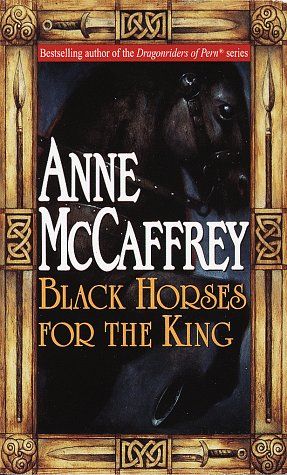
Black Horses for the King
- Автор: Маккефри Энн
- Язык: английский
- Жанр: Научная фантастика

Электронная книга - «Black Horses for the King». Краткое содержание книги:
After his father's death, young Galwyn Varianus is apprenticed to his uncle, who puts the boy to work on the high seas. But horses, not ships, are Galwyn's passion. Luckily, a passenger aboard, Lord Artos (later to rule as the legendary King Arthur), is bound for the great horse fair at Septimania. Risking his life, Galwyn abandons his uncle to serve the gallant leader. Galywn's calming way with horses quickly impresses Lord Artos and his men. But what no one expects is how crucial Galwyn will be to their upcoming battles--as he masters the secrets of the iron shoes that will protect the exotic horses' delicate hooves. . . .
"No hoof, no horse!" he exclaimed, eyes dancing with mischief.
I felt cheered for the first time since Spadix died.
THE EUPHORIA OF OUR DEPARTURE lasted us wellinto the day, with only brief stops for horses to rest and men to relieve themselves. We ate in the saddle at the walk. Otherwise we traveled at a good trot, the foot soldiers in the dust behind us but keeping up with the horses for all they had only two legs to go on. I wondered fretfully if Iswy were among them.
The second day, after a night checking loose sandals, I caught what rest I could in the saddle. Once again I blessed Ravus's smooth gaits. But because I slept on horseback, I scarcely recall much of the journey, though I do remember people cheering Lord Artos with "See the black horses! See the big, beautiful black horses!"
I was checking Cornix's hind plate the night we camped outside Ratae when the messenger came galloping up to Lord Artos's tent.
"The Saxons have crossed their borders, Comes." The messenger's voice was hoarse but loud enough to be heard around the camp. "I am to tell you that Aelle and his sons have gone east to Bannovalum. He must turn west, though, to avoid the fens at Metaris Aest."
"Then we'll march to Durobrivae, to Cnut's Dike, and head north along that until we meet these scurrilous invaders," Lord Artos said. "Inform your prince. Blwch, see that this man is fed and provided with a fresh horse."
Bwlch left with the messenger and I finished the stallion's hooves. Cornix was picketed right by Lord Artos's tent-the other Libyans nearby, in the most protected area of the camp. Cornix was in good fettle but he would often neigh wistfully. It would cause my breath to catch in my throat-that he still missed his pony companion. And where was Iswy now?
THE NEXT DAY'S LONG MARCH did get us over the rolling countryside to Durobrivae by late evening. The next morning, we turned north until another messenger arrived. I wasn't close enough to hear what he had to say but Lord Artos seemed very glad of his information, laughing and grinning as he called in his Companions.
Once again I spent the night with Borvo and Maros, checking all the war steeds, though only two needed to have clinches tightened. The camp was not still. I do not think many slept, for the rumors were that we were closing with the Saxons.
I heard other messengers arrive during the night; the spring evening seemed to amplify the sound of hurried hoofbeats.
We moved eastward well before dawn, making our way to a position above the confluence of two rivers. We were on a long slope above them, and they were not in full spate.
"The Saxons are there," I heard Bwlch murmur to Cei. Then the Companion saw me. "Galwyn, you and your smiths stay out of the battle line, but be handy." He pointed to a slight knoll behind us and, dutifully, I motioned the others to follow me as I left Ravus there. The tools in our saddlebags clinked softly against the nails and spare sandals.
Thus it was that Borvo, Maros, and I had probably the best view of the first Battle of the Glein. We spotted the Saxon force crossing the upper river, hundreds of them, with their winged helmets and their huge round shields.
More poured from the opposite bank, wading through the knee-high water. The Saxon horde paused when suddenly our line of archers spread out on the hill crest. I could hear the black horses whinnying-but out of sight below the brow of the hill.
I didn't know much about battle strategy in those days but I certainly trusted Lord Artos's wisdom and foresight. Had he not equipped himself and his Companions with the black horses? Had he not met the Saxons before they could achieve their objective: the domination and control ofallEastAnglia?
Audible now were the war cries of the Saxons as they swarmed up the hill to meet the waiting Britons. I heard the angry hiss as our archers loosed their arrows, to rain down on the oncoming foemen. And then I saw our mountain men step up beside the archers, and watched their lethal showers of stones knock men to their knees.
Still the Saxons charged forward, bellowing fiercely, in a seemingly endless flow across the river, multiplying the force opposing us. Their shouts all but drowned out the neighs of the Libyans.
And then, just when the Saxons were halfway up the hill and the barrage of our arrows and stones had thinned, the black horses moved up and over the brow of the hill, Artos on Cornix in front.
The black stallion reared, pawing the air with his metal-rimmed hooves. I saw the shock and horror on the faces of the leading Saxons. I saw them halt in their tracks as more and more big black horses followed Artos and charged down at them.
I shall never forget that sight-as frightening as I had once imagined it would be, those years ago during my first visit to Camelot. And I was not an enemy suddenly faced with the flaring red nostrils, the bared teeth, the blackness of these monsters. I was not a Saxon with no way to evade flashing, iron-clad hooves.
I cheered loudly, pumping my right arm skyward in a salute to that charge and leaning just slightly to my left. And heard, and felt, something zing past me between arm and head.
I whirled, crouching, hand on my dagger hilt, wondering what missile had so narrowly missed me.
Iswy was already launching himself at me, face contorted, dagger raised. He didn't even see Borvo and Maros instantly coming to my defense.
"No, he's mine!" I shouted at them, and ducked away from my assailant. "He slaughtered my pony!"
I didn't think of Yayin's lessons in dagger fighting: I thought only of avenging Spadix. That lent me a cunning I didn't know I possessed. I noticed that I had the reach of Iswy, for I had grown in arm as well as leg, and the years at the anvil had matured the spindly cabin boy Iswy had once mocked.
He came at me again and I caught his dagger hand, forcing it back, hoping to break it; but somehow he squirmed free and sliced at my belly.
The leather apron I had put on that morning deflected his blade. He cursed wildly.
"I'm not the easy mark I used to be, Iswy." It was my turn to taunt him as we crouched, facing one another and circling, each trying to discover an opening.
Like a snake, he twisted and made to stab at Ravus where the gray was tied to a bush. But Ravus reared, breaking the restraint and trying to run. Maros, for all his bulk, was fast on his feet and caught the trailing reins.
"Horse killer!" I cried. "That takes such a brave man, doesn't it, Iswy? To kill an animal that looks to be protected by you!"
I changed my dagger from hand to hand, making him watch the transfer: a trick Yayin had drilled me in. Then I attacked, just as I had switched the blade once more to the left. Iswy didn't expect that and didn't know which way to lunge. I sliced at his right leg, catching him above the knee with a deep gash.
He staggered back, totally surprised by my strategy. I switched the blade again even as I closed with him, my left hand gripping his right wrist and arm. I struck downward, through his leather jerkin, and into his chest.
"You've-killed-me," he gasped out, sinking to the ground, dead before his body stretched out.
I looked down at him and did not close his sightless eyes. Spadix's death was now avenged. Still gasping from my exertions, I turned away, back to the battle raging on the slope below.
The Companions on the great black horses wielded their swords tirelessly and brought down every Saxon enemy they passed on their way to the Glein. The river was turning red in the sun, with the blood of the wounded and dying.
And then our reinforcements-the troops of half-breed Libyans-charged out of the woods from the left of the river. It was a total rout of Aelle's arrogant horde.
"That were well done, Master Galwyn," said Borvo at my side.
"That were some fight," Maros added.
They were looking at the carnage below, but it wasn't that battle they meant.