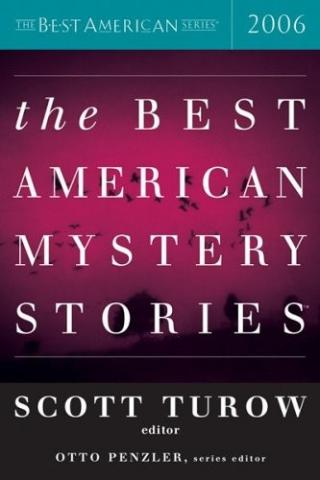
The Best American Mystery Stories 2006
- Автор: Дивер Джеффри, Хантер Эван
- Год: 2006
- Язык: английский
- Год: Houghton Mifflin Harcourt
- ISBN: 978-0-618-51746-6
- Жанр: Другие детективы

Электронная книга - «The Best American Mystery Stories 2006». Краткое содержание книги:
Ray was at the water’s edge breaking twigs and tossing them into the current. “Get rid of them dogs,” she screamed at Ray. “Nobody wants to see them dogs. Just let ‘em be gone. You hear what I say?” Ray snapped a twig and brought it to his mouth. He waved up his middle finger.
Danny ran past Ray, and thigh-deep into the raging flood he tore the red sweater off over his head and hurled it into a rush of gulls.
Christmas Morning, 1992: Helen held the lantern to Robert Joakes’s swollen face. Faint plumes of breath trickled from his lips. With a wooden spoon she pried opened his mouth, then pushed the spoon and his head tipped backwards. She considered, as she had many times before, to ask him why. Instead, she inserted the barrel of a shotgun into his mouth. He made noises, not words, gagging on the metal. She sat the lantern on the cold stove and closed tight her eyes.
The explosion in the small room made the pots in the cupboard rattle. A ringing pulsed in her ears. Joakes had toppled in his chair and lay in the dark of the floor. She worked fast, looking only when she had to, untying his legs and thighs, his hands and chest, blood pooling blackly over the uneven planks. She worried momentarily as to which hand was his shooting hand, then chose his right, and worked his thumb onto the trigger.
She piled the bindings into a garbage bag and left the lantern burning on the table. She hurried outside, careful with her footprints, stepping sideways into drifts so the snow would collapse, then on the exposed rocks behind his house, up the hill, breaking the ice and splashing through a tiny brook, then down the bluff to the frozen stream, where she paused atop a granite boulder.
The moon was in its descent, the stars fading. She’d wait for dawn, for pale light to arise and cover her. She thought of Freely’s grandchildren tearing pretty paper from gifts, and singing “Away in a Manger” in church. She thought of families gathered around tables thick with holly. In her mind she tasted honey-glazed ham, scalloped potatoes, macaroon cookies. But she could not wait for dawn. Her feet were wet and the night was bitterly cold. She clutched her collar and limped along the stony banks, and stepping up to enter the prairie she slipped and fell onto the garbage bag of rags and slid until she was out on the frozen stream. The ice popped, but held. Thistles of pain stabbed her toes. She lay on the brittle black ice and could hear water flowing beneath her.
Spring, 1993: The men had come down the hill from the shelter and gathered around the boat. They were solemn, unshaven, shirts rumpled, the pits of Pastor Hamby’s white shirt stained with sweat. The farmer’s body lay in the hull where once had been dogs, Helen’s jacket shrouding his face. The sun was high, the air damp. A new wall of thunderheads and the fur of rain bulged forth in the west.
“You’ll tell the others?” Helen said.
Pastor Hamby nodded. “What can we do for you?”
“I need rest,” Helen said, wilting, and almost began to cry from tiredness. “Let me rest a while.”
Suddenly came the wind, full and strong, and Helen’s coat blew off Keller Lankford and tumbled onto the hillside, exposing his blue bloated face. Helen lunged after her coat. Her ankle gave and she caught herself as she fell. A deacon, Jerry Timlinson, clambered into the boat and covered the dead man’s face with his own jacket, then squinted up at the approach of weather. Spatterings of rain fell sideways in wind and sunshine. Pastor Hamby and Frank Barker lifted Helen, each with a hand beneath her thigh and another at her back. Slate clouds rowed forward over the sun, its light dappling the hill and then the sun shower was a storm.
The men entered the lightless hall, shirts transparent with rain, Helen riding their arms. “Put me down,” she said, clutching their sleeves. Pale faces emerged from the darkness: Walt Freely and Marilyn, Connie and David Dempsy, the little girl held to his shoulder, everyone she knew, grimly nodding, touching her pant legs, stroking her wrists, some speaking her name with quiet reverence. “Let me down,” she repeated, but they did not, and Helen began to cry. Rain drummed the masonry. Light from the storm lay a greenish glow in the hall. She could not stop herself from crying. They huddled around Helen, silent in the gloam, then the pastor raised his pulpit voice and called for them all to just clear out and leave her be.
Emory Holmes II
A.k.a., Moises Rockafella
From The Cocaine Chronicles
1.
“You said I could have water. I want some water,” Fat Tommy asked again.
“You can have water, Moises, after you tell us how it went down. Understand? That’s our deal,” Vargas reminded him.
Fat Tommy’s big shoulders slumped. He was having a really bad day. His business was gone. His money was gone. His high was gone. And the cops weren’t buying his story. He laid his arms tenderly across his knees. He tried to sleep, but the cops kept butting in. He narrowed his eyes in the harsh light and squinted down at his arms. Still, he had to admit... he certainly was well dressed.
“Don’t give those white folks no excuses, Tommy,” his wife, Bea, had advised. “We ain’t gonna get kilt over this asshole.”
Bea had borrowed her mother’s credit card and bought him two brand-new white, long-sleeve business shirts from Sears for his interrogations and, regrettably, for the trial. That was such a sweet thing for Bea to do. Buy him new shirts that the cops would like. He loved his Queen Bea — she had been his sweetheart since grade school, way back when he was skinny and pretty. Bea was sexy, street-smart and loyal to him. After he’d knocked her up, twice, he had started to hang with her, help her with his sons, and had grown to love her.
Gradually, she had helped him develop his posh sartorial style: his dazzling jheri curl (forty bucks a pop at Hellacious Cuts on Crenshaw); his multiple ropes of gold, bedecked with dangling golden razors, crucifixes, naked chicks, powerfists and coke spoons; his rainbow collection of jogging suits and fourteen pairs of top-of-the-line Air Jordan sneakers (and a pair of vintage Connies for layin’ around their new pad). He had restricted himself to only five or six affairs after they got married. The affairs were mostly “strawberries” — amateur whores who turned tricks for dope.
Getting your johnson swabbed by a ’hood rat for a couple of crumbs of low-grade rock — not even a nickel’s worth — wasn’t like being unfaithful, he figured. It was medicinal; therapeutic; a salutary necessity — more like a business expense. Like buying aspirins or getting a massage on a high-stress job. But that was all past — the whores, the dealing, the violence, the stress. He had resolutely turned his back on “thug life” six months ago, when he realized that a brother, even an old-time G like him, was vulnerable to jail time or a hit — after he had experienced the deadly grotesqueries in which Pemberton was capable of entangling him.
So, hours after that goddamn murder, months before he knew the cops were onto him, he’d flushed the bulk of his street stash down the toilet — 1,800 bindles — and threw away most of his thug-life paraphernalia, even his jack-off books, Players and Hustlers mostly, and, his cherished Big Black Titty magazines and, faithfully (except when the Lakers were on TV, or Fear Factor, or The Sopranos), got down on his knees and read the Bible with Bea and promised to her on his daddy’s life, and on his granddaddy’s soul even, he wasn’t going to disappoint her anymore. No more drug-gin’, no more whores, no more hangin’ out. No more street. Swear to Jesus...