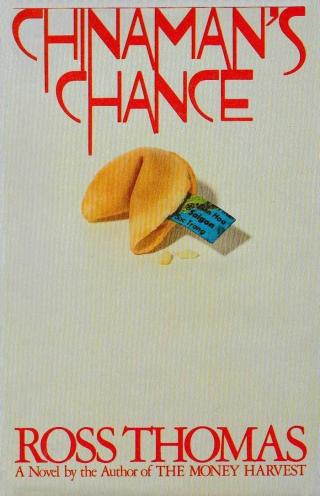
Chinaman’s Chance
- Автор: Томас Росс
- Серия: Arthur Case Wu #1
- Год: 1978
- Язык: английский
- Год: Simon & Schuster
- ISBN: 978-0-671-24070-7
- Жанр: Политические детективы

Электронная книга - «Chinaman’s Chance». Краткое содержание книги:
“Probably California,” Durant said.
“Probably.”
“I wonder whether he got champagne or flowers?”
“Well, he was an assistant secretary of state once.”
“And ambassador to Cambodia,” Wu said.
“Not to forget Togo.”
“Plus a few other things. Five bucks he got champagne.”
“No bet,” Durant said just as Wu knocked on the door.
The man who opened the door was Whittaker Lowell James, who was sixty-four years old and used all three names whenever the opportunity presented itself. He was white haired and very tall, just a little over six-three. He held himself stiffly erect, almost in a brace, and it gave him a somehow distant, almost forbidding air that his wintry smile, which he had just turned on, did nothing to dispel.
“Gentlemen,” James said, and looked quickly at his watch before offering a his hand first to Wu and then to Durant.
“Hello, Whittaker,” Wu said, because he knew that James hated for anyone to call him Whit.
“Arthur,” James said. “You’re looking fit. And you, Quincy — you, I think, could use a few pounds.”
“How’ve you been?” Durant said, wondering how long it had been since anyone had called Wu anything but Artie. Not since Mrs. Billington at the orphanage, he decided. She had always called him Arthur.
James told Durant he had been fine — splendid, in fact — and then Artie Wu said, “I like your flowers.”
James turned toward a blue, glazed vase that held an artfully arranged assortment of carnations, chrysanthemums, Dutch iris, and delphiniums touched up with some baby’s breath.
“The management sent those up,” James said. “Along with a quite good bottle of champagne.”
Wu and Durant didn’t look at each other because they knew that if they did, James would catch it. At sixty-four, Whittaker Lowell James was as alert as he had ever been, which was very alert indeed.
“Why don’t we sit over here,” he said. “At least, until breakfast arrives, which should be within” — he glanced at his watch again — “the next minute or so. I took the liberty of ordering for all of us.” He looked around as though ready to fend off any challenge to his judgment, and when none came, he smiled his December smile again.
James had waved Wu and Durant over to a striped maroon-and-white couch with overly delicate legs. Durant sat down on the couch. Wu chose a boxy easy chair covered in some kind of nubby pale gray fabric. James hesitated and then decided to sit in the chair that matched the couch. He sat as stiffly as he stood.
“Quite a nice hotel, this,” he said. “They even have kippers, which I thought we might have. You like kippers?”
“I do,” Wu said, “but Quincy hates them, although you don’t have to worry about it. All he ever has for breakfast anyhow is a raw egg.”
“You’re not as much of a gourmet as is our plump friend here, are you, Quincy?”
“I just don’t like to cook.”
“You still do quite a bit of fine cooking, Arthur?”
Wu smiled. “Whenever I get hungry.”
“I like to cook, you know. But rather simple fare, I’m afraid. A chop now and then, a salad, or perhaps an oyster stew. I do that quite well.”
The conversation had begun as it always began whenever Wu and Durant met with Whittaker Lowell James. They invariably talked about non-essentials at first — about nothing, really. And as they talked James inspected them both, measuring their posture and pauses and eye movements for possible signs of disenchantment and sloth and even incipient treachery. James was an extremely suspicious man, and he prided himself on his ability to read the small, telling signs that a body made. His guideposts were a tremor, a tic, a stammer, a gesture, a glance — even a silence.
James searched for them now as he talked about nothing. He had long made it a rule to talk about nothing before he hired anyone. Or fired them.
They were still talking about hardly anything at all when the knock came. James rose and opened the door. The Mexican waiter pushed the wheeled table into the room, smiling as though he enjoyed his job. James fussed for a moment about where the table should be put. When that was settled, the waiter started bringing the dishes up from the hot boxes underneath, and he and James chatted with each other in rapid Spanish.
Durant half-listened to the Spanish and felt grateful that James was talking to the waiter about the warm weather. Perhaps he’ll spare us that. Durant noted that James had made a concession to California informality by abandoning his usual dark gray or blue suit for a navy blue blazer and gray slacks. But he had clung to the bow tie — butterfly, of course, blue with white polka dots. And his gleaming black shoes were the kind that needed laces. Durant tried to remember when he himself had last worn shoes that demanded laces. At least ten years, he decided. Probably more.
When the waiter had gone they sat down at the table. Artie Wu took a lot of everything, including the kippers. James had a soft-boiled egg, some bacon, a bit of kipper, and a piece of dry toast. Durant took nothing but a piece of toast, which he buttered carefully.
After he had finished his egg, James patted his lips carefully with a napkin and said, “I must confess, gentlemen, I’m a little disappointed.”
“I thought it was good,” Wu said, helping himself to another portion or scrambled eggs.
“He’s not talking about the food,” Durant said, and lit a cigarette.
“No kidding,” Wu said. He finished the last of his eggs, used his napkin, leaned back in his chair with a sigh, and produced one of his long, slim cigars, which he held up to James.
“Mind?”
“Not at all.”
Wu carefully clipped an end off his cigar, then lit it with his usual kitchen match, and when he was sure that he had it burning nicely, he peered through the smoke at James and said, “Tell us about your disappointment, Whittaker.”
“In two months not a single report.”
Wu shrugged. “We had nothing to tell you.”
“Even that would have been interesting, if not useful.”
“Well, we were busy,” Durant said.
“How?”
“We had to set it up,” Wu said.
“I should have liked to know what steps you were taking.”
“What’d you want us to do,” Wu said, “call you up and tell you that we were looking for a dead pelican?”
James frowned, and when he did the chill in his pale gray eyes seemed to drop several degrees. “Perhaps we should review,” he said. “Would you like to start with the pelican?” He came down hard on “pelican,” almost biting the word in two.
Artie Wu smiled. “Let’s start before that. Let’s start with Aberdeen.”
“All right,” James said. “Let’s. And since I was privy to at least that part of our little venture, perhaps I should take the class.” He looked at both men as if again expecting a challenge. What he got from Durant was a slight smile and an even slighter nod. Wu waved his cigar a little.
“In Scotland — in Aberdeen, to be precise — we met and I explained the problem. From a short list of several names my little group had selected yours because we naively had thought that you — especially you, Quincy — might be highly motivated. I think it took only five minutes of conversation with you both before I realized how sadly mistaken we had been.”
Durant rubbed bis left eye. “Revenge is an awfully old-fashioned motive, Whittaker.”
“Apparently.”
“But when you mentioned money,” Wu said, “I think we perked up considerably.”
“Yes, you did, but my little group is not the government and we don’t have unlimited funds at our disposal.”
“What is it again that you call yourselves?” Wu said. “Something cute as I remember.”