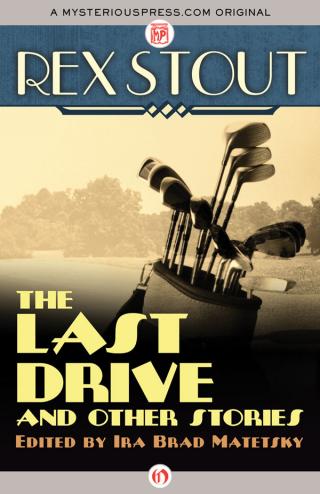
The Last Drive and Other Stories
- Автор: Стаут Рекс Тодхантер
- Год: 2015
- Язык: английский
- Год: MysteriousPress.com/Open Road
- ISBN: 978-1-5040-1134-1
- Жанр: Классические детективы

Электронная книга - «The Last Drive and Other Stories». Краткое содержание книги:
“Ah,” exclaimed Marsfield suddenly, interrupting himself, “here comes Rogers. Lucky dog! He got Jellie today. He was out Wednesday too and had him then.”
“A bit thick, I call it,” observed Penfield, who had once spent a month in England.
“He takes poor old Jellie for too much of a good thing,” put in Huntington, glancing at the two men as they approached down the corridor.
“But I say, look at Jellie’s face,” went on Penfield. “Must be one of his bad days. Just look at him.”
It was indeed evident from the expression on Mr. Jellie’s face that he was far from happy. His eyes were drawn half shut, as if in pain, his lips were quivering with emotion and his face was very white. Mr. Rogers, his companion, appeared on the contrary to be making an attempt to conceal some secret inner pleasure. A scarcely repressed smile twisted his lips and a twinkle of delight shone from his eyes. As he reached the corner where the others were seated he greeted them with familiar heartiness and beckoned to the waiter for a glass of something. Mr. Jellie sank into a chair with the briefest of nods in reply to the others’ greetings, thrust his hands deep in his pockets and gazed straight ahead at nothing with his eyes still half closed as though to shut out some painful sight.
It was Huntington who noticed at once an unusual vacancy in the atmosphere. He turned to Rogers to ask:
“Where’s Nibbie?”
Rogers grinned, glanced apprehensively at Mr. Jellie, and replied in one word:
“Dead.”
There was a chorus of astonished inquiry.
“Yes, dead,” Rogers reiterated.
“Dead as a dead dog. Jellie killed him.”
“What!” There was unbelief in ten voices.
Another broke in, Mr. Jellie himself.
They all turned to him.
“I suppose you’re glad of it,” he observed in a voice of mingled grief and indignation. “Well I’m not. I didn’t mean to do it. It was at the tenth hole. Rogers had me four down. Nibbie—” Mr. Jellie hesitated and gulped a little — “Nibbie had been very demonstrative all the way. I was 64 at the turn. I’d made a lot of rotten shots, and Nibbie was right after me all the time. You know how he feels — how he felt when I made a bad shot. Well, on the tenth I got a beauty from the tee, right down the aisle about 220 yards. On the second I took a brassie and carried the brook. It sure was a fine shot, I’ll leave it to Rogers.”
Mr. Rogers nodded in confirmation. “I always have to play short there myself,” he confessed.
“But Nibbie must have thought I didn’t carry it,” Mr. Jellie went on. “He must have thought I made the brook. Anyway, he evidenced disapproval. It made me mad, that’s all there is to it. He’d been howling at me all day for my rotten shots, which he had a right to do, but that was the best brassie I’ve had for a month, and when he set up that yelp I turned before I thought and threw the club at him. Of course I didn’t mean to hit him, or at least didn’t mean to hurt him—”
Mr. Jellie paused to control the tremble in his voice.
“It must have caught him right in the temple,” he finished.
It is not surprising that this recital of Nibbie’s death caused no demonstration of grief on the part of those who heard it. Call it heartlessness if you will; the reply is that these men were golfers with golfers’ nerves and that Nibbie had more than once made them miss a stroke. They did not even feign regret. They grinned openly; their remarks were for the most part facetious and satirical; one or two were openly exultant. There were ironic expressions of sympathy and advice.
“One trouble is,” observed Rogers to the grief-stricken Jellie, “that now you’ll have no way of knowing when you make a bad shot.”
“And probably,” added Huntington, “your game will suffer in consequence.”
“Why not have the body stuffed and set it up on wheels?” suggested another. “The caddie could pull it around for you.”
“Or have the hide cured and have a caddie bag made of it.”
“Or use the hide for leather grips on your clubs.”
“Anyway, you’re safe for awhile,” put in Marshfield, the Orientalist. “According to the old Egyptians, a dog’s soul roams the earth for three moons after his death. For that long, at least, Nibbie will be with you in spirit if not in body.”
Mr. Jellie got up abruptly and removed his hands from his pockets.
“You fellows think you’re funny,” he said quietly, looking from one to the other, “ but it’s no joke to me. Nibbie was the best friend I’ve ever had. He always found my ball in the rough, and he was a good sound critic.”
“He was sound alright,” observed Tom Innes, “if you mean noisy.”
“Oh, I know he was a nuisance to the rest of you,” Mr. Jellie agreed. “I don’t blame you any, but I can’t sit here and have a good time with Nibbie dead. I’m going up to my room.”
And he did so.
He remained in his room all evening without eating any dinner. He was in fact a very unhappy man. A bachelor without home ties, the possessor of an inherited fortune and therefore spared the worries of the business of making a living, golf had for three years been the absorbing interest of his life. And what, he asked himself, what would golf be without Nibbie? What — for instance — what if he did carry the bunker from the eighth tee? There would be no joyful bark from Nibbie to acclaim the performance. What if a thousand things? Nibbie was gone.
His thoughts were dreary and melancholy as he crept between the sheets, and it was an hour before he slept.
Perhaps it was during that hour that a certain fantastic idea first entered his brain. He had thought during the evening of many ways of paying tribute to Nibbie’s memory. He would give up golf. He would ask the club governors for permission to bury his dead at some appropriate spot on the links, say under the first tee. He would have the body stuffed and set up in his room. But finally he rejected all these plans in favor of one that had been suggested in a spirit of jocosity by someone downstairs. The more he considered it the better he liked it as a fitting and poetic method of expressing his sentiment for poor dead Nibbie.
About noon of the following Monday accordingly, Mr. Jellie took a train to Jersey City, accompanied by two men carrying a large wooden box with rope handles. At the Jersey terminus they took a taxi and were driven to a remote part of the town where the streets were dirty, the dwellings poor and dingy, and the atmosphere tainted with the smoke odors of numerous factories.
Before a door of one of the latter, marked “Office of the Darnton Tanning Company,” the taxi halted and Mr. Jellie sprang out, followed by the two men with the wooden box. Five minutes later they were ushered, box and all, into the office of the president of the company. This was a dapper little man with eyeglasses and an engaging smile who got up from his chair to greet Mr. Jellie with outstretched hand in an enthusiastic welcome.
“Ah, Jellie, my boy,” said he, “what a surprise! Glad to see you again.”
The visitor returned the greeting, then turned to the two men, who had deposited the box in the middle of the floor, gave them each a five dollar bill and dismissed them.
“It’s been four years since we’ve met,” observed the president when they were alone.
“All of that,” agreed Mr. Jellie, and there followed thirty minutes of reminiscences. After which Mr. Jellie came to the point of his visit. He first asked for a hammer, and when it arrived he removed the lid of the wooden box, disclosing to the other’s astonished view the carcass of a white dog.