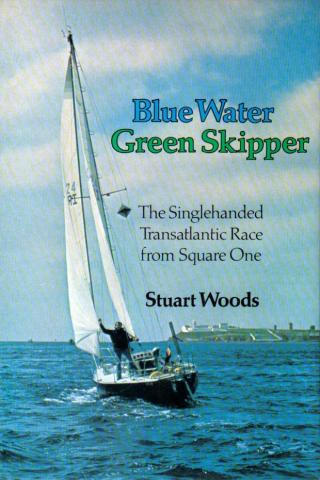
Blue Water, Green Skipper: A Memoir of Sailing Alone Across the Atlantic
- Автор: Вудс Стюарт
- Год: 2012
- Язык: английский
- Год: W. W. Norton
- ISBN: 978-0-393-03203-1
- Жанр: Биографии и мемуары

Электронная книга - «Blue Water, Green Skipper: A Memoir of Sailing Alone Across the Atlantic». Краткое содержание книги:
I motored up the river into Crosshaven and picked up a mooring in front of the Royal Cork Yacht Club. The place was deserted, apart from a steward and the customs men, who were there to meet me. As the customs men were going ashore, Nick appeared, roaring down the river in his rubber dinghy, standing up and waving both hands. He came aboard and we motored up to Drake’s Pool and picked up Harp’s mooring. Fred greeted us in a frenzy as we stepped ashore in front of the cottage, and I wondered, How many people can sail thirteen hundred miles and never touch land until their front doorstep? I turned and looked at the yacht swinging peacefully at her moorings.
Golden Harp was home.
19
Back home
Everything seemed very peculiar at home in Ireland. I had the usual problem of stopping the earth from swaying, of course, and the rooms of Drake’s Pool Cottage seemed vast after the confines of Harp’s cabin, which had seemed so roomy at sea. I staggered about the cottage, babbling incessantly to Nick and Heather. I could not stop talking. We had dinner at a local restaurant. The thing I had missed second most on the passage was food cooked by somebody else, served on a white tablecloth, with cloth napkins. I talked all through dinner and straight through till bedtime. By the time I crawled between my first clean sheets and soft bed in thirteen days I was hoarse from talking.
The autumn was a busy time, and the boat was my first priority. The broken log was returned to Brookes & Gatehouse for servicing; Hydromarine sent a man down to recondition the engine; Lucas replaced both alternators and the splitting diode, all of which had been corroded into uselessness by seawater entering the engine bay through the cockpit floor; Derek Holland, a neighbor at Coolmore and a former ship’s engineer, rewired the whole boat; Nick fitted my ingenious little heater; and the cooker, which hadn’t liked it when I had been thrown on top of it, was replaced. I raced the boat in a Sunday event in the harbor, crewed by a tribe of local Lydens, and she took twenty gallons of water in three hours, so Harold Cudmore and I packed the keelbolts with lifecaulk and hemp and retightened them, and this greatly reduced the water she was taking, though it did not cure the condition.
John McWilliam and I flew to the Southampton Boat Show and I got a lot done there: Marinaspec kindly replaced the blown-away masthead light, explaining that there had been a faulty weld on a few lamps and they had not been able to track me down; I met Jim Nolan of Barlow Winches, who agreed to loan me a pair of big self-tailing winches and a larger halyard winch; and I had a talk with Camper & Nicholsons about bringing Harp to England for repairs. On the flight back we had to divert to Shannon, as Cork Airport was closing, and the following morning we had a beautiful, low-level flight over the green Irish countryside, stopping at two small airfields along the way, one of them the front lawn of Kilbritain Castle, near Kinsale.
Before leaving Horta I had asked Luis, commodore of the Club Naval, to write to the Royal Western, confirming that I had left Horta alone; on arriving in Crosshaven, Harry Deane, secretary of the Royal Cork, had also written to them, confirming my single-handed arrival. I had then, as the rules required, submitted a list of my noon positions between Horta and Crosshaven, and on September 29 I received a letter from Lloyd Foster saying that I had been accepted for the race pending only the final inspection of Golden Harp in Plymouth the week before the race. This was a monumental landmark for me. I felt that I had now accomplished a great part of what I had set out to do: I had learned to sail, got experience on a wide range of boats, completed one navigation course and half of another, making up in practical experience what I had lost in classroom instruction; I had planned and had the yacht built, equipped her, sailed her fourteen hundred miles with Bill King and thirteen hundred single-handed; I had experienced an enormous variety of conditions, and both the boat and I had stood up to them. All that was left to do before the race was to overhaul the boat completely and make the refinements I had already worked out in my head.
The autumn slipped by in the most pleasant sort of way. David and Ann Walsh from Runnin’ Scared came over for a weekend sail to Kinsale, followed closely by Ann, who came for several days.
Harold Cudmore, Ann, and I sailed down the south coast of Ireland, stopping for the night and a good dinner in Kinsale, then proceeding to the lovely little village of Castletownsend, where we were joined by Philip McCauliffe for a short passage on to Baltimore. We ate well, slept well, and spent many pleasant hours in the West Cork pubs. After a day in Baltimore the weather went to hell and showed no signs of clearing up, so we got a lift back to Cork and left Harp on a mooring there for collection later.
While awaiting Harp’s return, Ron Holland, John McWilliam, and I appeared on the Irish version of the TV quiz show To Tell the Truth, in Dublin. We all claimed to be me, and a panel had to figure out who was lying. We must have been pretty good liars, because only one of the four panelists guessed correctly. Highlight of the program came when a panelist asked Ron what a centerboard was. “Something that keeps a boat from sailing sideways,” Ron answered. The panelist turned to McWilliam. “And what do you have if you don’t have a centerboard?” she asked, pouncing on him for an answer. “A boat that sails sideways,” replied John. We had a great time.
I had hoped that the television appearance might help pave the way toward finding a sponsor for the race, something that had eluded me so far. (There had been a regretful letter from Quinnsworth on my return from Horta, saying that they had decided they could not participate.) But the recession of 1974–75 had hit Irish businesses hard and advertising budgets, never very big in Ireland, were at an all-time low.
Ron, his design business expanding rapidly, bought a farmhouse across the river from the Royal Cork, made plans to renovate a pigsty and turn it into a design office, and hired an assistant. O.H. Rogers, a young man from Florida, had been Ron’s first client when he struck out on his own, the resulting boat being called Cherry Bomb. Now, after campaigning for a couple of seasons, O.H. was apprenticing himself to Ron, and he would turn out to be a big help to me in preparing Harp for the race.
On November 20, O.H. and I motored Harp up the harbor and delivered her into the hands of Southcoast Boatyard for her “immediate” repairs. On December 1 I left for my home in Georgia, to spend the Christmas holidays there. I stopped by the yard to see how work was progressing. I had a talk with them about it, and they promised to be well along with her when I returned in January.
I spent five weeks in the United States, working on the early chapters of this book, visiting friends at home in Manchester and in Atlanta, looking into the family business, a clothing business rapidly becoming a department store which needed further expanding, and just relaxing. Only one event occurred that might have had a bearing on my entry in the OSTAR.
My last week at home I did something to my back which made it very sore — a muscle strain, I figured. Then, on the day of my departure for Ireland, then London and the boat show, I was bending over the sink shaving when something down low snapped, and I was suddenly in excruciating pain. I tried to delay my departure for a day, but the only flight I could get was the one I was already booked on, so, walking in a rather peculiar way, I arrived at Atlanta Airport, struggled up to the Delta Airlines ticket counter, and said in a strangled voice, “Do you think you could get me a wheelchair, please?” The startled girl behind the counter picked up a telephone, spoke a few words, and within seconds a man with a wheelchair materialized at my elbow. My ticket was processed instantly, the gross overweight of my luggage was overlooked, and it was shipped straight through to Shannon Airport against all regulations, since I was stopping in New York.