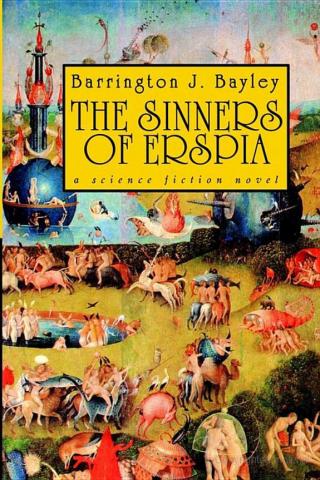
The Sinners of Erspia
- Автор: Бейли Баррингтон Дж.
- Год: 2011
- Язык: португальский
- Жанр: Научная фантастика

Электронная книга - «The Sinners of Erspia». Краткое содержание книги:
The three who had been approaching stopped to stare up at them with blank faces as they came out and stood on the platform. The clothing of the villagers was typically rustic: clumpy boots, loose trousers of a coarse, thick material, and waist-length smocks.
Laedo met their stares with one of his own.
“Is Klystar here?” he demanded loudly.
The labourers scratched their heads and looked questioningly at one another. Then one answered in a polite voice.
“No one of that name in our village. Could you have come to the wrong place?"
Laedo let it pass. “Do you have anyone skilled in metalwork?"
“That's Ebrok the smith you'll be wanting. He makes all our tools and suchlike."
Laedo grunted his disappointment, remembering Hoggora's metalworker on Erspia-1. A village smithy on Erspia-5 would work to about the same standard, he imagined.
He descended the steps. Histrina, with a winsome smile, descended behind him. As her foot touched the turf the local men deferentially fell back, ducking their heads.
“Pleased to meet you, ma'am,” they muttered together.
Then they glanced nervously overhead. The man who had answered for them pointed up at the moon.
“You aren't from there , are you?” he asked in hushed tones.
“No, we're not from there,” Laedo assured him.
He congratulated himself. These people did fear the satellite, as he had guessed. But the local's next words contradicted him.
“I thought not. No one ever comes from there. So where do you come from, in that big ... contraption you have?"
Laedo steeled himself to deliver incomprehensible information.
“We come from another world, much, much further off than your moon. You know the lights in the sky you see at night? The stars? Those are other worlds."
More scratching of heads. “Well, now, it's hard to see how there could be another world . As for the stars, we always thought them the souls of children waiting to be born."
The speaker shook his head and sighed, wearing the amiably confounded expression of one told something remarkable but of little account. “You've come a long way then, by Voluptus, and you'll be needing refreshment, so we'd be failing if we showed you no hospitality. Come along and meet the folks."
All three turned and strolled towards the village without a backward glance to see if their invitation was accepted.
Laedo wondered if it was worthwhile spending any time here, but once again curiosity got the better of him. He beckoned to Histrina, and followed on.
He was struck by a lack of reaction on the part of the farm workers. They accepted his fantastic story with no apparent wish to know more, and with no thought for possible dangers. Was it stupidity, or the habitual placidity of an animal without natural enemies? The inhabitants of Erspia-2 had been like that, and their passivity had hidden a sinister menace. But then they had been genuinely stupid, making no artifacts and with no social organisation. These people had to be smarter—they had an ordered society, built houses, farmed and made tools.
So had Klystar included a rural idyll among his worlds? A peaceful culture without perils or problems?
Perhaps as a control culture with which to compare the others...
But then there was the business of the moon...
In a few minutes they had entered the village, which was arranged around a lush central green shaded by fruit trees. Laedo noted rough dirt roads, scratched out of the landscape by use alone, vanishing into the countryside, presumably leading to other villages.
The atmosphere was tranquil. The timber-framed houses, with their glassless shutter windows, were interspersed with workshops. They passed a cobbler tapping at a nearly-finished boot, his wares laid out under an awning. Nearby was the promised smith, hammering red-hot metal on an anvil. Laedo guessed that the local economy used some form of barter, or even a system of mutual obligations. A number of women were about, accompanied by their children, the girls dressed the same as their mothers in long drab skirts and shapeless blouses, with no attempt at beautification. This was a society where appearances did not matter very much.
Histrina, in a comparatively skimpy shift borrowed from the projector station's supplies, fetched startled glances, even more so than Laedo in his form-fitting duty suit. Her gaze roved over the bodies of the men present, but half-heartedly. They were an unexciting bunch at that, Laedo thought, both men and women.
Still, they were friendly and welcoming. The field labourers’ spokesman turned his affable, ingenuous face to Laedo. “My name is Brio Fong. My wife Nellie will have food for us shortly."
Then he made a loud announcement to all within hearing.
“We have visitors from far away! Meet our guests!"
Knowing how suspicious of strangers rural communities could be, Laedo was reassured to see men, women and children wave and smile, the children following their progress with open curiosity. At the end of the village's single street yet more children spilled from the open door of a cottage, running to and fro between the interior and the dusty thoroughfare. “Behave now, children!” Brio Fong cried jovially.
“Remember your manners in front of guests!"
And indeed the children did fall quiet, lining up and watching in fascination as Laedo and Histrina were ushered into the cottage. In a cosy but disordered room, a thin woman with a drawn face was stirring a large pot hung over an open fire. From it came an appetising smell of stew.
“Put food on the table, Nellie!” Brio ordered with gusto. “Our friends have come a long way! They are hungry!"
Nellie Fong regarded the newcomers with interest. “Then you are not from Crosshatch, or Bubblespring, or any village nearby? Indeed I don't think I've seen you before."
Brio laughed chidingly. “Why no, woman! They are not from a village at all! They come from the sky and floated down on Butterly Meadow! In a sort of, er, flying house, I suppose you could call it."
Awe and fright came to Nellie's bony face. The wooden spoon almost dropped from her fingers. “From the sky! You're not from the Heavenly Mansion?"
Again Brio chortled. “No, no, no, woman! Nobody ever comes from there! Our guests hail from even further off! From the other worlds! The worlds in the sky! You know about those, surely?"
“Worlds in the sky?” echoed Nellie.
“Of course! What a patch of befuddlement you are, girl!"
Nellie stared blankly, then appeared to dismiss the matter. Her face cleared. “Well, as long as you love and serve our Lord Voluptus, I suppose that's all right."
With that, she returned to the stewpot.
“Who is this ‘Voluptus'?” Laedo enquired politely. “That's the second time I have heard the name today."
Brio, Nellie and their several children gasped and seemed astounded by his words. Nellie was the first to recover herself. “You mean you don't worship the Lord Voluptus?"
“I'm afraid not,” said Laedo, slightly taken aback. “We have never heard of him."
Nellie laid down her spoon, straightened herself and faced them with hands on hips. “Then what a mercy it is that you have come to us, poor heathen savages that you are—shoo, children, shoo! Out and play!"
Arms windmilling, she drove the young ones from the house and slammed the door behind them. “Not heard of Voluptus? How could one imagine such a thing! Though there is the tale of the village of Molem in olden times, all of whose people turned their backs on Voluptus. Well! It is up to us to put you right!"
Nellie was clearly in the grip of religious zeal. “The Lord Voluptus is the source of all our blessings. He makes the crops to grow, and the beasts of the field to bear their young. Yes, and the people, too! There would be no one left in the world if he did not bestow children on us. Now anyone may easily see for themselves that Voluptus is real, for you can see his Heavenly Mansion floating up in the sky.” With a frown she added, “I suppose you can see it from your world, too?"