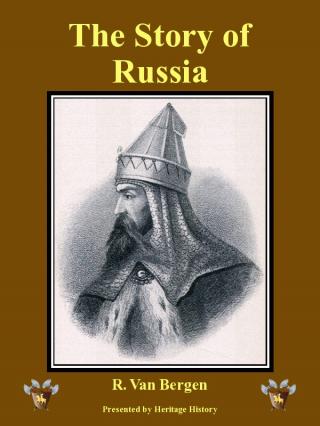
The Story of Russia
- Автор: Bergen Robert Van
- Год: 1905
- Язык: английский
- Год: Heritage History
- Жанр: История

Электронная книга - «The Story of Russia». Краткое содержание книги:
Sweden demanded the cession of the territory conquered by Peter the Great, and, since Elizabeth refused, the war continued. But Sweden was no longer the kingdom of Charles XII; the Russians were everywhere victorious, and by the Peace of Abo, in 1743, Sweden ceded South Finland and agreed to elect Elizabeth's ally, Adolphus of Holstein, as heir to the throne.
In 1740 the Emperor of Germany died, after obtaining from the powers the consent to set aside the Salic Law of succession, in favor of his daughter. This law restricted the right of succession to male heirs exclusively. In violation of the pledged word, several claimants appeared to contest the claim of his daughter Maria Theresa, and since almost every nation took sides, it was important to know what Russia would do. Elizabeth was undecided; at least, she played with both sides until 1746, when she entered into an alliance with Maria Theresa, while England promised subsidies in money. It was, however, 1748 before a Russian army of 30,000 men passed through Germany and took up a position on the Rhine. In the same year the war was ended by the Peace of Aix-la-Chapelle, without the Russians having been under fire.
Elizabeth hated Frederick the Great of Prussia. She claimed that "The King of Prussia is certainly a bad prince who has no fear of God before his eyes; he turns holy things into ridicule, and he never goes to church." The real reason was that Frederick had expressed his opinion about Elizabeth's private life, and she was not the woman to forgive his remarks. Then again, Frederick had an excellent army of 200,000 men; Elizabeth's chancellor, on that account, called Prussia "the most dangerous of neighbors, whose power it was necessary to break."
Russia, Austria, France, and Saxony, entered into a secret alliance against Prussia. Frederick found it out, and in 1756, began the famous Seven Years' War. The same year, 83,000 Russians under Apraxine crossed the frontier and seized East Prussia. A battle was fought; the Russians were the victors, but Apraxine fell back across the Niemen. France and Austria suspected treachery; Apraxine was arrested and the chancellor was dismissed and exiled. Fermor was appointed commander-in-chief.
The Russian army recrossed the frontier in 1158, took Königsberg and bombarded Küstrin on the Oder. Frederick with 32,000 men attacked the Russian army 89,000 strong at Zorndorf. The Russians fought stubbornly but were defeated with a loss of 20,000 men. Fermor was recalled, and succeeded by Soltykof who, in 1759, entered Frankfort on the Oder. Another battle was fought and Frederick was defeated by greatly superior numbers. He lost 8,000 men. Prussia was exhausted, but his enemies, too, began to feel the expense of the war. Elizabeth, however, was determined to humble the outspoken King when she died suddenly in 1761. She was succeeded by her nephew Peter Feodorovitch under the name of Peter III.
Elizabeth, although careless in her mode of living, was a stout supporter of the Greek Church. In 1742, she agreed with the Holy Synod to suppress all other churches, as well as the Mosques or Mahomedan temples in the south. This caused a revolt of the Mahomedans. The Jews were also expelled in some parts of the empire. A fever of fanaticism broke out, fifty-three raskolnik in Russia, and one hundred and seventy-two in Siberia, burned themselves to death.
Count Ivan Schouvalof, one of Elizabeth's friends, believed in education and was given a free hand. He ordered that the priests and their children should attend school, on penalty of being whipped. He founded the University of Moscow, which has educated many learned Russians. To induce students to enter, he induced Elizabeth to make a law that all students should be tchins of the tenth grade, and the professors hold the eighth grade. He sent young men abroad to study and established higher schools in every Government. Schouvalof was also the founder of the Academy of Fine Arts at St. Petersburg.
That capital was growing; its population was 74,000 under Elizabeth. She built the Winter Palace and saw the plans for Tsarskoé Selo, the magnificent retreat of the Russian emperors. She reëstablished the Senate, as organized by Peter the Great.
Russia Under Catherine II, the Great
CATHERINE II.
Peter III was thirty-four years old when he succeeded to the throne. Although it was twenty years since his aunt Elizabeth sent for him from Holstein, he was more of a German than a Russian, and had an intense admiration for Frederick the Great. He at once reversed Russia's policy, ordered the commander-in-chief of the Russian armies to leave his Austrian allies, and made peace with the King of Prussia to whom he restored all Russia's conquests. Then he entered into an alliance with Frederick, which was the means of saving Prussia.
Peter relieved the nobles of the duty of serving the state, for which they were so grateful that they proposed to erect his statue in gold; he heard of it, and forbade their doing so. He abolished the Secret Court of Police, and showed great kindness to the raskols and permitted many of them to return from Siberia. A host of other exiles were recalled, and he thought of relieving the hard lot of the moujiks.
For all this, he was unpopular and disliked. His disregard for old Russian customs and his mode of life gave deep offense. He was married to Sophia of Anhalt, who had assumed the name of Catherine; she was a woman of decided ability and strong character. Peter wanted a divorce. She heard of it and contrived a conspiracy among the high nobles and officers of the army and navy. Peter had no thought of danger, when he ordered the arrest of Passek, a young officer and favorite of Catherine. Thinking that the conspiracy had been discovered, she left her palace in the outskirts and came to St. Petersburg where the three regiments of Foot Guards declared in her favor, and Peter's uncle was arrested by his own regiment of Horse Guards. When Catherine entered the Winter Palace, she was sure of the army and navy; Cronstadt was seized by her supporters, and she issued a proclamation assuming the government. At the head of 20,000 men, she marched upon the Palace, where the czar, her husband, was residing.
Peter fled to Cronstadt and sought the Admiral. "I am the czar," he said. "There is no longer a czar," was the reply, and all Peter could do was to return to his palace, where he abdicated "like a child being sent to sleep," as Frederick the Great expressed it. He then called on his wife, "after which," Catherine tells us, "I sent the deposed emperor, under the command of Alexis Orlof accompanied by four officers and a detachment of gentle and reasonable men, to a place called Ropcha, fifteen miles from Peterhof, a secluded spot, but very pleasant." Four days later Peter III was dead. Catherine declared that he died of colic "with the blood flying to the brains."