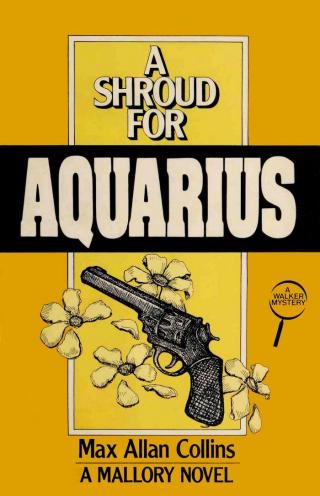
A Shroud for Aquarius
- Автор: Коллинз Макс Аллан
- Серия: Mallory #4
- Год: 1985
- Язык: английский
- Год: Walker
- ISBN: 978-0-8027-5629-9
- Жанр: Криминальные детективы

Электронная книга - «A Shroud for Aquarius». Краткое содержание книги:
“No. I loved Ginnie. I still do. But she was still living her life only for herself, for her whims, one gamble after another. She never... never really lived up to the responsibilities of being a grown-up.”
“That’s a problem for a lot of people our age. Those good old days of yours were a supremely selfish time, despite all the love-generation talk. We were a bunch of spoiled kids, rebelling against those who gave us everything.”
He looked at me sadly. “Is that how you see the sixties?”
“Sometimes. Hell, what else were we, but spoiled brats who thought we discovered politics, when all we really discovered was dope.”
“I smoke a little dope still,” he said, reflectively, sipping his tea, “but that’s about the extent of my... chemical recreation these days. I was part of the drug culture, but I’m not proud of it. Not proud of the way it’s hung onto our generation, and spilled over into the next and the next... I don’t let my daughter see me smoke dope. I don’t know, maybe I’m being hypocritical in that.”
“Don’t sweat it,” I said. “She’ll probably see her friends doing it when she’s in grade school.”
That prospect didn’t cheer him up.
“Maybe Aquarius isn’t dead yet,” he said.
“Maybe it should be,” I said.
I finished my tea, picked up the paper bag of books, told him he had a nice daughter, and left.
15
The Port City jail was across from the courthouse, the latter a big white stone wedding cake of a structure that had an entire city block to itself and its sloping-on-all-sides lawn. The jail was considerably less grandiose, taking up only half a block, the rest of which was given over to a more modern, sprawling, one-story building that had once been a supermarket but which now housed a mental health clinic and the driver’s license bureau — any connection between which I’ll leave for you to draw. As for the jail, it resembled nothing more than a rather ordinary stone cottage, if a tad oversize. Of course most ordinary stone cottages don’t have three stories, a back yard enclosed by a ten-foot electrical fence, and windows with iron bars barely visible through thick wire-mesh cages. Anyone next door in search of either better mental health or a driver’s license might view this barred, wired, electric cottage as an incentive to drive the straight and narrow.
I parked out front, fed the meter (I too was driving the straight and narrow) and walked up the steps and inside, into the outer office, a room as wide as the building but not very deep. Paneled in light pine, its walls were decorated with framed documents and the complimentary calendars of several local businesses; there were four files, three desks, two vending machines (milk, coffee, Pepsi) and one deputy. It was still the lunch hour. I nodded to the deputy — who was younger than me, always a disconcerting thought — and he nodded toward Brennan’s office, indicating the sheriff was expecting me. I walked between two desks down a narrow hall and knocked at the door at its dead-end.
“Come on in,” Brennan’s voice said.
He was sitting behind his desk, studying a computer printout. His Stetson and summer jacket were on a coat rack to my left as I came in; the pine-paneled office was small, the desk and Brennan’s comfy chair and a few spare uncomfy chairs the only furniture. On the wall to the right were three pictures, each of ducks in flight, coordinated so that the ducks seemed to be trying to fly out of one picture into the next, leaving the final duck with nowhere to go. On the wall to the left were framed clippings of a big murder case about fifteen years ago that Brennan had cracked: a local woman stabbed her husband with a pair of scissors and, thanks to an infamous local legal whiz, got off with a year, and has been serving meals around the corner at her Katie’s Snack Kitchen ever since. The wall behind Brennan bore no pictures or clippings, just a window with a view, the view being iron bars, wire cage.
Brennan looked unhappy, even a little disgusted. He motioned toward one of the spare chairs, and I pulled it up and sat. He studied the read-out, saying, “Your friend’s name is Novack. James C. Novack.”
“My friend?”
He looked up, aimed some of his disgust my way. “The feller that dropped by your place around midnight, to rassle?”
“Oh. He’s still in the hospital, I suppose.”
“Nope. They let him out for the arraignment.”
I leaned forward. “When the hell was that?”
“This morning. Bail was set at ten grand.”
“Bail! He tried to kill me...”
“No,” Brennan said, waving a finger at me. “Simple B and E, possible A and B.”
“He had a gun! That makes it at least ADW—”
“No,” Brennan said calmly — a fake calm. “He didn’t fire it at you. You were the only guy that fired it.”
I smacked a fist in a palm, both of which were my own. “I should’ve been at that arraignment.”
Brennan shrugged elaborately. “You weren’t required to be; you weren’t needed, neither. Your statement was on record. It wasn’t no trial.”
“But there will be a trial, won’t there?”
A less elaborate shrug. “Maybe. He made bail.”
“Shit!”
“Luther Cross was representing him.”
Cross was that aforementioned infamous local legal whiz; sixty-some sharp-witted years of age now, Cross was a sleaze in a three-piece suit, the town’s most notorious slumlord as well as the guy to call if you killed somebody with a pair of scissors.
“Back in the forties,” Brennan said nostalgically, “they say Cross was tied in with the Chicago crowd.”
“Legends,” I said dismissively.
Local legends had the Chicago mob connected to Port City elements as far back as the twenties and thirties, bootlegging days, up through the late fifties, when a reform mayor cleaned out several notorious blocks in town where gambling and prostitution flourished. Meredith Wilson did not have Port City in mind when he wrote The Music Man.
“Really?” Brennan said. “Would you like to know who James C. Novack is?”
“Sure.”
“He has a couple dozen assault charges, no convictions, four murder charges, no convictions, and... well, let’s just say he has no known convictions, and leave ’er at that.”
I swallowed. “Where’s he from?”
“I’ll give you a hint. They got a lake, and they got some wind.”
“Shit.”
He prodded the readout with a forefinger. “What we suspected last night seems to be the case... Novack wasn’t no house-breaker. He was there to kill you.”
I couldn’t find anything to say to that at first; the silence in the little room was, to coin a phrase, deafening.
Finally I managed a smile and said, “A Chicago hitman, in Port City, Iowa. How can you expect me to buy that?”
Brennan’s Marlboro man mug creased in a wide smile. “You don’t have to buy it. Somebody else bought it. It’s free, far as you’re concerned.”
“And the son of a bitch is out on bail.”
“Right. But I’d guess he’s probably on his way back to Chicago by now.”
“You think he’ll show up for the trial?”
Brennan gave me a facial shrug. “It’s a crap shoot. He might skip — or he might come back ’n’ face the music. If he does, he won’t get much of a sentence — might pay him and who hired ’im to sit it out in stir.”
“I don’t believe this.”
“I would, were I you, young man.”
I rubbed the sweat off my face; it was air-conditioned in here, but I was sweating. So would you, in my shoes. “I don’t feel much like a young man anymore, Brennan.”
“You want to move in with me, for a spell?”
That startled me.