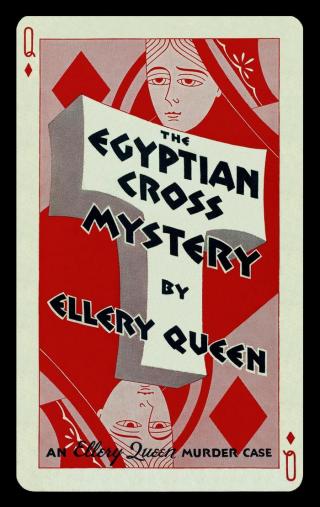
The Egyptian Cross Mystery
- Автор: Куин (Квин) Эллери
- Серия: Ellery Queen #5
- Год: 1932
- Язык: английский
- Год: Frederick A. Stokes Company
- Жанр: Классические детективы

Электронная книга - «The Egyptian Cross Mystery». Краткое содержание книги:
“I mean precisely that.”
Ellery rocked gently. “The voice of authority... Hmm. You wouldn’t want to place a small bet, now, would you, Professor?”
“I’m not a betting man; haven’t the income... Where did you get the idea that the crux commissa is called the Egyptian cross?”
“Encyclopaedia Britannica. About a year ago I had occasion to do some research on the general subject of crosses; I was working on a novel at the time. As I recall it now, the tau, or T, cross was described as a common Egyptian device, often called the Egyptian cross, or words to that effect. At any rate, my recollection is that the article definitely linked the words tau and Egyptian in connection with the cross. Would you care to look it up?”
The Professor chuckled. “I’ll take your word for it. I don’t know who wrote that article — for all I know it may have been someone of overwhelming erudition. But the Encyclopaedia Britannica is as fallible as other man-made institutions, and it isn’t always the last authority. I’m not an authority on Egyptian art myself, please understand, but it’s one phase of my work, and I tell you without equivocation that I’ve never encountered the phrase ‘Egyptian cross’; I’m sure it’s a misnomer. Yes, there is something Egyptian shaped like a T...”
Ellery looked puzzled. “Then why do you say the tau isn’t—”
“Because it isn’t.” Yardley smiled. “A certain sacred instrument used by the ancient Egyptians possessed a shape like the Greek T. It occurs frequently in hieroglyphic literature. But that doesn’t make it a tau cross, which is an old Christian religious symbol. There are many fortuities like that. St. Anthony’s Cross, for example, is a name also applied to the tau cross, merely because it resembles the crutch with which St. Anthony is generally depicted. It’s no more St. Anthony’s Cross, strictly speaking, than it is yours or mine.”
“Then the T isn’t properly an Egyptian cross at all,” muttered Ellery. “Damn it all, I would mess it up.”
“If you want to call it that,” said the Professor, “I can’t stop you. It’s true that the cross seems to have been a familiar enough symbol for ages — its use has been variegated and universal from the most primitive times. I could give you numerous examples of variations on the cruciform symbol — by the Indian of the Western Hemisphere before the coming of the Spaniards, for instance. But that’s irrelevant. The essential point is this.” The Professor screwed up his eyes. “If there is one cruciform symbol which you might by stretching a point call an Egyptian cross, it is the ankh.”
“The ankh?” Ellery looked thoughtful. “Perhaps that was what I really was thinking of. Isn’t that the T cross with the circle at the top?”
Yardley shook his head. “Not a circle, my boy, but a drop-or pear-shaped little figure. The ankh in substance somewhat resembles a key. It is called the crux ansata, and appears with extreme frequency in Egyptian inscriptions. It connoted divinity, or royalty, and peculiarly enough characterized the holder as a generator of life.”
“Generator of life?” Something was brewing in Ellery’s eyes. “Good lord!” he cried. “That’s it! The Egyptian cross after all! Something tells me we’re on the right track now!”
“Elucidate, young man.”
“Don’t you see? Why, it’s as clear as Herodotus!” shouted Ellery. “The ankh — symbol of life. Crossbar of the T — the arms. Upright — the body. Pear-shaped dingus at the top — the head. And the head’s been cut off! That means something, I tell you — Krosac deliberately changed the symbol of life to the symbol of death!”
The Professor stared at him for a moment, and then broke into a long and derisive chuckle. “Ingenious, my boy, ingenious as the devil, but a million parasangs from the truth.”
Ellery’s excitement subsided. “What’s wrong now?”
“Your inspired interpretation of Mr. Krosac’s motive in cutting off his victims’ heads might be tenable if the ankh, or crux ansata, were symbolic of the human figure. But it isn’t, Queen. It has a much more prosaic origin.” The Professor sighed. “You remember the sandals Stryker wears? They’re imitations of the typical ancient Egyptian footgear... Now, I shouldn’t like to be quoted on this — after all I’m no more an anthropologist than I am an Egyptologist — but the ankh is generally considered by experts to have represented a sandal strap like the one Stryker uses — the loop at the top being the part that passes around the ankle. The perpendicular below the loop was that part of the strap which went down over the instep and connected with the sole of the sandal between the great toe and the other toes. The shorter, horizontal pieces went down the sides of the foot to the sole of the sandal.”
Ellery was crestfallen. “But I still don’t see how that symbol, if its origin was a sandal, could possibly come to represent the creation of life, even in a figurative sense.”
The Professor shrugged. “Word- or idea-origins are sometimes incomprehensible to the modern mind. The whole thing’s unclear from the scientific standpoint. But since the ankh sign was frequently used in writing various words from the stem meaning ‘to live,’ it came eventually to stand for a symbol of living, or life. So much so that, despite the fact that the material of the true origin was flexible — the sandal generally being made of treated papyrus, of course — eventually the Egyptians employed the sign in rigid forms — amulets of wood, faïence, and so on. But certainly the symbol itself never meant a human figure.”
Ellery polished the damp lenses of his pince-nez, squinting thoughtfully meanwhile at the sunny water. “Very well,” he said with desperation. “We abandon the ankh theory... Tell me, Professor. Did the ancient Egyptians practice crucifixion?”
The Professor smiled. “You refuse to surrender, eh?... No, not to my knowledge.”
Ellery set the glasses firmly on his nose. “Then we abandon the Egyptological theory altogether! At least I do. I went off half-cocked — an alarming symptom of late; I must be getting rusty.”
“A little learning, my boy,” remarked the Professor, “as Pope said, is a dangerous thing.”
“By the same token,” retorted Ellery, “faciunt nae intelligendo, ut nihil intelligant... by too much knowledge they bring it about that they know nothing. That’s not personally intended, of course—”
“Of course not,” replied Yardley with gravity. “And Terence didn’t mean it either, eh?... At any rate, I thought you were bending over backwards in an effort to interpret the facts Egyptologically. You were always prone to romanticize, as I recall, even in the classroom. Once, when we were discussing the source of the Atlantean legend as it was transmitted by Plato, Herodotus, and—”
“If I may interrupt the learned gentleman,” said Ellery a little testily, “I’m trying to shoulder my way out of a lot of mud, and you’re befouling the terrain with irrelevant classicism. Excuse me... If Krosac by lopping off the heads of his victims and strewing T signs about the scenes of his crimes meant to leave the symbol of a cross, it certainly was not an ankh cross and could only have been the tau cross. And since there seems to be little if any significance to the existence of the tau cross in Pharaonic Egypt, the probabilities are that Krosac had no such thought in mind, despite the fact that he was associated with a madman whose obsession was things religious in the Egyptological sense... Confirmation? Yes. Thomas Brad was hung on a totem pole — pardon, post. Another religious symbol worlds removed from hieraticism. Further confirmation — if Krosac meant an ankh cross he would have left the heads rather than removed them... So we have cast doubt upon the Egyptian theory, we have no evidence for the American totem theory except the single fortuitous fact of Brad’s place of crucifixion — and that was apparently chosen because of its T-shaped significance rather than any religious significance — and we cannot persist in the cruciform theory at all... the tau cross in the Christian creed — since decapitation as far as I know has never played a part in the murder of martyrs... Ergo, we abandon all religious theories—”