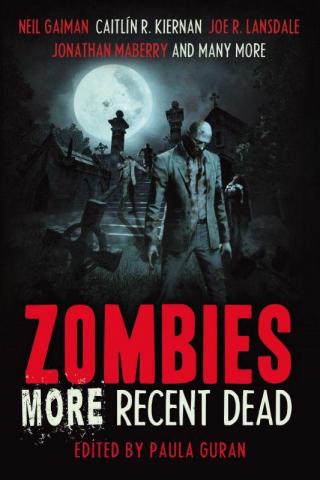
Zombies: More Recent Dead
- Автор: Гуран Пола, Гейман Нил Ричард
- Год: 2014
- Язык: английский
- Год: Prime Books
- ISBN: 978-1-60701-440- 9
- Жанр: Пост-апокалипсис

Электронная книга - «Zombies: More Recent Dead». Краткое содержание книги:
Zombies have become more than an iconic monster for the twenty-first century: they are now a phenomenon constantly revealing as much about ourselves—and our fascination with death, resurrection, and survival—as our love for the supernatural or post-apocalyptic speculation. Our most imaginative literary minds have been devoured by these incredible creatures and produced exciting, insightful, and unflinching new works of zombie fiction. We've again dug up the best stories published in the last few years and compiled them into an anthology to feed your insatiable hunger . . .
Steve Berman: Zombies: Shambling Through the Ages (Prime, 2013; mix of reprinted and original stories)
Holly Black & Justine Larbalestier: Zombies vs. Unicorns (Margaret K. McElderry Books, 2010; half zombie, intended for YA)
John Joseph Adams: The Living Dead 2 (Night Shade, 2010, mostly reprints)
Christopher Golden: The New Dead: A Zombie Anthology (St. Martin’s Griffin, 2010)
Christopher Golden: 21st Century Dead: A Zombie Anthology (St. Martin’s Griffin, 2012)
Paula Guran: Extreme Zombies (Prime Books, 2012; reprints and only for fans of the extreme)
Stephen Jones: Zombie Apocalypse! (Running Press, 2010)
Stephen Jones: Zombie Apocalypse! Fightback (Running Press, 2012)
Silvia Moreno-Garcia: Dead North: Canadian Zombie Fiction [Exile Editions (Canada, but distributed in US), 2013]
Otto Penzler: Zombies! Zombies! Zombies! (Vintage, 2011; aka as Zombies: A Compendium of the Living Dead; historical overview; reprints)
Check the acknowledgments at the back of this volume, and you’ll discover a broad range of sources of zombie stories from the past few years. You might also note that all but seven of the thirty-six entries collected here were published in 2010 or after. Of those seven: two are poems (which I did not consider for the 2010 volume), one has been published only in Australia, two were not then available for reprint, and the other two I was simply unaware of.
One thing I noticed as I discovered (or rediscovered) these very recent zombie stories: in our fictional worlds, we seem to accept that zombies exist or will exist far more readily than we did a decade ago. They are almost considered inevitable. Their fictional popularity is even sometimes referenced. This, perhaps, allows the writer to venture further from the generic trope and deal more with dead that live in different ways rather than adhere to the more common ideations—including the more fantastic. It may also allow the authors to be either more compassionate with the undead or even less understanding of the once-human monsters. We’ve known all along the living dead are really us, but authors seem to be using the metaphor of the zombie in ever more creative ways.
Usually, of course, the stories are more about living humans than the living dead—if and how they remain human after the world is utterly, irrevocably, (but not always horribly) changed. Our reaction to zombies is far more telling than the existence of the dead that walk and prey on the living—if they pose a threat to the living at all.
I won’t name titles, so as not to spoil any plots, but among these thirty-six stories you will find both the humorous and the achingly serious. Naturally, using tales of the living dead to comment on culture as a whole, religion, and politics are still fair game, and—
Zombies, along with other apocalyptic events, are used purely as a metaphor for personal pain . . .
The affliction is not immediate onset, you gradually get “sicker” until you are an “end-stager” . . . or the infection comes on in a hour—there is time to record your turning from a thinking person to a brain-eater . . .
Instead of a mass event, returning from the dead can be individual happenstance: a spouse comes back from the grave, a guy at the office shows up after he’s dead, through strange science one explores the liminal spaces that separate life from death . . .
The living dead are part of history, and the world has put itself back together one way or another. Zombies, like disease, are just another truism or merely something else that messes your life up . . .
The dead are raised for convenience, through inadvertent or intentional science or even necromancy. Society has contrived ways to deal with them . . .
Zombies are revived in various alternate histories: a pre-Roman Britain . . . First Nation legends . . . ancient Babylon . . . among nineteenth-century pox-ridden cadavers . . . during World War Two . . .
The dead return to life and nothing has changed for them or anyone else . . .
A few zombis, with roots in a mixture of Afro-Caribbean lore and the religion of voudou, appear . . . as well as other dead things commanded by more fantastic magic . . .
There is an outbreak of zombism in a posthuman far-future (complete with all the trappings of hard science fiction) on a spaceship traveling to distant stars . . .
Of course there are a variety of gritty futures where civilization has turned into an environment worse than any primitive jungle and one must fight the dead to live . . . and much more.
Are these all truly zombie stories? To me, they are: all deal with the dead coming back to some semblance of physical life. At the very least, they are worthy of your perusal and debate. The zombie subgenre, as I mentioned four years ago, is a hardy virus and continues to mutate and thus thrive.
So, once again, dear readers—BONE appetit!