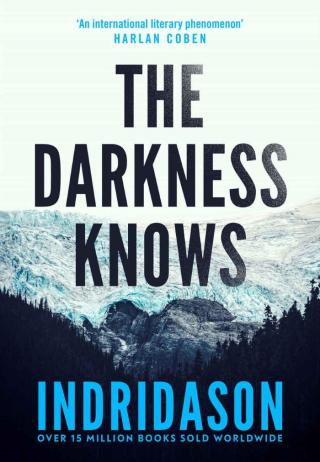
The Darkness Knows
- Автор: Indridason Arnaldur
- Серия: Detective Konrad #1
- Год: 2021
- Язык: английский
- Год: Harvill Secker/Penguin Random House UK
- ISBN: 978-1-78730-232-7
- Переводчик: Victoria Cribb
- Жанр: Криминальные детективы

Электронная книга - «The Darkness Knows». Краткое содержание книги:
The case: impossible to solve. Until now.
A frozen body is discovered in the icy depths of Langjökull glacier, apparently that of a businessman who disappeared thirty years before. At the time, an extensive search and police investigation yielded no results-one of the missing man’s business associates was briefly held in custody, but there wasn’t enough evidence to charge him.
Now the associate is arrested again and Konrád, the retired policeman who originally investigated the disappearance, is called back to reopen the case that has weighed on his mind for decades.
When a woman approaches him with new information that she obtained from her deceased brother, progress can finally be made in solving this long-cold case.
‘No, no logos,’ Ingibergur said. ‘He was older than us. At least, that’s the feeling I’ve always had. The dour type. I don’t think he had much to say for himself; he just listened to Villi talk.’
‘Why didn’t you go and join those women?’
‘I just changed my mind.’
‘Yes, but why?’
‘I...’ Ingibergur hesitated.
‘What?’
‘I recognised one of them,’ he said. ‘She was in my class for the last two years of school. Helga. I recognised her as soon as they came in and I was going to say hello but...’
‘You couldn’t do it?’
‘No. I... I changed my mind.’
Konrád gazed over at the corner where the chicken-hearted Ingibergur had sat that evening seven years ago. ‘Villi must have told you about Öskjuhlíd,’ he said.
‘Loads of times,’ Ingibergur replied. ‘He was always banging on about it. But then of course you used to run into all sorts on Öskjuhlíd in the old days.’
‘Yes, indeed.’
‘Like the gays,’ Ingibergur said. ‘They used to hang out there.’
‘So you remember the talk about the gay men on Öskjuhlíd?’ Konrád prompted. ‘From when you were a boy?’
It had been rumoured that gay men used Öskjuhlíd for their encounters. The police had considered the question of whether Sigurvin might have been cruising there, though he wasn’t known to be homosexual. But his sister had dismissed the idea as absurd, and said there was no way he could have been picking up men on Öskjuhlíd — that was crazy. Konrád had sometimes wondered if there might have been other people hanging around the tanks that night who hadn’t dared come forward because it had been so much tougher in those days to be gay.
Ingibergur drew a deep breath. ‘It might never have happened if I’d been with him,’ he said in a low voice.
‘Did you usually go back to his place after your trips to the bar?’
‘Sometimes,’ Ingibergur said, his voice dropping until Konrád could hardly hear him. ‘Sometimes to mine. We’d listen to music. He was a good mate. I... I was really sad about losing him. Still am.’
‘It’s tough, losing a friend,’ Konrád said. ‘I can hear how much you miss him.’
‘I still think about him all the time,’ Ingibergur said. ‘I miss him like hell.’
27
Húgó dropped round that evening with the twins. Their mother was entertaining her women friends and Húgó had taken the twins to a burger joint before stopping off at their grandfather’s place on the way home. Konrád was delighted to see them, as always, and joked around with his grandsons before giving them some chocolate ice cream he had in the freezer.
‘How are you doing?’ his son asked. ‘Still obsessing over Sigurvin?’
‘No, not really. I’ve just been looking into a couple of things since he turned up,’ Konrád said, switching on the coffee machine. ‘I have to amuse myself somehow.’
‘You refuse to let it go, you mean,’ Húgó said. ‘You’re determined to find out who put him there.’
‘I try not to get bored, is all I meant.’
The boys had sat down in front of the TV with their ice cream and found a film to watch. Húgó left them to it. They could be boisterous at times, especially when visiting their grandfather, who had a habit of winding them up. Anything that calmed them down was a bonus.
‘Aren’t you just bored and missing work?’ Húgó asked.
‘No, I’m not.’
‘You did when you were sacked.’
‘I wasn’t sacked,’ Konrád protested. ‘I took a year out.’
‘You didn’t take a year out, you were sent on leave. You’re still in denial. It’s unbelievable.’
‘All right, I was sent on leave,’ Konrád said. ‘Why bring that up now? What’s it got to... How’s it relevant?’
Konrád fetched their coffee, a little taken aback at the turn the conversation had taken. He didn’t know why Húgó had brought it up. The fact was, he’d been sent on unpaid leave a month or two before Villi was killed in the hit-and-run. That was why he knew so little about the case. He’d blotted his copybook and for a while it had looked as if he wouldn’t be reinstated, but it had been sorted out in the end, thanks largely to Marta.
Konrád handed Húgó his coffee. In looks, Húgó took after his mother’s side of the family, which was lucky for him.
‘Of course it’s relevant,’ Húgó said. ‘You and Mum. The old Sigurvin case. You were a real mess at the time.’
‘It was a difficult case, Húgó. Honestly, I don’t know what good it does to rake it up.’
‘Then why not leave it alone? You’re not in the police any more. It’s none of your concern.’
‘I don’t know. It was a big part of my life. Cases like that, they stay with you. I can still make a contribution. Besides, Hjaltalín wouldn’t talk to anyone else. He was the one who dragged me back into it.’
‘In spite of everything?’
‘Yes, in spite of everything.’
‘I imagine Sigurvin’s body reappearing like that must have stirred up a lot of ghosts, a lot of uncomfortable stuff you’ve maybe tried to forget. Then all of a sudden it’s brought up to the surface and you have to start processing it all over again.’
‘I’ll survive. There’s no need to worry about me.’
Húgó picked up the wedding picture of his parents from a nearby table. It had been taken outside Háteigur Church immediately after the ceremony. Konrád was wearing a borrowed dinner jacket and Erna a beautiful bridal gown, and they were smiling into each other’s eyes.
‘It’s been nearly six years,’ Húgó remarked.
‘Yes. Six years.’
After Húgó had left with the boys, Konrád picked up the picture and contemplated it. He hardly recognised the young couple on the church steps. Hardly remembered those days. Him tall and lanky, with long hair. Her wearing her hair down, with a white ribbon round her head, and heavy make-up. He had been twenty-six; she’d been a year older. It had been a beautiful summer’s day, the last weekend in June, and their smiles conveyed the certainty that they would be together for the rest of their lives. The news at the time had revolved around fishing treaties and the hay harvest. In the outside world, the usual wars had been raging. They had already lived together for several years, as had been the fashion in those free and easy times, and on the morning of their wedding day he had watched her sleeping until he could no longer resist it and had woken her with a light kiss. Then they had lain in bed and laughed over all the fuss involved in preparing for the ceremony. In those days it hadn’t been the norm for young people to get married, let alone to have a church wedding, but they had decided to go for it, however bourgeois it seemed. He had actually gone down on one knee to propose. He had suggested they elope and find a country church where they could get hitched, just the two of them, but she had been afraid of disappointing her family.
‘Always thinking of others,’ he whispered to the picture.
He heaved a sigh and into his mind came a line from a popular song that he suddenly remembered had been played at their wedding reception; a poignant tune that reached him like a whisper from a long-ago summer’s evening:
the trial of many an aching night
is to suffer and endure...
28
Konrád rarely spoke of his father to anyone, but he made an exception for Eygló. She had worked as a psychic for a while, just like her father before her. Konrád had met her when he was looking for answers about his father’s connection to a crime dating back to the Second World War. The victim, a girl called Rósamunda, had been found murdered behind the National Theatre. When the hunt for her killer was at its height, her parents had attended a seance hosted by Konrád’s father, at which Eygló’s father had acted as the medium. During the seance he had claimed that he sensed Rósamunda’s presence, but one of the other participants had suspected foul play. It transpired that Konrád’s father had gathered information about Rósamunda’s parents before the meeting and passed it on to the medium. The pair were found guilty of fraud and deception over a long period, and were accused of having deliberately set out to profit from the parents’ grief and desperation for answers. Not long ago, Konrád had immersed himself in the details of Rósamunda’s case, which had taken place in 1944, the year he was born, and it had turned out to involve soldiers from the American occupation force, leading members of Icelandic society, and residents of the Shadow District.