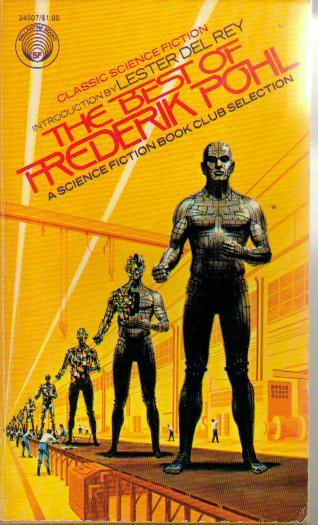
The Best of Frederik Pohl
- Автор: Пол Фредерик
- Год: 101
- Язык: русский
- Жанр: Научная фантастика

Электронная книга - «The Best of Frederik Pohl». Краткое содержание книги:
"Yez, thanggs," said Marchand politely, but he still did not listen to the talk about the machine. As long as it existed, he would use it-his conscience would not let him off that-but he didn't want details.
Because the thing was, there were all those wasted lives.
Every year in the Tycho Brahe's deep freeze means a month off the life of the body that lay there. Respiration was slowed, but it was not stopped. The heart did not beat, but blood was perfused through a pump; tubes dripped sugar and minerals into the torpid blood; catheters carried wastes away. And Groombridge 1618 was a flight of ninety years.
The best a forty-year-old man could hope for on arriving was to be restored into a body whose biological age was nearly fifty-while behind him on the Earth was nothing but a family long dead, friends turned into dust.
It had been worth it. Or so the colonists had thought. Driven by the worm that wriggled in the spine of the explorer, the itch that drove him on; because of the wealth and the power and the freedom that a new world could give them, and because of the place they would have in the history books-not Washington's place, or even Christ's. They would have the place of an Adam and an Eve.
It had been worth it, all those thousands had thought when they volunteered and set out. But what would they think when they landed!
If they landed without knowing the truth, if some ship like Eisele's did not reach and tell them in mid-space, they would find the greatest disappointment any man had ever borne. The Groombridge 1618 expedition aboard the Tycho Brahe still had forty years to go on its original trip plan. With Eisele's invention driving faster-than-light commerce, there would be a planet populated by hundreds of thousands of people, factories at work, roads built, the best land taken, the history books already into their fifth chapter. . . and what would the three thousand aging adventurers think then?
Marchand moaned and shook, not entirely because the ship was taking off and the acceleration squeezed his rib cage down against his spine.
When they were in the polyflecter's grip, he floated across the pilot room to join the others. "I vas never in zpaze bevore," he said.
Eisele said with great deference, "Your work was on the Earth."
"Vas, yez." But Marchand left it at that. A man whose whole life was a failure owed something to humanity, and one of the things he owed was the privilege of allowing them to overlook it.
He watched carefully while Eisele and Ferguson read their instruments and made micrometric settings on the polyflecter. He did not understand anything about the faster-than-light drive, but he understood that a chart was a chart. Here there was a doubly profiled representation of the course line of the Groombridge 1618 expedition. The Tycho Brahe was a point of light, some nine-tenths of the way from Sol to the Groombridge star in distance, which meant something under three-quarters of the way in time.
"Mass detectors, Dr. Marchand," said Eisele cheerfully pointing to the charts. "Good thing they're not much closer, or they wouldn't have mass enough to show." Marchand understood: the same detectors that would show a sun or a planet would also show a mere million-ton ship if its speed was great enough to add sufficient mass. "And a good thing," added Eisele, looking worried, "that they're not much farther away. We're going to have trouble matching their velocity now, even though they've been decelerating for nine years.
Let's get strapped in."
From the hammock Marchand braced himself for another surge of acceleration. But it was not that; it was something different and far worse.
It was a sausage-grinder, chewing his heart and sinews and spitting them out in strange crippled shapes.
It was a wine-press, squeezing his throat, collapsing his heart.
It was the giddy nausea of a roller coaster, or a small craft in a typhoon. Wherever it took them, the stars on the proffle charts slipped and slid and flowed into new positions.
Marchand, absorbed in the most crushing migraine of all but a century, hardly knew what was happening, but he knew that in the hours they found the Tycho Brahe, after giving it a thirty-year start.
IV
The captain of the Tycho Brahe was a graying, yellow-fanged chimp named Lafcadio, his brown animal eyes hooded with shock, his long, stringy arms still quivering with the reaction of seeing a ship-a ship-and human beings.
He could not take his eyes off Eisele, Marchand noted. It had been thirty years in an ape's body for the captain. The ape was old now. Lafcadio would be thinking himself more than half chimp already, the human frame only a memory that blurred against the everyday reminders of furry-backed hands and splayed prehensile feet. Marchand himself could feel the ape's mind stealing back, though he knew it was only imagination.
Or was it imagination? Asa Czerny had said the imposition would not be stable_something to do with the phospholipids-he could not remember. He could not, in fact, remember anything with the clarity and certainty he could wish, and it was not merely because his mind was ninety-six years old.
Without emotion, Marchand realized that his measured months or weeks had dwindled to a few days.
It could, of course, be the throbbing pain between his temples that was robbing him of reason. But Marchand only entertained that thought to dismiss it; if he had courage enough to realize that his life's work was wasted, he could face the fact that pain was only a second-order derivative of the killer that stalked his ape's body. But it made it hard for him to concentrate. It was through a haze that he heard the talk of the captain and his crew-the twenty-two smithed chimpanzees who superintended the running of the Tycho Brahe and watched over the three thousand frozen bodies in its hold. It was over a deep, confusing roar that he heard Eisele instruct them in the transfer of the FTL unit from his tiny ship to the great, lumbering ark that his box could make fleet enough to span the stars in a day's journey.
He was aware that they looked on him, from time to time, with pity.
He did not mind their pity. He only asked that they allow him to live with them until he died, knowing as he knew that that would be no long time; and he passed, while they were still talking, into a painful, dizzying reverie that lasted until-he did not know the measure of the time-until he found himself strapped in a hammock in the control room of the ship and felt the added crushing agony that told him they were once again slipping through the space of other dimensions.
"Are you all right?" said a familiar thick, slurred voice.
It was the other, last victim of his blundering, the one called Ferguson. Marchand managed to say that he was.
"We're almost there," said Ferguson. "I thought you'd like to know. There's a planet. Inhabitable, they think."
From Earth the star called Groombridge 1618 was not even visible to the naked eye. Binoculars might make it a tiny flicker of light, lost among countless thousands of farther but brighter stars. From Groombridge 1618 Sol was not much more.
Marchand remembered struggling out of his hammock, overruling the worry on Ferguson's simian face, to look back at the view that showed Sol. Ferguson had picked it out for him, and Marchand looked at light that had been 15 years journeying from his home. The photons that impinged on his eyes now had paused to drench the Earth in the colors of sunset when he was in his seventies and his wife only a few years mourned. He did not remember getting back to his hammock.
He did not remember, either, at what moment of time someone told him about the planet they hoped to own. It hung low around the little orange disk of Groombridge 1618-by solar standards, at least. The captain's first approximation made its orbit quite irregular, but at its nearest approach it would be less than ten million miles from the glowing fire-coal of its primary. Near enough. Warm enough. Telescopes showed it a planet with oceans and forests, removing the lingering doubts of the captain, for its orbit could not freeze it even at greatest remove from its star, or char it at closest-or else the forest could not have grown. Spectroscopes, thermocouples, filarometers showed more, the instruments racing ahead of the ship, now in orbit and compelled to creep at rocket speeds the last little inch of its journey. The atmosphere could be breathed, for the ferny woods had flushed out the poisons and filled it with oxygen. The gravity was more than Earth's-a drag on the first generation, to be sure, and an expense in foot troubles and lumbar aches for many more-but nothing that could not be borne. The world was fair.