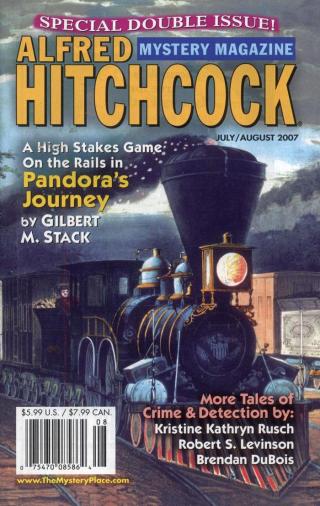
Alfred Hitchcock’s Mystery Magazine. Vol. 52, No. 7 & 8, July/August 2007
- Автор: Baldwin Barry, Campbell Melodie
- Год: 2007
- Язык: английский
- Год: Dell Magazines
- ISBN: ISSN:0002-5224
- Жанр: Другие детективы

Электронная книга - «Alfred Hitchcock’s Mystery Magazine. Vol. 52, No. 7 & 8, July/August 2007». Краткое содержание книги:
“Dangerous how?”
“Like I could be dead any minute, murdered, before you have a chance to mount your white charger and ride to my rescue, the way Errol Flynn — bless his dear, drunken soul — did in Fort Worth.”
“I remember Flynn in San Antonio and Virginia City,Santa Fe Trail, but Fort Worth? I don’t know that movie. Is it out on DVD?”
“Not a movie. We were in Fort Worth on a war bond tour, Errol and me and a bunch of other Warner Brothers contract players. That crazy galoot saved me from having to go to bed all by my lonesome.” She laid in a lusty groan. “Think he’d also saved all the other dames on the tour before the Superchief got us back to L.A.” Another cough from lungs that sounded in trouble. “So, what do you say, Neil? Come give an old broad a helping hand?”
“As dangerous as you say, aren’t you better off calling the cops?”
“You hear why straight from the filly’s mouth, you’ll understand why not. At Burbank Studios. On the Melancholy Baby set the rest of the day. I’ll leave your name on the pass list at the Barham gate.”
She was off the line faster than I could raise another question.
A couple hours later, I tagged a “-30-” to tomorrow’s column, an emotional screed decrying the destruction of another landmark, the Ambassador Hotel and its fabled Cocoanut Grove, where the stars came out to play when Hollywood was Hollywood and Laura Dane was a name-above-the-title movie star who specialized in playing “the other woman,” much as she had done in real life most of her life, wreaking havoc on Kay Francis, Miriam Hopkins, Claire Cavanaugh, Bette Davis, Barbara Stanwyck, Joan Crawford, and others of her peers.
I e-mailed the piece downtown and took off for a landmark that had withstood the ravages of progress, the Warner Bros. Studio, renamed the Burbank Studios after a shotgun marriage of economic convenience with Columbia Pictures. It was a typical Los Angeles afternoon, the slate blue sky lush with cumulus clouds, the Hollywood Freeway flush with bumper-to-bumper traffic, impatient drivers answering one another with honking horns and expressive middle fingers.
After forty minutes, I pulled up to the Barham Boulevard entrance. A gatekeeper hiding behind reflective shades checked my name against the list on his computer screen and overacted giving me a once-over twice over, logged in my aged Jag’s license number, and directed me to the outdoor set where Melancholy Baby was shooting.
The company had broken for lunch.
Nobody seemed to know who I was talking about when I asked for Laura Dane, except a prune-faced actor in his late seventies or early eighties, costumed in Sunday best, an extravagant handlebar mustache, and a halo of thick white hair, who stepped over at the mention of her name and said, “Check Marnie Nichols’s trailer. Back there, the biggest one of all. Can’t miss it.”
Marnie Nichols.
The name gave me a smile and a jolt of memory as electric as my first dose of morning coffee.
When I met her, she was this fresh-faced kid from Columbus, studying acting with her Great Aunt Laura, driven by the usual wide-eyed dreams of fame and fortune that’s oversold in bulk on television and magazine racks. She’d become one of the few who could cash in her bus ticket back home, as attested to now by the glitter-speckled gold star adhered to the door of her trailer. I rang the bell and when that got me nowhere hammered with my fist and called her name.
After a few more failures, I turned to leave, till I heard the door creak open a crack. A voice full of challenge demanded to know: “That you, Neil Gulliver?”
“In living Technicolor,” I said, swinging around again to confirm it was Laura.
“Get the hell hurry-up inside,” she said, pushing the door wide enough for me to see the Colt .45 caliber automatic she had aimed at my chest, struggling with criminal intensity to keep her two-handed grip steady.
“That’s a prop gun, right?”
She ignored the question. “C’mon, handsome, give it the gas,” she said. “Inside before the son of a bitch spots me.”
There was more luxury to Marnie Nichols’s motor home than to my Westwood condo, all the accoutrements of the stardom earning her twelve million dollars a movie and a modest chunk of the gross, more than your most basic math told me I’d make over my lifetime, however long or abbreviated.
And nobody would ever mistake Marnie for trailer trash, especially not looking the way she looked now, in repose like Ingres’ Grande Odalisque, the risqué Mademoiselle Airière, on a plush chaise lounge covered in crimson velvet about halfway back, twenty-five feet or so, across carpeting a foot deep from an entertainment center out of Mission Control.
Her smile was warm and inviting, her almond-shaped cerulean blue eyes ablaze with the suggestion of more than homespun hospitality — unlike Laura, who alternated looks of dread and fear. Laura’s thread-thin lips ticked recklessly into her hollow cheeks, her gray eyes dulled by time, shifting left and right while she used the .45 to direct me to the driver’s seat. The equipment that had earned Marnie the deserved sobriquet “Body Bountiful” was on full display under a pink silk camisole, and I made a mess of averting my gape, drawing a tinkling giggle of appreciation from her.
Laura said, “You notice anything strange going on?”
“Outside or in here?”
“Not a laughing matter, handsome. Tell him, Marnie, how it’s not a laughing matter.”
Marnie threw an arm across her breasts, putting an end to my peep show. “It’s truly not, Mr. Gulliver. Somebody has been stalking my auntie, threatening to kill her.”
I returned Laura’s anxious stare with one of my own, briefly bagging her head to toe with disbelieving eyes. Long gone was the sex kitten who could get a gent’s pulse skipping beats with a simple wink, replaced by a woman somewhere in her mid eighties, with the sallow complexion and wasted body of someone ill beyond repair.
Laura had turned into half the woman I’d dealt with before, when the astonishing key-ring waist and conical breasts of her stardom had given way to an elephantine body she routinely hid inside tent dresses. The hair she had let go naturally white then and wore like a tight snow bonnet had become a hodgepodge of cotton tufts and random strands.
She coughed into her fist again and asked, “You heard her. More than having to take my word for it.”
I slipped Marnie a glance.
She answered with a wink and a furtive nod that seemed to say, Play along with her.
I said, “When did the stalking begin, Laura?”
Laura closed her eyes and nodded to a silent count that ended with her deciding, “Forty years ago, maybe more.”
At once, I had visions of a stalker using a walker. “A pretty determined fellow. And the threats on your life? Also forty years ago?”
“Starting ten days, maybe two weeks ago. Calling me up again and again, and how he got the unlisted numbers, I don’t know. Every time telling me he’s close as my shadow, and one day soon, he’ll show himself, punch my ticket for good.”
Laura parked the .45 on the copilot’s seat, studied my reaction while scoring a cigarillo from the flip-top box on the dashboard. She slotted it in a corner of her mouth, tossed me the Zippo lighter on the dash, and crooned, “Put your hot one to my cold one and make my cold one hot, baby.” Like I was Cagney in a scene burnt into my memory from the movie where he torched a cigarette for her, then used the smoldering butt to brand her on the neck.