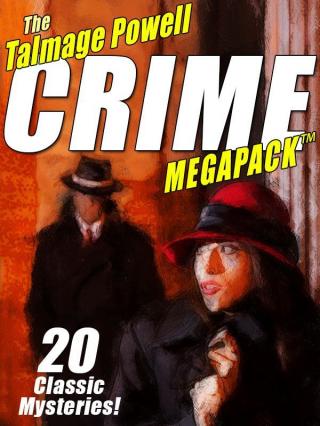
The Talmage Powell Crime MEGAPACK™: 20 Classic Mysteries!
- Автор: Пауэлл Тэлмидж
- Год: 2015
- Язык: английский
- Год: Wildside Press
- ISBN: 9781479406111
- Жанр: Криминальные детективы

Электронная книга - «The Talmage Powell Crime MEGAPACK™: 20 Classic Mysteries!». Краткое содержание книги:
“Sounds pretty dull,” I conceded.
“You’ve no idea,” he said. “For a time, I tried to make friends. You know, have somebody drop into the house and play bridge or have a little dinner. The experiences were horrible. A couple would drop in and Jassie wouldn’t stir. I’d have to cook the dinner and explain her illness. Newly made friends usually dropped in only once, the house was usually... well, dirty, unmade, you know. Sometimes the dirty dishes and garbage container made it smell. Anyway, Jassie would never return a visit. As time went on, she got worse, of course.” He looked at me calmly and I got a mental picture of Jassie, spreading over the couch as the years spread over her. Jassie so helpless, demanding every moment of his time, hemming in every second of his life.
“After a long time,” he said in a tone more introspective than he’d used before, “I realized I must leave Jassie. I had no money. We never had any money. I didn’t make much, and she knew the amount to the penny. She didn’t know how to handle money. We arrived at every payday flat broke. Week by week — sort of like a motion picture that’s going nowhere.
“Although I lacked money, I did get a chance to go in business. A man who knew my work offered me the same starting salary and a small interest if I would go into a new venture he was starting.
“Jassie wouldn’t hear of it. It was risky. I wouldn’t be able to work set hours. Sometimes I’d have to work nights or on weekends. The business was bound to fail. Everything must go on just as in the past.”
“Did the business fail?” I asked.
“Most ironically,” Hervie Taylor said. “The man who took the place I was offered absconded with considerable funds. He was later caught and punished, but the damage to the business was done. He’d spent the stolen money. I’m certain,” he added solemnly, “the story would have been different had I entered the venture. I would have worked hard. I would never have touched the first penny.”
I believed Hervie Taylor on that point. Until he’d chopped up Jassie, his record had been without blemish.
“Please understand,” he said, “how this affected me. Here was a business ruined and gone in which I might have found delight, interest, even excitement. So for the first time I left Jassie.”
“First time?”
He nodded. “I slipped my clothes out of the house and moved to a hotel. I left her a note saying I would send her money each week. Believe me, I had no intentions of living a dissolute life. But I did have a glorious evening, just able to walk the streets. Jassie came to me. She begged. She wept. She implored. She just now realized how much she loved me, she said. She’d do better.”
He looked out the window for a few moments. “Women,” he said, “have emotional weapons they use against men sometimes, some women. You can’t feel this weapon, you can’t name it. It’s like an invisible net and the more you struggle against it, the more you feel like a monster and brute. Do you know what I mean?”
“Well,” I said, “I’ve never had your experience.”
“You haven’t a Jassie,” he said. “I went back to her. And for a little while she was different. She even cooked a steak or two. It didn’t last, this new Jassie. Before long she was back in her rut, only more so.”
“You left her again?”
“Yes. This time she came with the tears, the imploring, the promises. They didn’t work. The next, evening a seedy looking guy with the photostat of a private detective’s license in his wallet came to see me. He said that Mrs. Taylor was his client and I was through mistreating her. His threat was veiled, but I understood. I returned to Jassie.”
“That was the last time you left her?”
“Oh, no. She hemmed me in worse than ever. I simply couldn’t stand it any longer. This time I would really run away, go to another city, change my name.”
He paled a little, remembering. After a moment, he said, “She caught me slipping out of the house. Know what she did? She whipped the literal hell out of me. That’s what she did. I mean, she used her fists. She knocked me down and kicked me and dragged me to my feet and knocked me down again. This went on for a considerable time. I really don’t know of anything more shattering that can happen to a man. I despised myself. She despised me just as much. For years she had counted out my pocket money to the penny. Now she even told me what to eat for lunch. It was never much. I’ve never known the human heart could hold so much hatred as I felt for Jassie.”
“You didn’t run away again,” I said.
“No. I knew it would be no use. A week later, after I’d cooked supper one night, she called to me to bring her food to the living room so she could finish watching one of her interminable TV programs. A strangely nerveless feeling came over me. I found myself with the knife in my hand. Funny... when the knife disappeared in her, she gave a little squeak for all the world like a fat, gray mouse.”
We rode a little in silence. We were almost at the prison now. Hervie Taylor sat at his window to catch the first sight of it.
“Relax,” I said. “There are no whips or sadistic guards in displace.”
“Relax?” He turned to look at me. “But I understand it’s a model prison. Weekly movies, a machine shop, a prison brass band, a nice library, even a baseball team.”
“That’s right,” I said.
His reply was brief, simple, and straight to the point. A beatific smile brought out the boyishness in his face. He looked out the window toward the distant grey walls of the prison. “Freedom,” he said.
Money, Murder, or Love
Originally published in Alfred Hitchcock’s Mystery Magazine, June 1961.
The call came in shortly before I was due to go off duty at 7 A.M.
York stuck his head in the squad room. “We got a job, Nick. A kid just found a stiff in an alley off Kilgo Street.”
We went downstairs to the garage and got in one of the black, unmarked cars. As I drove across the city to Kilgo Street, York kept up a barrage of talk. He’s been a cop almost as long as I have, twelve years, but he’s never got used to the idea of death. He talks to cover his nervousness.
He talked about his wife and kid, as if really interested in selling me on the idea of marriage. He talked about the weather and of Sergeant Delaney’s gall stone operation. He talked of anything except the violation of a human life.
The city was awakening, and for this brief moment it felt vital and clean, qualities that never extended to the street we were headed for.
By the time we reached Kilgo Street, York had run out of extraneous talk. “Well,” he muttered, as I stopped in the mouth of the alley, “I guess he can’t be much. Some bum. Who else would get himself killed in a Kilgo district alley?”
We got out of the car. The beat cop — a heavy, porcine guy intended by birth, reflexes and mentality never to rise far — came forward to meet us.
Hemmed in by scabby brick walls, a Kilgo Street alley is a particularly unpleasant place to die.
The beat cop grimaced. “He’s back there.”
“Touch anything?”
“No, sir.”
“That kid find him?” I asked, pointing toward the skinny youth pressed against the wall.
“Yes, sir. He was short-cutting it through the alley, on his way to work at the produce market.”
I saw York had that pale look about him. So I said, “Take over with the kid.”
“Sure, Nick,” he said quickly.
In our society, few people find their natural place. York should have been an insurance salesman. Instead, he’d needed a job years ago and the civil exams had been open. It’s the little fates that put us where we are.