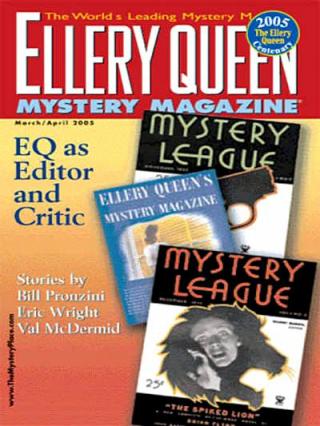
Ellery Queen’s Mystery Magazine. Vol. 125, No. 3 & 4. Whole No. 763 & 764, March/April 2005
- Автор: Dean David, Dempsey Timothy F.
- Год: 2005
- Язык: английский
- Год: Dell Magazines
- ISBN: ISSN 1054-8122
- Жанр: Другие детективы

Электронная книга - «Ellery Queen’s Mystery Magazine. Vol. 125, No. 3 & 4. Whole No. 763 & 764, March/April 2005». Краткое содержание книги:
“Better get out there,” Hennessey said. “Go in force. If we can lift Charlie Pimlott’s fingerprints from the chair, with the statement, that will convict him. He’s slipped up.”
“Only if he hasn’t sent in the cleaners.” Yellich stood. “We’d better move quickly.”
Ten months later, Hennessey and Yellich sat in silence as a scarlet-clad judge sentenced Thomas Alfred Baruch, aged thirty-three, to life imprisonment for the murder of Charlie Pimlott, and twelve years’ imprisonment for the possession of a quantity of cocaine with intent to supply. Both sentences to run concurrently.
After giving evidence at the trial at York Crown Court, Henry Cooke was ushered away in a police vehicle to begin a new life in a new location with a new identity. He lived from then on with the knowledge that from his prison cell Thomas Baruch had put a one-million-pound price tag on his head.
Copyright ©; 2005 by Peter Turnbull.
Seduction
by Maureen Tan
Though she is new to our pages, Maureen Tan is the author of two novels published by Warner Books (AKA Jane — hardcover 1997/paperback 1999; and Run Jane Run — hardcover 1999/paperback 2000), and the recently published A Perfect Cover, the first in a new series from Harlequin Bombshell. A second book in the Bombshell series is expected in May 2005. Her contribution to EQMM belongs to a genre we see little of these days — the spy story.
Ian Fleming lied. Suave, handsome men are not the best spies. Nor are young, glamorous women. Not that they don’t have their place, but it’s usually in someone else’s bed. Prone and passionate, seductive spies inspire subversive whispers and coerce confidences. But beyond the bed, it’s unremarkable, middle-aged women who are the masters of the trade.
Seduction is unnecessary and irrelevant.
I was female, fifty-eight, and ordinary. Not to say that on some days I didn’t feel extraordinary, mostly because I’d survived almost four decades in the intelligence business. But I didn’t look glamorous or remarkable. I never had. The face and body I was born with put me well on the way to plain. Makeup and wardrobe put me half a step into homely. But I avoided stepping into ugly.
People remember ugly better than they remember pretty. And people don’t trust ugly. By those standards, Professor Smith was extremely memorable and absolutely untrustworthy. He was tall, round-backed, and hairy. Mostly hairy. Wiry strands sprang, untamed and unkempt, from his head, ears, cheeks, upper lip, and chin. The hair framed a face that was dark-skinned, flat-nosed, and creased with lines that had not been formed by smiling.
Professor Smith was also brilliant. Those trying not to be racist called him a credit to his race. I, too, was black. But in the hallowed halls of Urbana State University, I was too insignificant to be considered a credit or debit to anyone’s race. I was just another woman working as a handmaiden to a Great Man. The university’s personnel office classified that position as Transcribing Typist III.
On the day I interviewed for my job, I sat in front of Professor Smith’s metal desk and leaned sideways so that I could see him past the backside of an oversized computer monitor and a tangle of cords and connectors that cascaded down the back of the desk and disappeared beneath it. There were no papers on his desk, no books in his bookcase, no posters or photographs on his office’s stark white walls. Professor Smith believed in the paperless society. He practiced his beliefs. Everything was stored on his computer, and his interactions with others were primarily electronic. He had no wife, no children, no lover, no friends, no students.
He couldn’t type.
“My thoughts, my words are to be transcribed exactly as I speak them,” Professor Smith said. “No editing. No reorganization. No commentary. Can you manage that? The last one couldn’t.”
The last one, I’d been told by someone in personnel, had lasted six weeks. And she’d done better than most.
“Yes, sir. I can do that. Only—”
I let a little fear creep into my voice.
Professor Smith didn’t notice. He had drifted back to his monitor, was absentmindedly twisting greasy facial hair between the fingers of one hand as he tapped at the keyboard with the fingers of the other. His chronic frown deepened into a scowl.
“What?”
Still, I hesitated, intent on emphasizing an all-important lie.
“What?” he repeated. His busy fingers paused and his impatient voice was angry.
“I’m not good with computers,” I said. “I’m okay to type onto them. I’m a good typist. Really fast. But those other computer things — the Internet and e-mail and spreadsheets and things — well, they confuse me.”
His attention remained on the screen, which was a window to one of the most sophisticated computer systems in the world. On it, the professor was designing a low-power propulsion system — a pulsed Teflon plasma thruster that worked in the 10-to-100-watt power range. Reports coming out of the U. S. Department of Defense anticipated that, within months, Professor Smith would perfect a system that was sophisticated, elegant, and essential to the efficient operation of small satellites. Those satellites were essential to a host of military and civilian applications. Which is why the university tolerated and the government funded such an unsophisticated, inelegant, and imperfect man.
“I asked for a typist,” he said. “I assume you’re qualified if they sent you. Be here tomorrow morning. Now go away.”
I left. And I wondered if, at any point, he would ask my name. The professor never did, which went a long way to making my job easier. I always found it difficult to kill someone I liked.
On Monday morning, I took the Route 5 bus across town to campus, just as I had every weekday for four months. I walked across the grassy central quadrangle, beneath towering oaks budding with springtime green, and between massive buildings devoted to education and research. The Goddard Aerospace Engineering Building was at the north end of the quad. It was a Gothic-style brownstone with granite steps worn smooth by 190 years’ worth of footsteps, mostly white, mostly male.
Inside, the venerable structure had been retrofitted to meet the needs of modern researchers. And modern security. Energy-efficient Thermopane windows were wired into a central alarm system. Placards mounted at all the entrances warned visitors that cameras scanned the hallways. A keycard was required for access to individual laboratories and offices. The card I’d been given unlocked the small vesitibule where my desk was tucked, an interior door to Professor Smith’s spacious office, and a laboratory that the professor judged wholly inadequate.
Little about me had changed since the first day the professor and I met. My hair was still styled by a beautician who violated zoning ordinances by operating a salon in her kitchen. She smoothed it down and pulled it back into a “do” that was dated and conservative. Every day, I carried the same purse with me to work. It was oversized and worn, its tapestry fabric decorated with faded pink and burgundy roses. The dresses I wore in all but the most severe weather also tended toward florals. I never wore a girdle — the fifty extra pounds I carried jiggled comfortably beneath my clothing. I made myself so ordinary and predictable that no one in the bustling college town took much notice of me. Not my neighbors. Not faculty, staff, or students. Not anyone. Especially not Professor Smith.
In the time I’d worked for him, he had expressed interest in only two things — his research and Professor Chan’s laboratory. He coveted Professor Chan’s large, ultra-modern laboratory space the way another man might lust after his neighbor’s sexy wife. He couldn’t get it out of his mind, he desired it above all things, and he was willing to do almost anything to possess it.