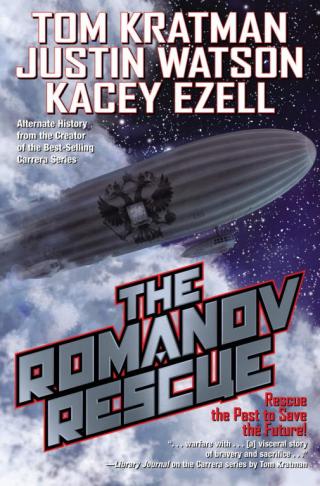
The Romanov Rescue
- Автор: Кратман Том, Watson Justin
- Год: 2021
- Язык: английский
- Год: Baen
- ISBN: 978-1-9821-2570-7
- Жанр: Альтернативная история

Электронная книга - «The Romanov Rescue». Краткое содержание книги:
As WWI comes to a close a German general, an escaped prisoner of war, and the crew of an airship converge to effect THE ROMANOV RESCUE. Can there be a world without communism?
Mankind’s history is bound up in the fabric of fate, a strong cloth, tough and closely woven.
It is the beginning of 1918, the last year of the greatest war in human history, to date. All the belligerents stagger on their feet. Starvation is an ever present reality, while disease waits in the wings. In Russia, no longer a belligerent but, instead, rapidly descending into civil war and chaos, a lone family—Father, Mother, four beautiful young girls, and a brave but sickly boy—await their own fate, shivering and hungry in the dark, hoping and praying for salvation.
Their relatives in England have turned their backs. The guards set over them do little but torment them. They look Heavenward, but God doesn’t answer. They know they’re a threat to the new regime, a threat that will, in time, be eliminated.
But even the strongest fabric has flaws. An escaped prisoner of war, caught, injured, and punished, but still highly capable, might be one. An airship, returned and at loose ends after a failed mission to Africa might be another. A German general, taking a wrong turn on his nightly walk and suddenly coming face to face with the reality of the monster rising in the east, would be a third.
Follow, then, as the general gives the orders, the prisoner of war raises the men from among his fellows, and the airship launches itself forward, to contest fate, to tear the fabric of time, and to effect The Romanov Rescue.
About the Carrera series:
“Yes, sir.” The clerk reached down and grabbed one kit at random. Opening it, Daniil found it was perfectly clean.
“Are they all this clean?” he asked.
“Yes, sir; very thorough people, don’t you know, the Germans; that, and sanitary. Well, I suppose they have to be, packed in like they are. But apparently all the battlefield leavings they salvage they also clean and maintain.”
“How many do we have of the kits?”
“On the theory that some would be defective—none of them are—Captain Romeyko got seven hundred and fifty. We have a good many extras.”
Hmmmm, thought Kostyshakov, that’s a lot of pretty high-quality copper we can trade, if anyone has something to trade for it.
Daniil passed the mess kit back. “I’ll draw mine with the rest of the officers, after the men are fed.”
He stopped then to examine the lay of the kitchen. The door was just a space covered by a piece of canvas. The exterior walls were mud-chinked. There was some kind of oiled paper over the windows, impossible to see through but admitting a degree of light. An overhead covering, held up by four-by-fours and extending perhaps twenty-five feet from the door, provided a modicum of shelter for some of the troops. Gravel lay over the dirt, in near enough to the exact dimensions of the overhead shelter.
Of course, that’s not about troop comfort; that’s about keeping the ground dry—or drier—to reduce dragging mud into the mess.
Stopping at the door and pulling the canvas aside, Daniil felt the wood framing the door. It was overlapping rough-sawn pine with the bark still on. Some class of wood, at least, is still plentiful. Speaking of which… Daniil walked into the kitchen, hot and steaming after the cold morning air.
Pointing at the grayish brown half loaves on display, Daniil asked of the elderly German noncom responsible for both kitchens, “What’s in the bread, Feldwebel…?” He noticed the chief cook wore an Iron Cross, First Class, on his apron. This was not common.
“Feldwebel Taenzler, Herr Oberstleutnant…” the head chef hesitated.
“It can’t be worse than what’s fed at the prison camps, Taenzler.”
“It varies with what’s available,” the German admitted, “and, yes, better than what’s served in the camps, from what I hear.” Picking up a half a loaf, the German continued, “These loaves have some wheat, a lot of rye, some lentils, some maize, a good deal of potato flour, and…”
“And a bit of sawdust?” Daniil prodded.
“Not sawdust exactly, that’s only for bread for prisoners of war, and that only if we’re desperate, but wheat and rye bran, yes. Under ten percent, by weight, but yes, sir, bran. I won’t say that some bakers, unscrupulous or desperate, take your pick, don’t sometimes resort to ‘tree flour’—or even worse things—but the army? No.”
Well, I’m glad of that.
“Is that what’s authorized for a combatant ration?” Daniil asked.
“Yes, sir.”
“Okay, what else have we got?”
“Officially? Officially, Sir, the men get about five or six ounces of meat a day, but officially Germany is winning the war, too. It’s very difficult, I find, to reconcile those two bits of information.
“Unofficially, a lot of the meat will be ‘war sausage,’ which we call a ‘mouthful of sawdust’; no, there’s no sawdust in that, either. It’s mostly vegetable in origin, flavored with some blood, some meat scraps, some offal, some fat. It’s not sawdust, but it feels like it is. I counsel against enquiring too deeply as to where the fat came from; suffice to say that at least it isn’t human. Oh, and water, too, of course, lots of water.
“We might get fish, occasionally. It’s likely to be past its prime. Some of the meat, too, will be horse… but you don’t get much meat from a horse anymore, what with overworking and underfeeding.
“Frankly, we get what we can at the front and those behind get less. But, then, too, it could be worse; we could still be trying to keep body and soul together with rutabagas, and not enough of those. And cattle starving because people were eating the rutabagas that the cattle usually ate.
“We’ll have some potatoes,” the chief cook continued, “some vegetables—I have my men scrounging for nettles for soup—occasional cheese—no, it isn’t good cheese—some peas, some beans. Every man’s supposed to get an egg a day but two a week is a surfeit of riches; one is more likely and not every week. Most of the time there will be a kind of fake egg made of potato or maize, some coloring, and maybe some additives that don’t bear thinking about. Butter is… well… it’s curdled milk, some sugar, and also some food coloring. Sometimes we get Schmaltz, which has the great virtue of, at least, being mostly real. Today, we have enough Schmaltz. Coffee… we have enough ersatz…”
“Roasted acorns, beechnuts, and chicory? I’ve had that; we all have,” Daniil said.
“That, yes. It’s not good, especially, but it is a little better than nothing. And on a cold winter’s night… not much sugar for it, mind, and rarely any milk.”
“And this,” Daniil asked, “is what you’re feeding your own men?”
“When we can get it,” the cook answered. “Sometimes we can’t. Mind, there is a better ration, but it’s usually only fed for a few days, maximum a week, before an offensive. It’s close to real food. But talk about mixed feelings…”
Note to self, talk to Brinkmann about getting on that superior ration scheme.
Daniil sniffed. “Stew?”
“Yes, sir, stew. I thought about porridge for breakfast but not only didn’t I have any real milk, I figured something a little heartier might be more to taste after the camps. Besides, we were able to scrounge some mushrooms to eke out the little bit of meat for today.”
“How did you end up running a mess?” Daniil asked, pointing at the Iron Cross.
The cook grabbed a long ladle and tapped his left leg with it, producing a hollow, wooden sound. “Verdun,” he answered, in full and complete explanation.
Daniil shook his head; he’d heard about the battle in great detail from de Gaulle; there were no words for someone who had gone through that particular hell on Earth. Finally, he said, “While you don’t actually work for me, do let me know if there’s anything I can do to help with your operation here. We’ll do our best.”
As I am pretty sure you will, old soldier.
“There is one thing, Herr Oberst? I could use at least one Russian cook to advise me on Russian recipes.”
“Now that, Feldwebel Taenzler, is an excellent idea. Indeed, we have some cooks, six or seven. Let me arrange to send them to you, some or all. Do you have anyone who can speak Russian?”
“Polish? I can at least get by in Polish.”
“We might have a Pole.”
While the men were drawing food, to be followed by individual equipment, less small arms, in one part of the camp, in another the remarkably unlovely Captain Romeyko and his assistants were laying out unit equipment packages on the still grass but soon to become dirt street in front of the quartermaster’s shop. This consisted of nine Lewis guns, in 7.62x54R, each, for Second and Third Companies, plus two 37mm light infantry cannon, French captures, two Russian Maxim heavy machine guns in the same caliber as the Lewis guns, for First Company, as well as two 13.2mm antitank rifles the Germans had been willing to part with.