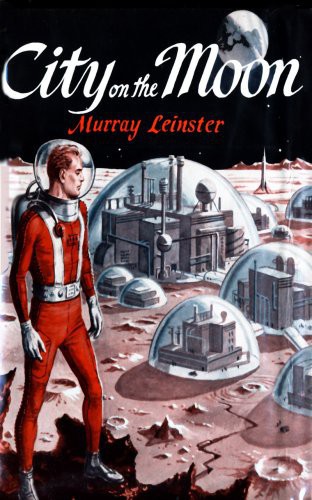
City on the Moon
- Автор: Лейнстер Мюррей
- Серия: To the Stars #3
- Язык: английский
- Жанр: Научная фантастика

Электронная книга - «City on the Moon». Краткое содержание книги:
That was a moon-story akin to that ancient tale of the rider on the obedient mule who trotted over a precipice with a man on its back—the man's life was saved when he called "Whoa!" and the mule obediently halted in its descent. The chief finished with the bland statement that the really tough part of the ordeal was that they couldn't smoke except out-of-doors.
Cecile smiled sweetly at him and closed her faceplate, explaining that, "Ef theese should break, now that I go outside, I would look vairy ugly to you!" She seemed to enter an airlock. The camera shifted, and she appeared to come into outer airlessness through the lock. There was a moon-jeep in the projected background; she pointed to its picture and explained with seeming excitement about those vehicles of burden. She explained about vacuum suits—information she'd gotten from Arlene. She lifted a handful of moondust, brought in for the purpose, and let it sift from her mittened hands, showing how slowly it fell. She talked of landslides and dust-lakes with a contagious shudder, which was just right to give her audience shivers without frightening it in the least.
Then she seemed to clamber a little, the camera following her, and there was a view of a moon crater, with Cecile looking across it and telling in an awed voice of the wonder of its creation. A monstrous planetoid of stone and iron had come plunging out of the sky at many miles per second, and had literally exploded from the violence of its impact. This ring mountain, miles in diameter, was the consequence; it was the splash of that ancient catastrophe.
There was more; by the end, Kenmore was angry, because there was every appearance of Cecile Ducros leaping lightly down in the gentle gravity of the moon, to stand at last before blackness and then to say excitedly that here was something she had discovered herself. Here were flowers—the blossoms of the moon I And she was vairy proud that though other growing tufts of such moon flowers had been reported, she, Cecile Ducros, had found this leetle garden wheech the charming people of Civilian City had decided to name after her. And here eet was!
She pointed dramatically, and it seemed that lights from a moon-jeep shone upon and past her; and there was an infinitely delicate garden of slender, silver stalks and drooping leaves.
The camera seemed to approach it; the detail and the delicacy of the flowers was quite incredible, but Kenmore recognized it as a photograph. He'd taken it himself under a cliff, when he and Mike and Arlene were trying to find a spotter station after the Shuttle-ship had crashed—an hour before Haney and the chief found them.
But it was excellent television. There was not one word to hint at sabotage, murder, sudden death. Still less was there any reference to the destruction of the Space Laboratory.
The show ended when Moreau, also in a vacuum suit, appeared and gestured imperiously for Cecile to come with him. His helmet was a normal one, and his face could not be seen in it. But Cecile's helmet allowed her to be seen very clearly; she smiled at him eagerly and turned half-regretfully to the camera.
"Now I am told that eet ees dangerous for me to stay any longer in thees wonderful, beautiful place. So I go back to the Ceety, and there I weel talk to you again." And she looked at the rather statuesque figure of Moreau in his vacuum armor—with much of its equipment removed to make it look better—and sighed audibly.-"I have to do as I am told," she confided flutteringly to her audience.
"He ees vairy handsome!" And then she said, "Ah! I am so susceptible!" and moved toward Moreau.
The monitor screen went blank on an excellent public-relations job for a project which was a failure.
CHAPTER XVI. THE LAST STROKE
AMONG the more than two billion living human beings, perhaps fifty still lived who knew what the Space Laboratory had reported—that further progress in atomic science meant the suicide of humanity. Most of those fifty faced the conclusion with violent emotion. There were three suicides. Several collapsed into quasi-schizophrenic withdrawal from reality.
A few—a very few—reacted to the report by the decision that it could not be true. The cosmos, they asserted, made sense; it would not make sense if it could be destroyed by one of its own parts—man. Therefore, the report must be wrong.
And while Joe Kenmore watched Cecile Ducros' phony broadcast, there were possibly half a dozen men at work checking and rechecking the implications of the report from the Space Platform.
The data, itself, was past question. There was a field of force in which neutrons could be guided and accelerated, like electrons in a television tube. That field could be formed into lenses, which would focus a stream of neutrons to a mathematical point, while raising their speed to any imaginable value. If such a focused stream of neutrons hit matter—why, no molecule, no atom, no subatomic particle at all could possibly escape collision. If those neutrons were hit hard enough, it seemed that they must crack; and if even one neutron cracked . . .
The cracking of a subatomic particle should mean its instant conversion into pure raw energy, equal in mass to the object destroyed. This would not be the energy of fission or fusion, but the true energy of matter—the energy of the composition of substance itself.
One cracked particle of any nature should crack other nearby particles. They should crack others. The true explosion of one single atom should set off every other atom within a horrifying range, and a chain reaction should begin in which all matter was explosive and exploded. Had this begun in the Space Laboratory, the detonation should have set off the moon, though forty thousand miles away. The moon should explode the Earth; and Earth the sun; and the sun all the planets, and the nearer stars, and they . . .
Such an explosion should be propagated even by the infinitely diluted matter in interstellar space—one atom per cubic centimeter. It should leap the gap between galaxies and turn the cosmos into flame.
This line of thought had destroyed the men in the Space Laboratory; they could not live with it. But a bare dozen men, back on Earth—scientists—refused to accept the Laboratory conclusion, and set out to find the flaw in the thinking which led to it.
It was a man named Thurston who carried the examination through. He was the same one who'd uncovered the false assumptions about kinetic energy in satellite-primary relationships. He worked out this problem on the Harvard analogue computer, at whose controls he sat for seventy-two hours straight, gulping coffee and working with a magnificent obstinacy. When he finished, he was bleary-eyed and staggering from fatigue, and he uttered pungent and unprintable words as he explained the answer tape to those who waited for it.
It was simply that the experimenters had used the idea of a small and homogenous object as the idea of a neutron. They thought of neutrons as something like nuts; it was convenient to think of them that way. But a neutron is actually much more like a gas-giant planet than a pecan. It has an extremely dense core, but it thins out to nothingness from there.
The point brought out by the analogue computer was that the physical structure of a neutron was important. If two things like nuts collided at high speed, one or both would smash. But when a neutron of the actual sort collided with another particle, it would not smash; at any speed up to the speed of light, it would bounce. At the speed of light it would not be a neutron. It would not even be an object, but a wave.
But on the moon, Joe Kenmore knew nothing of this theoretic discovery. He sad angry, crackling things after Cecile Ducros' broadcast ended.