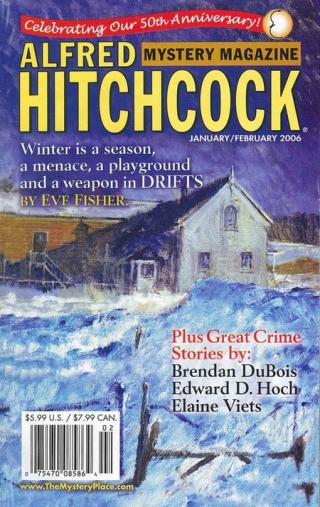
Alfred Hitchcock’s Mystery Magazine. Vol. 51, No. 1 & 2, January/February 2006
- Автор: Бетанкур Джон Грегори, Jr. William J. Carroll,
- Год: 2006
- Язык: английский
- Год: Dell Magazines/Crosstown Publications
- Жанр: Другие детективы

Электронная книга - «Alfred Hitchcock’s Mystery Magazine. Vol. 51, No. 1 & 2, January/February 2006». Краткое содержание книги:
I had a cold shower, then just sat and watched the rain for a while, thinking to call Scotty, but I didn’t.
Bad news could always wait — both the giving and receiving — so I just sat there, on the balcony, until night came over everything.
The rain stopped around eight P.M., and I watched a little TV — Amanda was still hundreds of miles to the southwest and apparently not showing signs of moving toward land. I caught part of a baseball game, but couldn’t stay interested, and finally decided to go out for a beer.
There was a small bar off the lobby of the hotel, but it was empty except for the bartender, and I felt the need to be among people, so I headed out of the hotel.
The Dixie Bar and Grille across the street was closed, the sign in the boarded window read CLOSED BY ORDER OF AMANDA, so I got in my truck and started to cruise, south and out of town.
And about five miles along, I found a place — The Last Chance.
It was a small, slate-roofed, pine-walled building, with a satellite dish on top and a business-could-be-a-lot-better air about it that I found appropriately depressing.
I parked next to an old rusted pickup in front, got out, and heard the mournful strains of a country-western song that leaked from the interior. Fighting back a what-are-you-doing-here? feeling that rose up suddenly, I went inside.
There were several tables to my left, at one of which a heavily made-up woman in a too-tight dress sat watching a large-screen TV on the wall in the corner. Several men stood around a pool table to the side of the TV. A wide bar ran along the right wall, behind which a scrawny old man stood, looking at me with what seemed suspicious surprise.
“What can I do you fer?” he asked as I took a seat on a stool.
I asked for a draft and got it, and I’d just taken a sip when the door to the “Gents” at the back of the place slammed open — and Carl Mongon swaggered out.
He went to the pool table, grabbed a cue, looked at the table for a second, then looked up and saw me.
“Well, if it ain’t the Yankee faggot,” he said.
Right, I thought.
“How ya’ll doin’ tonight, faggot?”
I looked at my face in the mirror behind the bar as Mongon made his way up to me, saying, “Well, well, well.”
I had another sip of my beer.
“Ya know,” Mongon said, tapping my shoulder with the cue, “correct me if I’m wrong, but I told you to pass on through Bayette.”
I watched him in the mirror and saw the woman at the table, looking at us with anticipation.
“You remember me tellin’ you that?”
“Carl!” one of the other pool players called out warningly.
“I’m talkin’ to you, faggot!” Mongon said to me, now angry.
There was, as before, liquor on his breath.
I stood up and put money on the counter.
“You hear me?!”
I smiled at him.
“Boy, you’d better answer me or...”
I turned away and started out, but Mongon grabbed my shoulder — and then I lost it.
I turned fast and backhanded him hard across the face, sending him against the bar and knocking over a barstool.
He blinked at me, felt blood coming from his nose, touched it with his fingers, looked at it, then at me, and said, “Oh boy. You really done it now.”
I waited.
He straightened up, held the cue out to his side, and said, “That was assault, faggot.”
“No,” I told him. “This is assault.”
I kicked hard into his groin — harder than I should, but I was pretty worked up — then took the cue from him and whacked him with it on the shoulders and back, until he fell on his face, where he groaned there at my feet, holding himself.
His pool-playing friends came toward me, and I readied myself, but there was, curiously, no threat in them.
We did a stare-off thing for a few seconds, then two of them got Mongon to his feet and over to a table, where he sat and groaned, still holding himself. The third — young and wary — just kept staring, as did the wide-eyed woman in the too-tight dress.
And I felt suddenly disgusted. I tossed the pool cue onto the floor, then walked out.
I’d just gotten the door to the Explorer open when the third man — the young one — came out of the bar and said, “Excuse me?”
I looked at him. He seemed to be about twenty and he was bigger than I was, but no threat.
“I’m sorry about that stuff,” he told me, nodding back over his shoulder.
I wasn’t sure what he was apologizing for.
“Carl’s my cousin,” he told me. “He’s not like this — usually.”
“That’s good to know.”
“Picked a fight with me, little while ago,” he added, as if to unmake his point.
“A lot of anger in him,” I agreed.
He nodded, then shrugged and started back inside, but then stopped and said, “His wife run off ’bout a month ago.”
“Uh-huh.”
“Went off with some soldier, and Carl’s been in a bottle since it happened.”
“Well,” I said to the young man, “Carl’s going to be sore about a day.” I got into my truck. “Ice is the best thing for it.”
And figuring I’d had my fill of Bayette night life, I went back to the Congaroo and took another cold shower. Then I had a pipe back out on the balcony and watched the moon peek through some dark clouds, until I was sleepy enough to sleep.
And I did a good job of it, not getting up until after ten the next morning.
I grabbed a big breakfast in the café downstairs and decided to drive straight back to Raleigh and give Scotty the news about Crash in person.
So, I started packing up the few things I had, listening to the TV news on Amanda, now a hundred miles off the coast, but bearing northeast — it looked like good weather for the drive. I was just stuffing Steensen’s sack of “valuables” into my suitcase when I finally noticed the stenciling on that old bag.
Faded to a bare whisper and stained-over, just below the cracked handle, were the words FEDERAL RESERVE BANK — ATLANTA, GA.
I wondered about it as I packed it away. Wondered how Steensen came by such a thing. Wondered enough to unpack it and give it another look-over. Heavy gray canvas, black handle, zippered top, and those words.
Might have found it anywhere, I reasoned, but my head put it together with the map, the “cave,” and the body he’d said he’d found, and I couldn’t let it go.
Which has always been my curse — or virtue, as the case may be.
So I didn’t check out, after all, I went out, instead, into semi-sunshine and put myself in the Bayette Public Library, behind a computer, putting in hit after hit on “Federal Reserve Bank, Atlanta.”
After about an hour, I came up with a headline and story in the Atlanta Constitution, dated fifteen years earlier, which read:
Atlanta Police, the Georgia State Highway Patrol, and the FBI are undertaking a massive manhunt for two men wanted in connection with a Christmas Eve hijacking of an armored car, the killing of three Wells Fargo employees, and the theft of cash and bearer bonds from the Federal Reserve Bank in Atlanta.
According to a spokesman from the Atlanta Police Department, at 7:30 A.M. yesterday, two men armed with automatic weapons stopped a Wells Fargo van on Route 7, blocking the road with their vehicle. A gunfight ensued and two guards were killed. A third guard was taken to Northside Hospital in Atlanta where he later died. The names of the dead are being withheld pending notification of relatives.
The police believe the armed hijackers drove the armored truck to a wooded area north of Hartwell and removed five cash bags containing large denomination bills and negotiable bearer bonds valued at an estimated $24 million.