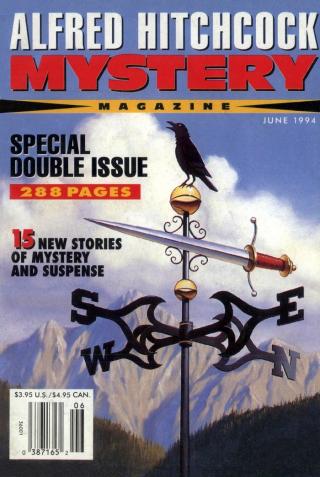
Alfred Hitchcock’s Mystery Magazine. Vol. 39, No. 6, June, 1994
- Автор: Bashover Albert, Crawford Dan
- Год: 1994
- Язык: английский
- Год: Dell Magazines
- ISBN: ISSN: 0002-5224
- Жанр: Другие детективы

Электронная книга - «Alfred Hitchcock’s Mystery Magazine. Vol. 39, No. 6, June, 1994». Краткое содержание книги:
She took my left hand in both of hers and squeezed it. “Oh, Bram, you’re priceless. You really are.”
I was a little put out and thought about pulling my hand free, but Sue Baney was smiling again and she began stroking my arm. I just let things go on that way.
I was comfortably adrift in that nether world that precedes sleep when the brainchild of P. W. Litchfield, the president of Goodyear, jarred me awake again. As a young executive many years earlier, Litchfield had clock towers built at every plant so the employees would never lose sight of the importance of time. The original at Plant One stood a hundred yards from the boardinghouse on Dudley Street. It sounded four melodic notes on the quarter hour, eight on the half and so on until it reached sixteen. Then came sonorous bongs to make everyone in the neighborhood aware of the hour.
During the day and evening the chimes were one small part of life in East Akron, no more noticeable than the noise of traffic on Market Street, the smell of rubber in the air, the black grit crunching underfoot. Not so at midnight. When the dozen strokes of the big clapper shattered the calm, I never failed to remember that all was quiet and serene at The Anchorage, Litchfield’s estate far out on Merriman Road.
As usual, I counted every note. As silence fell again I heard soft footsteps on the stairs and the opening of Jack Eddy’s door across the hall. I slipped on a robe and went over. While unbuttoning his shirt Jack managed a weary grin. “What’s new, buddy?”
“That’s what I was going to ask you.”
“Hard to say. One thing, Jerry Lynch is having problems with his numbers bank. I’m not sure how it fits in or even if it does.”
“How’d you find out?”
“Cal Andres buddied up to one of Lynch’s ticket sellers. Stood for a few rounds, you know the routine. Lynch isn’t getting wiped out, but for a couple of months he’s been paying off on more one- and two-buck tickets than the percentages call for. It’s eating up his profit, but what’s really got him in a stew is that someone may be setting him up for a knockout score.”
“I’ve never paid much attention to the numbers racket, don’t really know how it works.”
“It can vary a little from place to place, but Lynch’s bank is pretty much standard. Like I told you, Victor Reiner handles the day-to-day operation. You can buy tickets in five denominations from ten cents to two dollars. The average factory Joe plays for a dime or a quarter, someone with a heftier income, or a guy who’s a confirmed gambler, goes for a buck or two a day.
“So you pay the seller, then write your three-digit number on a dated and numbered ticket. He gives you the original and turns the carbon in to Reiner before the stock market closes. You can check the winner in a late edition, the last number on the closing figures of industrials, railroads, and utilities in that order.”
He took a December tenth issue of the Times-Press from his bedside table and turned to the business section. “Here,” he said, pointing to columns of figures in agate type, “the winner is 278. For anyone who played it, the payoff is five hundred to one, but the odds against you are twice that.”
“A sucker’s game.”
“Sure, but you’ve got a lot of pigeons out there ready to fly.”
“How could anyone beat the system?”
“There are ways, friend. The only one I’ve run across personally is fixing the numbers. Say a rival bank wants to put Lynch out of business and take over his territory. They get to somebody in the composing room at your paper, have him alter the numbers on a given day. Then they spread the word ahead of time so there’s a heavy play on that number and a killer payoff. That might work some places, but you couldn’t pull it off in northeast Ohio. Too many newspapers.”
“Looks to me like you’re wasting your time, Jack. How could Lynch’s problems have anything to do with Beverly Keeler or Anderson Spangler?”
“Right now I’m not sure. Give me a little time, and maybe I’ll figure a tie-in. To Keeler, I mean, not Spangler. It’s just a hunch, but I seem to smell Damokura in this.”
Despite the holiday slump, Goldsmith kept after me for stories. The police were spinning their wheels on the DeRidder murder; Jack Eddy seemed to be stalled on dead center. Auto accidents on slick streets provided my only material of consequence. Six had died in crashes the previous day, leading Mayor Lee D. Schroy to say that given an additional hundred policemen he would cut the toll in half in 1938. Political puffery, but it kept Goldsmith off my back for one day.
Desperate for a story with some meat to it, I decided to do a little nosing around on my own. As often as not that meant making a fool of myself.
Jerry Lynch’s legitimate business, his front, was the Emerald Laundry and Dry Cleaning. His white trucks decorated with shamrocks were a familiar sight all over town. The plant was in an old building on Bartges Street near the Ohio & Erie Canal south of the Goodrich complex.
Brief snow squalls interspersed with periods of pale sunlight kept a person guessing as I parked half a block away. With my newer but dirtier suit tucked under one arm, I walked to the sign of the shamrock. The customer service area was sticky with heat coming from the plant at the rear. After a middle-aged woman who looked as though she had lost the knack of smiling filled out a work order and handed me the claim ticket I said, “Is Jerry around?”
“Mr. Lynch? Could be back in his office, I guess. He doesn’t check in and out with me, you know.”
Without waiting for an okay I walked around the counter and through a door into a steambath. Sweaty young women, uniformly pale and haggard, were busy at a variety of jobs, none of them pleasant. On the left, middle-aged men in shirtsleeves were doing book-work in cubicles enclosed by glass that did little to keep out the heat. The place would be a real joy in July.
I asked one of the men where I might find Lynch. Without looking up from his ledger he nodded toward a stairway at the rear. They say heat rises, but the second floor was twenty degrees cooler than the first. After passing three closed doors I came to one that wasn’t. Beyond it was a carpeted office where a man sat with one hip on the corner of a mahogany desk. Another stood staring out a window with a view of the bustling, dreary corner of Bartges and Main. When I said, “Mr. Lynch?” he turned, giving me a quick once-over before saying, “Who’re you?”
“Bram Geary, Times-Press.”
A look of disbelief came over Lynch’s round, ruddy face. “A newsie? A newsie poking his nose in here?”
I grinned sheepishly. “It’s our slow time of year, so I was thinking of maybe doing a series on a few local businesses. You know, those that everybody’s familiar with. You can’t be on any street in town for ten minutes without spotting one of your trucks.”
Lynch hesitated, then broke out in a smile. “Sounds like a good idea, kid. Wha’ja say your name is again?”
I repeated it, and he said, “Yeah, I’ve seen your byline. Usually write crime stuff, don’cha?”
“When there’s any of it to write. December is pretty quiet.”
“Okay, so whaddya want to know?”
The man by the desk cleared his throat and said, “Business is fine, Jerry. I don’t think we need any newspaper publicity.”
Lynch gestured toward him. “My associate, Victor Reiner. Look, Vic, I don’t see how it can hurt.”
Aside from his eyes, Reiner could have been any Akron businessman. He wore a blue pin-striped suit and gray spats, the first pair I had seen in several years. He was about six feet tall, three inches shorter than me, which wasn’t as big as I had him pictured. His neatly trimmed blond hair was held down by a product that gave it the look of being shellacked in place. But the eyes, empty of all feeling, belonged on the face of a leopard.