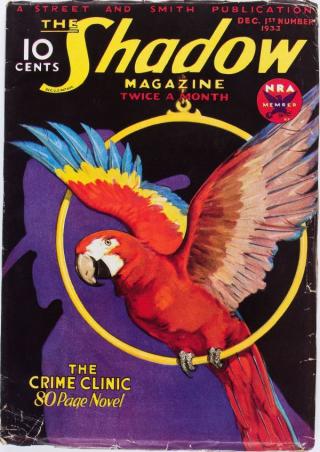
The Crime Clinic
- Автор: Грант Максвелл
- Серия: The Shadow #43
- Год: 1933
- Язык: английский
- Год: Street and Smith
- Жанр: Крутые детективы

Электронная книга - «The Crime Clinic». Краткое содержание книги:
“This bird,” he said, “has a remarkable proclivity for remembering words that it hears. For instance, suppose someone is introduced to it—”
Mrs. Winchendon stepped forward.
“This is Mrs. Winchendon,” said Sarborn, to the macaw. “Mrs. Winchendon. Would you remember her?”
He was scratching the bird’s head and looking toward it as he spoke. The macaw’s trembling beak became more furious.
“Winchendon!” shrilled the scarlet bird. “Winchendon!”
Sarborn began some new experiments, much like those he had shown to Melken. To further demonstrate the bird’s intelligence, he stepped away and stood at arm’s length, while he made a noise like a kitten mewing.
“Cats! Cats!” screamed the bird.
“It is odd,” remarked Sarborn, when the macaw had become silent, “how this bird has managed to actually associate sounds with words that it has heard concerning them. The reference to cats was a surprising accomplishment. On the boat, coming up from South America, we had a joke of pointing out other ships and saying, ‘Pirates.’ In the harbor of Port-au-Prince, the macaw fairly screamed ‘Pirates! Pirates!’ every time we had it on deck and it saw the shipping of the harbor.”
“Pirates!” shrilled the macaw.
A clock was chiming ten. Bart Melken, who had been standing across the room, strolled near a French window and began to fumble with his cigarette lighter. Only Lamont Cranston observed the action.
CRANSTON’S position was so taken that he could see from the other French window, although he did not appear to glance in that direction. While Sarborn was still coaxing the macaw, Cranston’s keen eye again turned toward the darkness outside.
A tiny speck of light glimmered beyond. It went out. It reappeared. That was all. Cranston strolled toward the spot where Farrell Sarborn had the macaw.
“Can the bird tell my name?” he asked. “I think it heard you give it.”
“We’ll try,” replied Sarborn. He scratched the macaw’s head, then shrugged his shoulders.
“I’m afraid you have stepped too close to it,” he said. “Just step back a few paces, Mr. Cranston.”
“Cranston!” screamed the macaw, the moment the millionaire obeyed.
“It heard your name again, then,” laughed Sarborn. “I did not realize that I was mentioning it.”
Cranston had joined in the general laughter. He was retiring toward one of the curtained doorways. As Sarborn again turned his attention to the macaw, all eyes were on the bird. Cranston’s keen gaze observed that fact.
With a slight sidewise motion, the millionaire eased through the curtained doorway, so unobtrusively that not a single person witnessed his departure. In the darkness of a hallway he lifted folded garments from beneath a chair.
Cloth rustled over shoulders. A black slouch hat settled upon the millionaire’s head. With swift, silent motion, Lamont Cranston gained a window at the end of the hallway. The sash rose noiselessly. A dark form passed over the sill.
Lamont Cranston had become The Shadow.
CHAPTER XIV
THE CALL
TEN o’clock had been the time that Bart Melken was awaiting. There was another man who was watchful for that hour. Joe Cardona, huddled in a corner of the Derry Cafe, in Corona, was hoping that Limps Silvey would appear.
Outside, Joe had a squad of men in readiness. They were far enough away not to attract attention. They had two cars; they were anxious for the word to go. Joe had told them that important work might be afoot tonight.
Where was Limps Silvey? Joe Cardona began to wonder if he was the victim of a stall. Had the crafty hobbler seen him in the darkness, and made a fake call? Joe did not know. He had nothing to do but wait.
The telephone bell began to ring. The coin box was situated in an obscure corner of the restaurant, not far from the spot where Cardona was located. Joe waited, then realized that it might be the call for Limps.
Under sudden impulse, Cardona arose and approached the telephone. He raised the receiver. He heard an unfamiliar voice. It asked a single question.
“That you, Limps?”
“Yeah,” responded Joe, in an attempt to imitate Limps Silvey’s husky tones.
“Scram, then,” came the voice over the wire. “We’ve picked our lay. It’s O.K. We’re on the ground now. Bing decided to go ahead with the Winchendon job.”
“Which one?” inquired Cardona huskily.
“I didn’t say which one,” came the voice. “I said Winchendon. You know — the place you looked over. Old Silas Winchendon’s house. We’re busting in there. That’s why you’d better scram. It’s only a few miles from where you are now.”
“O.K.”
Joe Cardona hung up the receiver. He had the dope he wanted. He had been studying society news in an effort to pick places which might lure The Jackdaw. He had seen a mention of a party at Winchendon’s; he had paid little attention to it, because it had not appeared to be more than a mere formal gathering.
Cardona did know, however, that the Winchendons lived in Copperwood, near Long Island Sound. It was not far there from Corona; but the speaker on the telephone had mentioned that the gang was already there.
Joe considered quickly. He realized that a rapid swoop would be more effective than a delayed telephone call. He hurried out to the street.
“Stay here to grab Limps Silvey,” ordered Joe. “We’re hopping out to stop a job.”
Rounding a corner close by, Joe leaped into the first of two parked cars. The automobiles were filled with detectives. Joe gave his next order.
“Head for Copperwood,” he barked. “The Winchendon house. I can locate it when we get there.”
The motor thrummed. The first car shot away. The second followed. Joe Cardona gave instructions as they rode along. It was a mad chase; a broad, good road lay ahead. It was not until they made a turn at Cardona’s order that trouble was encountered.
JOE knew the way to Copperwood. He had picked a good short cut. Barring signs blocked it, half a mile from the spot that they had left the main road. There was no passing. The signs marked a fallen bridge.
Joe Cardona fumed as he gave the order to turn around. The cars headed back to the main road. Five good minutes had been lost through this misadventure. More would be gone because the longer route must be taken. Joe Cardona regretted that he had not called Silas Winchendon by telephone.
It was too late to do so now. The only hope was to make all speed. Crime lay ahead. Word had been gained through a fortunate break. Now, mischance seemed destined to ruin Cardona’s opportunity to met The Jackdaw’s hordes.
Meanwhile, Silas Winchendon’s mansion lay silent amid the grounds that surrounded it. Cars were parked in the driveway; others were on the sloping street that ran by the side of the house more than fifty yards away.
IT was in one of these cars — a coupe — that a young man was seated. Harry Vincent, agent of The Shadow, was peering into darkness. He had been here long, had Harry. He had been watching the lights in the French windows that indicated Silas Winchendon’s living room.
He had noticed something else. Creeping figures had shown dimly beyond the low hedge that lined the sidewalk. Mumbled voices had come to Harry’s ears. In response, he had flicked the dashlight twice. That sudden glimmer, on and off, on and off, had been a signal to The Shadow.
Harry was sure that it had not been observed. The men in the darkness were under cover of the hedge. Now, however, since they had advanced farther across the lawn, Harry had become worried. Had The Shadow seen the signal?
Yielding to an impulse, Harry Vincent repeated the signal. On went the light; off again. On; then off. Twice in quick succession. Harry knew that The Shadow was alert; indeed, he tad seen tokens of miraculous ability on the part of his mysterious chief. In the tenseness of the moment, however, Harry was overanxious to play his part.