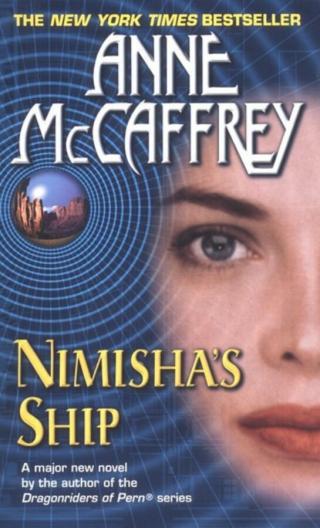
Nimisha's Ship
- Автор: Маккефри Энн
- Язык: английский
- Жанр: Научная фантастика

Электронная книга - «Nimisha's Ship». Краткое содержание книги:
When Nimisha takes an experimental ship on a solo test flight, something goes horribly awry, marooning her light-years from home on a planet as deadly as it is beautiful. Now the ruthless members of a rival branch of the Rondymense family are given the chance they've been waiting for: to reclaim the Ship Yards by any means necessary.
Only Nimisha's ingenious child, Cuiva, stands in their way. But for how long? For just when her daughter needs her most, Nimisha is in a precarious situation herself--and unable to help. But Nimisha has never given up in her life--and she's not about to start now . . .
As Helm obeyed her instructions and they cruised across the plateau to the first object of interest, the grazers didn't so much as raise their heads from their industrious eating. Great shaggy brown and black creatures, they moved steadily across the grassy savanna, heads swaying back and forth as they ate. She did notice that the young of this species were kept behind a formidable wall of their elders. So there were predators of some sort.
"We are closing, ma'am. Shall I magnify?" Helm asked.
"By all means." She gasped as the sharply defined image filled the screen. "Undeniably a spaceship," she said. "A match on our files?"
"A fair big mouthful for that wormhole to trap," Doc remarked.
Nimisha gave a bark of laughter. "Trap? That's a good description of a wormhole. Well, well. This ship's very old. Maybe we're number twenty, not nineteen. Can you decipher anything of the ship's original ID markings, Helm?"
"Wind, sun, and time have scoured the hull, which was badly damaged."
"In the wormhole?"
"That is a distinct possibility given the turbulence the Fiver experienced. The tube of the hole did not have a regular shape. It was difficult to avoid contact with the walls."
"Which proves the merit of having an AI at the helm, when femtosecond reactions are required," Nimisha said approvingly.
"Perhaps when we are closer, some traces will be legible enough to identify the craft," Helm said, unaffected by either praise or blame.
"An ID might give a clue as the frequency of the wormhole on the FSP side of it," Doc said.
"My very thought, Doc. But it's not very well designed, is it?" she commented, scanning the vessel. "Cumbersome, to say the least."
"No match, ma'am, on available files."
"That old?" asked Doc.
"Not disparaging the files of our Navy, are you, Doc?"
"Even their files do not contain some of the early independent efforts of humankind to probe space for habitable planets."
"That's true enough, Doc," Nimisha agreed, rubbing her chin and trying to figure out what sort of propulsion the ship used with that stern configuration, dented and mangled as it was. She shook her head and gave a sigh.
By now, they were closing with the object, and Helm automatically switched to normal screen.
The ship hadn't been landed with any great skill, for its prow had plowed a long furrow across the plateau to where a high ridge out-thrust from the foothills had finally halted its forward momentum. The furrow was clearly visible from the air, along with the heavy vegetation that had grown up in it. She could distinguish the bleached white skeletons of the giant grazers that had been bowled out of the way of this minor leviathan until it had come to a grinding halt.
"It's been there a long time," she murmured as they closed with the wreck. "How could anyone survive such a crash?"
"The ship was not designed for landing," Helm said. "It is also not equipped with either thrusters or vanes for atmospheric manoeuvring."
"Any life signs?" asked Doc.
Nimisha laughed at such optimism. "Hardly, if such dense vegetation has grown up on the avenue it plowed. Probably from the First Diaspora. Imagine being brave enough to go into space in that sort of contraption," she added with some admiration. "Please land, Helm, near the center of the ship. I see some sort of airlock in its side."
She dressed in appropriate skintight protective gear for a first walkabout. As the air had tested pure, she didn't require a breathing apparatus. Pure enough to breathe, but slightly tainted with an unfamiliar smell, she thought as she stepped out of the Fiver and onto the thick grassoid surface covering. Three steps into it, she was glad of the impregnability of her suit, for the "grass" was saw-toothed and managed to leave scratches on the tough material. What digestive equipment those shaggy creatures must have to graze on this, she reflected. She took samples of the obvious varieties growing about her and had to use the vibro blade to sever the blades and stems.
She tripped over the first skeleton, partially hidden in the vegetation and by the remains of its apparel.
"Human skeleton, clad in exceedingly durable clothing," she reported to Helm.
"Bring me a swatch of the material and a bone and I'll do a forensic and carbon-date it," Doc suggested. The longest finger bone was added to her pouch, along with a piece of the material, now so old it tore like paper.
"They must have set up some sort of a camp," she said. There was a clearing of sorts, evidently made by melting the ground into a semi-glaze that defied the grassoid's attempts at succession. There were oddments of metal scattered about, poking up from the dirt that had blown over them. The larger items she unearthed were crushed as if the grazers had put their big clumsy feet on them.
"Analysis suggests this ship was of a design used in the First Diaspora, with chemical fuel engines of the type typical of that period for planetary landing and takeoff," Helm informed her. "I have been able to distinguish sufficient of the faded insignia on the bow to determine that it belonged to a federation known as the United Nations of Earth. We are the twentieth ship to come through the wormhole."
"Thank you for that update on our position, Helm," she said with gentle irony. She had not programmed any humour into Helm, but sometimes he was inadvertently funny. Then she looked at the timeworn spaceship. "Poor guys," she said, shaking her head.
Gaining entrance to the ship was not a problem. A ramp or steps of some kind must originally have been used, but the centuries had allowed a buildup of windblown dirt and debris that reached to the lower lip of the hatch. There were exterior controls where any sensible designer would have put them, and since she was an even more sophisticated designer, it took only moments to open the airlock. She climbed in. The inner lock stood open, and as she neared it, she heard some sort of ventilation system begin to circulate the air inside.
"Not bad," she said. "Some power remains."
"Solar panels have been detected," Helm said.
"Why would they use solar panels if this wasn't a landing type craft?"
"There were many attempts at achieving the optimum use of many power sources-chemical, nuclear fusion, and solar power, both from generator panels and light sails-on early spacecraft,"
Helm said in the pedantic tone he assumed for his "science officer" role.
"Well, they did that right."
Nevertheless, the air was stale and still had an acrid stink that left a taste at the back of her throat of metals, old foodstuffs, human perspiration, and hydrocarbon hydraulic and lubricant fluids.
"One does have to air the place out every now and then," she said in her best imitation of her womb-mother.
"Repeat?" Helm asked, mystified.
"Don't bother," Doc said. "I'll explain it to him."
She went forward to where she expected to find the bridge. And did, though it was dark, since the forward screen had crashed right into the rock of the hillside and was now shards on the deck. She used her wrist light and found the appropriate toggle. She pushed it and faint illumination resulted-enough to see that the bridge was empty. She hadn't expected to see any bodies. The establishment of some sort of a base camp indicated there had been crash survivors enough to have suitably interred their dead. The big question was if any had survived long enough to establish a colony.
She tried to access the bridge log, but evidently the small source of power that circulated the air did not spark the computer systems into action.
She toured the ship and its cramped crew quarters with bunks stripped to the metal frames. Lockers had been emptied; dust had sifted in through the vents over the centuries that the ship had lain here. The galley, when she entered it, was also tidy, apart from dust. Again all useable items had been taken. The same could be said of any other transportable item or equipment that such a vessel would have carried. Well, if one were shipwrecked on an alien planet, one would certainly use whatever equipment was on hand. Only where had it-and its porters-gone? Would she find the descendants somewhere else? Had they regressed to a primitive state in the meantime? Certainly she had seen neither fires nor fossil fuel smoke to indicate any human settlement… so far, that is. The climate of the plateau and its position on the continent made it part of a temperate zone. Considering the new growth she had noticed on trees and shrubs, she had landed in this planet's vernal period. Part of the shagginess of the grazers might be due to shedding winter fur.