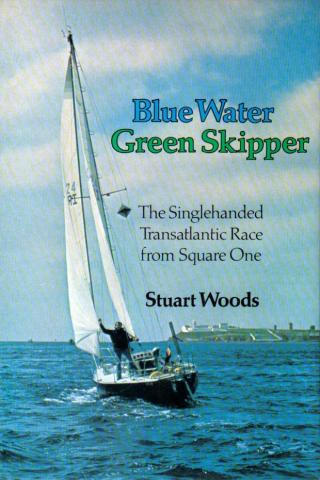
Blue Water, Green Skipper: A Memoir of Sailing Alone Across the Atlantic
- Автор: Вудс Стюарт
- Год: 2012
- Язык: английский
- Год: W. W. Norton
- ISBN: 978-0-393-03203-1
- Жанр: Биографии и мемуары

Электронная книга - «Blue Water, Green Skipper: A Memoir of Sailing Alone Across the Atlantic». Краткое содержание книги:
Bill and Richard were still expressing doubts about our being ready for the start, and finally I exploded. “Look,” I said, “we have five hours to finish what has to be done. If we don’t make it, we won’t start, but let’s stop wasting time and get on with it. Don’t anybody say to me again we won’t make it, okay?” Everybody went back to work.
The race was to start at seven o’clock in the evening. Incredibly, by five-thirty we were finished. Everything was stowed and Richard had accomplished a lot of absolutely essential work on deck. We had just time to dash for a shower. That finished, we pulled up at the fuel dock just in time to catch the attendant before he left for the day. We took on diesel, then left Richard on the fuel dock. We would not have made it on time without him. We motored out to the line with the main up and immediately found a fouled genoa halyard. I had to go up the mast to clear it but, fortunately, the sheltered waters were flat and motion at the top of the mast was minimal. I took a moment for a look at the view. There were fourteen yachts on the line, only two of them monohulls, Harp and Gypsy Moth V, being sailed by Giles Chichester, Sir Francis’s son. There were a number of large multihulls, in the fifty-foot range, and a number of smaller cruising types. It was a very pretty sight in the late-afternoon sun.
We started badly. The seaward end of the starting line was to be an anchored trimaran, the committee boat. However, there was also another trimaran anchored nearby, a spectator boat, and we mistook that for the committee boat. We started third from last. But we had started.
Book Three
15
On our way
As soon as we had altered course down the Solent we found the light wind behind us and got up the Betsy Ross floater. Harp began to move. With about five knots of wind showing on the B&G meter, her speed increased from two and a half knots under main and genoa to four knots under spinnaker. We began to overtake multihulls.
Just before Cowes, as we passed Norris Castle, we heard explosions from shore. “They’re saluting us!” Bill shouted. Sure enough, Tarka and Anita were firing the castle’s cannon in our honor. As we approached Cowes, the little town’s lights began to come on in the dusk. We passed the Italian tall ship, Amerigo Vespucci, at anchor, and astern of her, the Royal Yacht. It was too late in the evening for an exchange of salutes, but as we passed, a small, dark-haired woman waved a handkerchief at us from the ship’s afterdeck. I think it was the tea lady!
By the time we’d passed Cowes, we had overtaken four catamarans and trimarans, and, shortly afterward, we passed another. Mike Ellison’s voice came out of the darkness: “Your navigation lights are excellent!” He was referring to our very bright Marinaspec masthead light, and it was comforting to know we could be seen from a distance. We were facing heavy traffic in the Channel and God-knew-what in the Atlantic, and I had no wish to experience being run down by shipping. We continued to pull away from Mike’s trimaran and, shortly, were hot on the heels of a big cat, both of us doing everything possible to put on speed so as to make the Needles light before the tide turned foul in the Solent and trapped us there in light winds. Then the wind began to freshen and the catamaran pulled slowly away from us, although we could see his lights until after midnight.
We got the featherlight floater down in the freshening winds and continued under the genoa, both of us too exhausted to set the heavier all-round radial spinnaker. Each of us slept soundly when off watch that first night.
We sailed most of the next day with the boomed-out, big genoa, still too tired to get a spinnaker up. The weather was sunny and warm, and we let Fred steer while we lay on the decks and rested. Shirley felt better for a time, then returned to her original condition. She refused all offers of aspirin to lower her temperature, and by late afternoon Bill was saying that we were fast approaching the point where we would have to decide whether to put her ashore in Plymouth. It was not much of a decision. Shirley was only a passenger in her condition, and her condition wasn’t improving. We altered course for Plymouth.
Our vague plan had been to sail the boat somewhere pleasant after we’d dropped Shirley, if it came to that, somewhere that I could sail back from single-handed in order to qualify for the OSTAR. But now I was very dissatisfied with this notion. I put it to Bill that we go on to the Azores. After all, the boat had been repaired, we were thoroughly overprovisioned for the passage, the boat was easily managed by two, and our exhaustion was beginning slowly to slip away. Bill readily agreed, to my everlasting relief. I would have been very unhappy if, after all this preparation, we had been forced to change our plans. Now we began to plan how to lose as little time as possible in Plymouth. Our first plan had been to pick up a mooring in front of the Royal Western Yacht Club or to put into the Mayflower Marina and get a night’s rest before continuing. But since deciding to continue to Horta we were in more of a hurry. I got on the VHF and contacted Rame Head Coast Guard as we approached Plymouth. They said they would arrange for the pilot boat to take Shirley off at the breakwater and would ring Richard to collect her ashore. We pressed on.
Near midnight, as we approached Plymouth breakwater, we were able to contact the Plymouth pilot boat directly on the radio-telephone, and they soon spotted us, sailing slowly under main only, with the deck lights on. They came skillfully alongside and took off Shirley, her suitcase, and an incredible number of plastic shopping bags. As we prepared to get under way again there was a shout from the pilot boat. Shirley had forgotten a shopping bag. We repeated the performance, tossed the last bag over, then were free. Bill took the first watch and set a course for the point where we had left our original course. Our plan was to return there before continuing to Horta, keeping a record of our lost time in order to appeal to the committee in Horta to subtract this from our elapsed time. We would also appeal not to be disqualified.
When I came on watch Bill reported that we had been sailing through thunderstorms with gusts up to Force seven and that he had reefed everything and been up the mast twice to retrieve or sort out halyards. I had slept through everything. On my watch little happened except a fishing boat that wouldn’t go away, and I spent an hour making sure we didn’t hit him or foul his nets. Later in the day I telephoned a committee member and reported our loss of crew and lodged our request to remain in the race and be credited with the eleven hours it had cost us to put Shirley ashore and return to our original course. He said they would let us know in Horta. I then telephoned my mother in the United States and Ann, who had returned to London, to let them know of our progress before we were out of range of Land’s End radio. I don’t know what the Land’s End operators say when they ring a telephone number, but it never fails to astonish anybody who is getting a telephone call from sea. They can never quite believe that it is possible for a small boat out of sight of land to make a telephone call. It is great fun.