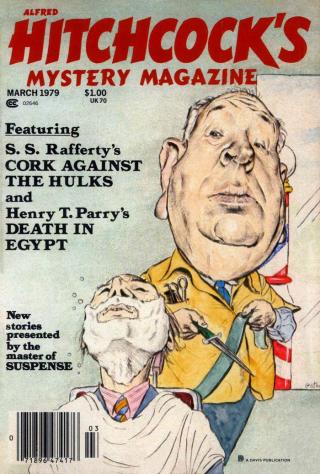
Alfred Hitchcock’s Mystery Magazine. Vol. 24, No. 3, March 1979
- Автор: Холдинг Джеймс, Лутц Джон
- Год: 1979
- Язык: английский
- Год: Davis Publications
- ISBN: 0002-5224
- Жанр: Другие детективы

Электронная книга - «Alfred Hitchcock’s Mystery Magazine. Vol. 24, No. 3, March 1979». Краткое содержание книги:
“I don’t get it,” said Mr. Damson.
“What would Hummelmeyer’s do if you caught one of your charge customers stealing?”
“Cancel out her account op the spot.”
“You see? With Estelle in one of her light-fingered moods, we’d soon be up to our knees in canceled credit cards and charge accounts.”
“Do I understand that she has a charge account at Hummelmeyer’s?”
“I have, Mr. Damson. C. B. Miller, 102 °Cedarhurst Drive, charge card number 3616690-41-1. If you feed it into your computer, you’ll find my credit is excellent, Mr. Damson. Meanwhile, if you’ll be land enough to keep Mrs. Miller there in your office, I’ll be there in twenty minutes or so to take her off your hands.”
I whistled one of Scott Joplin’s tunes from The Sting as I drove my station wagon downtown toward Hummelmeyer’s Department Store to “rescue” Dixie from the clutches of Mr. Damson. I felt confident, optimistic. Now that the first hurdle had been successfully surmounted, what could possibly go wrong? Yet I realized that my euphoric mood was premature, to say the least. It was still too early in the operation to predict success with any certainty — and already too late for Dixie and me to escape unscathed if anything went wrong. Still, I couldn’t avoid the conviction that this time everything would fall into place smoothly and inevitably. Fortune couldn’t turn her back on me now.
Not after my incredible luck in finding C. B. Miller’s wallet in the YMCA locker room.
I’d come out of the shower and was toweling myself off after my game of handball, when I spotted the black-leather wallet lying under one of the dressing benches in the aisle next to mine. I could hear voices reverberating in the adjacent swimming pool. For the moment, however, I was alone in the locker room.
My first impulse was purely larcenous, of course. I counted the cash in the wallet’s money pocket and found it to come to the pleasant sum of one hundred and twenty-one dollars. A small bonanza. Then I rapidly investigated the rest of the wallet’s contents: credit cards for five major oil companies, Master Charge, Visa, Carte Blanche, Diner’s Club, American Express — all issued in the name of C. B. Miller of 102 °Cedarhurst Drive in one of our fashionable suburbs; registration certificates for a Lincoln Continental and a Cadillac Seville; a driver’s license, tucked in behind an Avis credit card; membership cards for the University Club and one of the district’s exclusive country clubs; plastic charge-account plates for a number of local stores; a dog-eared business card identifying C. B. Miller as the president of something called The Superior Drilling Supply Company of Texas; a wallet-size color snapshot of a fiftyish woman and two teenaged boys standing beside a private swimming pool, with a hand-written caption on the back, “Estelle and Dick and Jimmy, taken the day I retired, Dallas, 1975.”
Not the sort of stuff you’d expect to find in your ordinary YMCA member’s wallet.
Briefly I contemplated appropriating wallet, credit cards, cash, and all. Then I realized how useless that would be. The moment C. B. Miller found his wallet missing, every credit card he owned would be invalidated within twenty-four hours after he reported the loss to the Hot-Line Protection Service whose sticker adorned each card in his wallet. I wouldn’t be able to use any of them safely.
So in the end I replaced everything, including the cash, in Mr. Miller’s wallet except for two items; his driver’s license, which in our state does not carry the driver’s photograph, and the charge card for Hummelmeyer’s Department Store. These two items, I concluded after consideration, would probably not be missed for a few days after Mr. Miller recovered his wallet.
Which he would undoubtedly do. For although I did not know C. B. Miller, never having encountered him to my knowledge at the Y or anywhere else, he must, I reasoned, own one of the voices I heard echoing in the swimming pool. I therefore replaced his wallet exactly where I had found it under the bench, dressed hurriedly, and left, asking myself why Mr. Miller would be disporting himself in a humble YMCA swimming pool instead of in the pool of his exclusive country’ club. I needn’t have worried. I found out later that he was a member of the Y’s local board.
When I returned to my car in Hummelmeyer’s parking lot after being closeted for twenty minutes with Mr. Damson, Hummelmeyer’s security chief, and a Mr. Conrad, the store’s credit manager, I found Dixie demurely awaiting me in the front seat of my station wagon.
“Well, Professor,” she asked me at once, “did you sell them?”
I had sent her down to the car to wait for me, being reluctant, I explained to Damson and Conrad, to discuss her disorder with strangers in her presence, as she was very sensitive about it.
“Sensitive is right,” Damson had agreed, watching a piteously weeping Dixie, a.k.a. Estelle Miller, depart from his office under convoy of the young security officer who had detected Dixie in the act of shoplifting — a fellow who was introduced to me by Damson as Harry Something-or-other.
Harry looked like anything but a man whose aim in life was to reduce Hummelmeyer’s pilferage losses: six feet of spare muscular body, black hair cut long enough to cover his ears, a quiet, respectful demeanor, and very alert brown eyes. In faded jeans and sloppy T-shirt, he looked more like a college kid or a hippie on his way to a commune. Even I, with my vast experience, would never have suspected he was a store detective.
“Of course I sold them,” I told Dixie, not without pride, climbing behind the wheel of the station wagon and starting the motor.
“Goody,” she said, all smiles. “Tell me about it.”
“With pleasure,” I said. “Your superb performance as the troubled kleptomaniac was almost enough in itself to convince Hummelmeyer’s of our good faith. Miller’s driver’s license established our identity, of course. And our charge record at the store established us as free-spending charge customers, as I had hoped. Miller’s original application for a charge account at Hummelmeyer’s didn’t hurt either. By the time I got there they’d looked it up. Very impressive credentials. The Millers have accounts at the right banks, previous charge accounts at Neiman-Marcus, and so on. And of course I made out a splendid case history for you, Dixie. I told them that your psychiatrist in Texas had advised me privately that a series of public humiliations as a kleptomaniac would certainly exacerbate your condition — that the best therapy for you would be to pretend that you were doing no shoplifting at all, even when engaged in the act. I explained that you hadn’t had a spell of this disorder for two or three years now, ever since we moved north from Texas. After I dropped a few hints as to my club memberships and my recent contribution to the local library building fund, Damson and Conrad were totally in agreement with my proposal.”
“Which was what, exactly?” Dixie asked.
I drove carefully past a traffic policeman who wore spotless white gloves and a supercilious smile. “That you be allowed to work out your own salvation,” I said. “That I would personally be responsible for anything you stole from Hummelmeyer’s. That I am financially well able and willing to cover the cost of anything you might absentmindedly remove from their store without paying for it. And that they therefore should give you permission to lift anything you fancied — as an aid to your complete recovery — and merely put it on my tab. That is,” I amended, “on the tab of Mr. C. B. Miller. And I would gladly and thankfully pay it.”