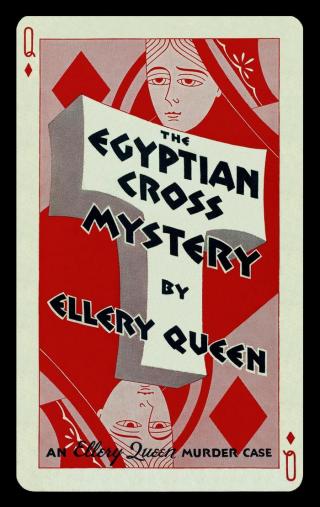
The Egyptian Cross Mystery
- Автор: Куин (Квин) Эллери
- Серия: Ellery Queen #5
- Год: 1932
- Язык: английский
- Год: Frederick A. Stokes Company
- Жанр: Классические детективы

Электронная книга - «The Egyptian Cross Mystery». Краткое содержание книги:
Harakht began shrilly: “Paul, come away! These are infidels!”
“Keep quiet!... The old man here hasn’t left the place since we got here. I went into the village a week ago for supplies.”
“That’s the ticket.” The Inspector released Romaine’s arm. “Get going. We want to see your headquarters, or temple, or whatever the hell you call it.”
In single file they followed the incongruous figure of Harakht along a footpath which led from the shore directly into the brush toward the heart of the Island. The Island was curiously still; there seemed to be little bird and insect life, and no human life whatever. Romaine stamped along noncommittally; he seemed to have forgotten the presence of Dr. Temple, who followed in his footsteps, watching the brawny back with unwavering eyes.
Evidently Romaine had sounded a warning before the arrival of the investigating party, for when they emerged from the woods into a large clearing, where the house stood — a sparsely slatted, huge wooden structure crudely put together — the members of Harakht’s cult were awaiting them, all clothed. It had been a hasty warning, for the neophytes, numbering some twenty men and women of all ages and descriptions, were attired in scraps of garments. Romaine growled something indistinguishable, and like a tribe of troglodytes they scuttled back into various wings of the house.
The Inspector said nothing; he was not at the moment interested in infractions of the public decency law.
Harakht glided on, oblivious; he held the home-made uraeus high before him, and his lips moved presumably in prayer. He led the way up the steps of the central building into what was apparently the “shrine” — an amazing room, vast in extent, rigged out with astronomical charts, plastercast statues of Horus, the falcon-headed Egyptian god, cows’ horns, a sistrum, an emblematic disc supporting a throne, and a curious sort of pulpit which was surrounded by bare wooden slabs whose use was, to Ellery at least, obscure. The room was roofless, and the late afternoon sun cast long shadows on the walls.
Harakht went directly to his altar, as if safety lay there, and disregarding his visitors he raised knotted fleshless arms to the sky and began to mumble in a strange tongue.
Ellery looked inquiringly at Professor Yardley, who stood, tall and ugly, listening intently a foot away. “Extraordinary,” muttered the Professor. “The man is an anachronism. To hear a twentieth-century human being speak in ancient Egyptian...”
Ellery was astonished. “Do you mean to say that this man actually knows what he’s talking about?”
Yardley smiled sadly, and whispered: “The man is insane. But he had good reason to go insane, and as for the genuineness of his speech... He calls himself Ra-Harakht. Actually he is — or was — one of the world’s great Egyptologists!”
The sonorous words rolled on. Ellery shook his head.
“I meant to tell you,” whispered the Professor, “but I really haven’t had a moment with you alone. I recognized him the instant I saw him — which was a few weeks ago, when I rowed out to the Island on a purely curiosity-satisfying exploration... Curious story. His name is Stryker. He suffered a horrible sunstroke while excavating in the Valley of the Kings years ago, and never recovered. Poor chap.”
“But — speaking ancient Egyptian!” protested Ellery.
“He’s intoning a priestly prayer to Horus — in the hieratic language. This man,” said Yardley soberly, “was the real thing, please understand. Naturally, he’s addled now, and his memory isn’t what it should be. His lunacy has garbled everything he ever knew. There’s nothing like this room, for example, in an Egyptological sense. Conglomerate — the sistrum and cows’ horns are sacred to Isis, the uraeus is the symbol of the godhead, and there’s Horus floating about. As for the fixtures, the wooden slabs where, I suppose, the worshipers recline during services, his own Biblical turn of speech...” The Professor shrugged. “It’s all been thrown together out of his imagination and the wreckage of his brain.”
Harakht lowered his arms, took an odd censer from a recess of the altar, sprinkled his eyelids, and then descended from the rostrum quietly. He was even smiling, and he seemed more rational.
Ellery regarded him with newborn vision. Insane or not, the man as an authentic figure became a totally different problem. The name Stryker, now that he masticated it in his memory, raised a faint flavor of recollection. Years ago, when he had been in preparatory school... Yes, it was the same man he had read about. Stryker the Egyptologist! Mumbling a language dead for centuries...
Ellery turned to find Hester Lincoln, attired in a brief skirt and sweater, facing them from a low doorway on the opposite side of the altar room. Her plain face, white though it was, showed a steely determination. She did not look at Dr. Temple, but walked across the room to stand openly by Paul Romaine’s side. Her hand took his. Surprisingly, he turned beet red and edged a step away.
Dr. Temple smiled.
Inspector Vaughn was not to be sheered off by trifles. He strode up to Stryker, who was standing quietly regarding his inquisitors, and said: “Can you answer a few simple questions?”
The madman inclined his head. “Ask.”
“When did you leave Weirton, West Virginia?”
The eyes flickered. “After the rite of kuphi five moons ago.”
“When?” shrieked Vaughn.
Professor Yardley coughed. “I think I can tell you what he’s trying to say, Inspector. The rite of kuphi, as he calls it, was practiced by the ancient Egyptian priests at sunset. It consisted of an elaborate ceremony in which kuphi, a confection made of some sixteen ingredients — honey, wine, resin, myrrh and so on — was mixed in a bronze censer while the holy writings were read. Naturally, he’s referring to a similar ceremony held five moons ago at sunset — January, of course.”
It was as Inspector Vaughn nodded and Stryker smiled gravely at the Professor that Ellery let loose a resonant bellow that made them all jump.
“Krosac!”
His eyes were bright as he watched the sun god and his business manager.
Stryker’s smile vanished, and the muscles about his mouth began to twitch. He cringed toward his altar. Romaine was unmoved; rather astonished, from his expression.
“I’m sorry,” drawled Ellery. “I get that way sometimes. Proceed, Inspector.”
“Not so dumb,” grinned Vaughn. “Harakht, where is Velja Krosac?”
Stryker wet his lips. “Krosac... No, no! I do not know. He has deserted the shrine. He has run away.”
“When did you tie up with this goof?” demanded Isham, leveling his forefinger at Romaine.
“What’s all this Krosac business?” growled Romaine. “All I know is I met up with the old man in February. Seemed as if he had a good idea.”
“Where was this?”
“Pittsburgh. Looked like a swell opportunity to me,” continued Romaine with a shrug of his broad shoulders. “Of course, all this” — he lowered his voice — “this bunk about sun gods... It’s good stuff for the yokels but the only thing I’m interested in is getting people to take their stinking clothes off and get into the sun. Look at me!” He inhaled deeply and his magnificent chest rose like a balloon. “I’m not sick, am I? That’s because I let the beneficial rays of the sun get at my skin and under my skin...”
“Oh can it,” said the Inspector. “I know the line, the usual sales talk. I’ve been wearing clothes since I jumped out of my cradle, and I could twist you around my little finger. How’s it happen that you came here, to Oyster Island?”
“You could, could you?” Romaine’s back swelled. “Well, cop or no cop, suppose you try it some time! I’d—”