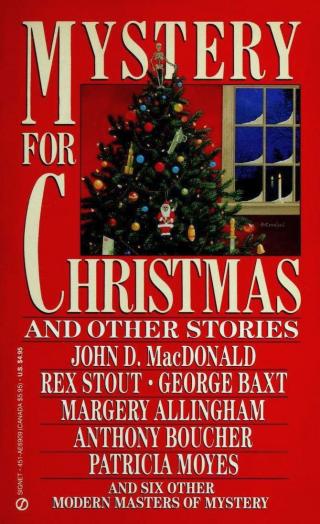
Mystery for Christmas and Other Stories
- Автор: Аллингем (Аллингхэм) Марджери (Марджори), Бучер Энтони
- Год: 1990
- Язык: английский
- Год: Signet
- ISBN: 978-0-451-16909-9
- Жанр: Другие детективы

Электронная книга - «Mystery for Christmas and Other Stories». Краткое содержание книги:
“Nice work if you can get it,” I murmured.
I followed the Ghost down a narrow byway along the back wall of a great stone house, relieved to be free of the feathered bedlam of the poultry market. We came out on a street of large, impressive buildings only slightly less congested than the thoroughfare, and Marley’s Ghost, apparently oblivious to the chill drizzle of sleet that was beginning to fall from the gunmetal gray sky, and the black city mud splashed up from the street by passing hooves and bare metal wheels, jaywalked joyously across toward a narrow courtyard almost hidden between two buildings. I hesitated a moment before following him into that nineteenth century rush hour, for I still did not quite trust my bodiless condition.
A light touch on my arm caused me to turn. The Ghost of Christmas Past, disguised as my daughter Stephanie, pointed northward along the side of the great stone house.
“East India House. Torn down in 1862. You ought to have a look at the front portico facing Leadenhall Street. You will have seen something no person living has seen.”
That sort of exclusiveness holds little appeal for me. I was much more interested in exploring Marley’s wine cellars, but something else facing Leadenhall Street did catch my interest. A nervous young woman in a striped silk dress and a dark shawl and bonnet had just crossed the thoroughfare and was turning north by the soot-stained gothic church of St. Andrew Undershaft.
“Hey, Marley! Up this way!” I shouted. “I want to see where that girl’s going.”
He followed me with an obedience I have yet to inspire in the living.
“May I presume to ask why we are stalking this particular person?” he asked when he had caught up.
“I don’t know, really. It’s just a hunch. Good detectives always follow hunches.”
Crossing Leadenhall at that hour was dangerous and indeed all but impossible for ordinary mortals, but we floated easily through hansom cabs and hackney coaches, piemen and holly decorated donkey carts. We followed the girl northward past aging mansions and half timbered Elizabethan relics into an area of small shops with living quarters above them.
“Where are we?” I asked Marley.
“Simmery Axe.”
St. Mary Axe, I translated. English place names are marvelous and their pronunciation even more marvelous. I couldn’t say at first how I happened to know this particular pronunciation, but a song began to run through my head as I trotted up the pavement in pursuit of my hunch.
Gilbert and Sullivan, wasn’t it? I used to know all the words to most of the patter songs when I was younger and could sing after a fashion. The clatter of the horses and the rhythmic clanging of a muffin man’s bell formed an accompaniment, and I sang aloud, safe in the realization that no mortal ear could hear me. Marley, however, regarded me with some pain.
Good Lord. I stopped abruptly in front of one of the small shabby shops, for the girl in the bonnet had stopped and was looking uncertainly at it. The stone front was black, as was the door. The bowed windows — meant, I suppose, to display wares — were so soot begrimed as to appear black as well. The uncertain flicker of candles inside the shop only helped to obscure the view. I looked up. Over door and window in polished brass letters was the name of the shop, with the number 70 set like quotation marks at each end.
I started to laugh. The whole thing was so preposterous. I was not used to having such literary dreams. But this was stuff I knew about, and I couldn’t let a gaffe like that pass.
“I’m sorry,” I said to Christmas Past, who still floated on my right. “You just can’t do that.”
“I beg your pardon?” said the courteous Spirit.
“Anachronism. Blatant, baldfaced anachronism. Gilbert wrote The Sorcerer in 1877. This is supposed to be the London of 1836. Gilbert was born in 1836! Now, how do you explain that away?”
“Elementary,” said the Ghost. “It’s an old established family firm. The present proprietor is Gilbert’s sorcerer’s grandfather.”
“That’s ridiculous. How could the company exist before its author invented it? You can’t do that, even in fiction.”
“You can do anything in fiction as long as you’re consistent,” the Ghost explained with a great show of patience. “And once something, a place, a character, is conceived, it acquires an existence of its own — a past, a present, and a future.”
I laughed. “What a cop-out. Are you trying to tell me there’s no difference between flesh-and-blood historical reality and — and the figment of somebody’s imagination?”
“My dear sir,” the Spirit replied, “we are all figments of Somebody’s imagination.”
That’s what you get for arguing with a ghost.
I returned to my hunch.
The girl, after taking another quick, frightened look about her, entered the shop, activating a tinkly little bell. I followed, passing through the door after she had closed it, just for the thrill of doing it that way while I could. After all, I’m going to have to open doors for the rest of my life.
The inside of the shop was as dark as the outside, and the soot-saturated fog seemed to have passed through the closed door and filled every crevice. What little I could see through this miasma looked like a combination of old fashioned hardware store and the sort of cheap magic tricks emporium found on seaside boardwalks between the penny arcade and the bingo parlor. A small, round, bald man wearing a blue herringbone checked waistcoat over a pink shirt looked up from behind a low wooden counter where he sat playing solitaire with a set of ancient tarot cards by the light of a close-trimmed oil lamp. A meagre coal fire provided the only other light.
“And what may I do for you, madam?” he asked the girl in a carefully smoothed down cockney accent. His face was pink, his smile somewhat cherubic; his voice was oily and self-deprecating, a pudgy Uriah Heep.
The girl’s hand, when she removed it from her fur muff, was trembling, and her voice was thin and strained with tension.
“I... I’ve come for the — uh — the effigy.”
The proprietor raised his spectacles to the top of his head and looked carefully into her face for perhaps half a minute.
“Ah, yes,” he said slowly. “Mr. Scrooge.”
He spun around to face a cluttered shelf on the wall behind his desk, although I have no idea how he did it, since the chair did not swivel.
“Ah, here we are. Mr. Scrooge.”
He took down a cylindrical package wrapped in newspaper like an order of chips and handed it to her. She took it gingerly and stared at it a moment.
“Oh, dear. How dreadful. I don’t know how I could do this.”
J. W. Wells smiled slightly. “The first time is always the hardest.”
“Oh, dear,” the girl cried in agitation. “I certainly shan’t be doing this again. It’s not for me, you know. I never could do such a thing for my own gain. It’s for Fred, poor dear Fred. He hasn’t a farthing, and it’s so dreadfully unfair.”
“And if dear Fred ’asn’t a farthing, he can’t marry you, eh?”
The girl lowered her head. “He hasn’t asked me yet.”
“He ’asn’t? Bless my soul.” The little shopkeeper chuckled, catching the girl’s hand in a quick, gentle, but firm movement. “Come now, let’s see what we ’ave here.” He took the package from her hand and spread the palm out under the lamp, raising the wick just a trifle. “Now this is very nice, don’t you see? Such a lovely long life line. I see marriage, but not so soon. No matter, it’s a very fine hand: happiness, many children, prosperity in due time. Be patient, say the Stars, your time will come.”